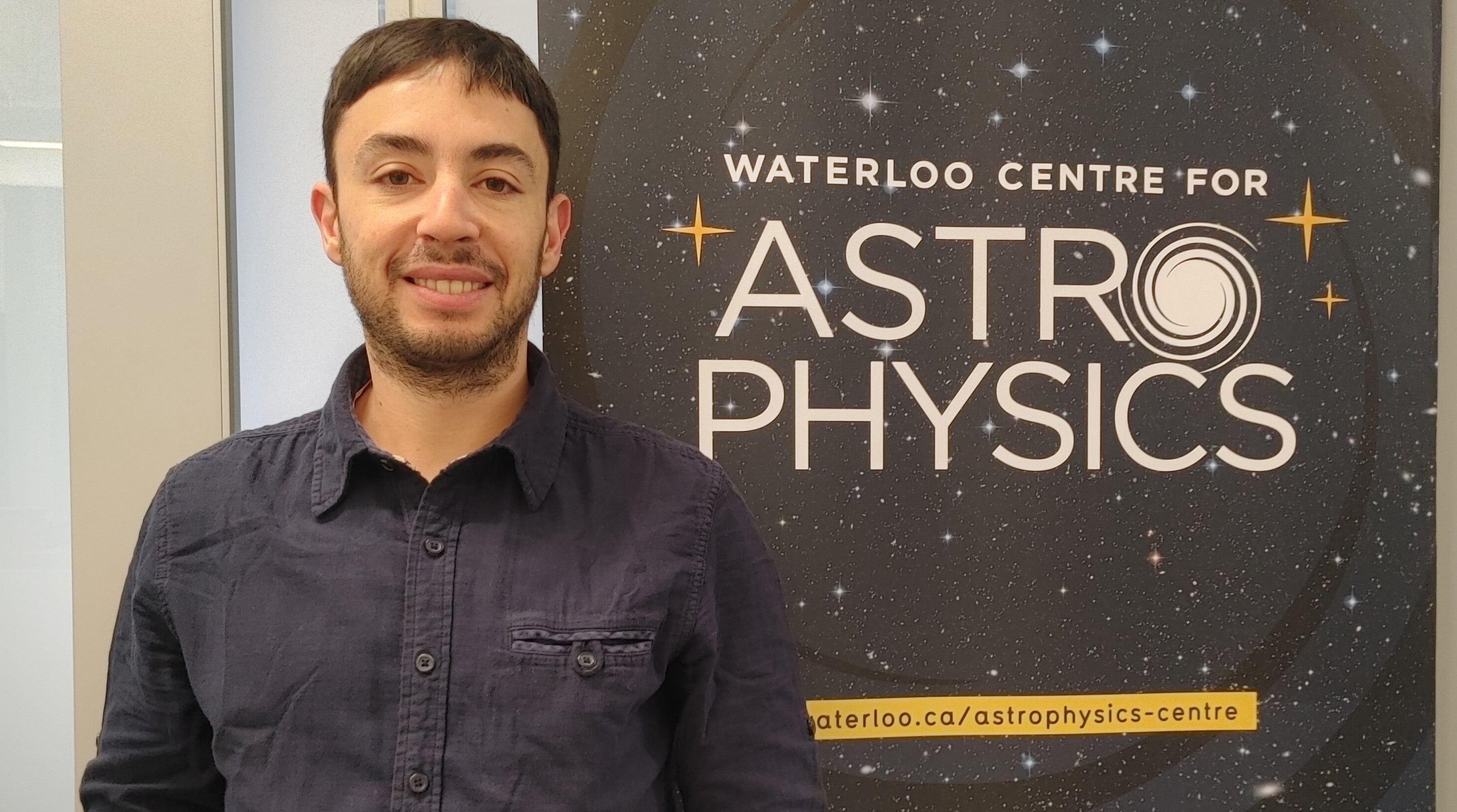
Dr Carlos Garcia Garcia is a cosmologist working at the interface of data and theory to understand the nature of dark energy. He received his PhD in 2020 from the University of Barcelona and has spent the past five years as a Beecroft Fellow at the University of Oxford. Carlos is active in the Vera C. Rubin Observatory’s Dark Energy Science Collaboration, where he has held different leadership roles, most recently serving as co-convener of the Weak Lensing and Large-Scale Structure working group. He is also a member of Euclid.
Carlos's research focuses on dark energy, modified gravity, and model-independent tests of cosmology. He works extensively with different large-scale structure probes to identify potential cracks in LCDM. Carlos developed COSMOTHEKA, a flexible catalog-to-cosmology pipeline integrating 23 datasets (galaxy clustering, weak lensing, CMB lensing, and gas tracers) to enable consistent cross-survey analyses. It has been extremely useful at Oxford, supporting cosmic growth reconstructions, analyses of the S₈ tension and baryonic effects, among others.
Title: Dark energy from a wide range of cosmological probes
Abstract: We are entering an exciting era in cosmology, with tantalizing hints of dynamical dark energy. While current data are not sufficient to fully characterize its nature, they may already offer clues about its microphysical properties. Assuming that the latest observations (DESI BAO + SNe Ia + CMB) are correct and that dark energy arises from a scalar field, I will show that there is strong evidence for either a non-minimal coupling to gravity or a non-standard kinetic term, along with a preference for a negative squared mass.
These results so far rely only on cosmological background evolution and linear perturbations. With forthcoming data from Euclid and Rubin, we will soon access the non-linear regime with unprecedented precision. To fully exploit this opportunity, I am developing COSMOTHEKA, a large public repository that consistently re-analyzes virtually all projected large-scale-structure data sets within a common framework. I will highlight new results enabled by this approach, including percent-level constraints on the clumpiness parameter S₈, reconstructions of the cosmic growth history, and constraints on baryonic effects from all current weak lensing surveys. I will argue that multi-tracer analyses will be essential for Euclid and Rubin to robustly constrain cosmological parameters and unveil the true nature of dark energy.