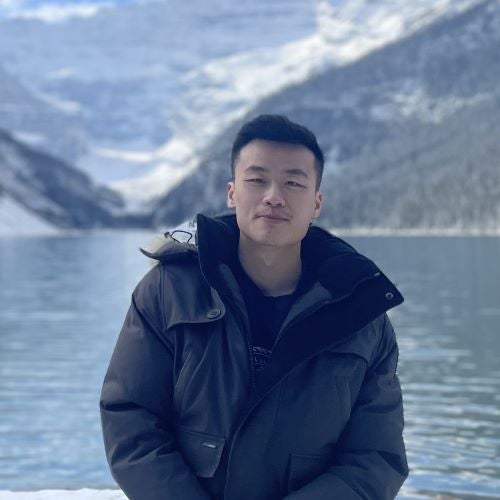
David Dayi Li earned his undergraduate and master’s degrees from Western University before joining the University of Toronto (U of T) in 2020 to pursue a PhD in astrostatistics as a CANSSI Multidisciplinary Doctoral Trainee. During his doctoral studies, he was named a Doctoral Student Fellow of U of T’s Data Sciences Institute. After completing his PhD in 2025, he continued at U of T as a postdoctoral fellow. David now holds an NSERC Canada Postdoctoral Research Award and is jointly appointed as a postdoctoral fellow in the Department of Statistics and Actuarial Science and the Waterloo Centre for Astrophysics at the University of Waterloo. His research focuses on developing computational and statistical methods for efficient Bayesian inference in complex astrophysical and cosmological problems.
Title: Detection of Almost Dark Galaxies: Bayesian Modeling and Efficient Inference
Abstract: Ultra-diffuse galaxies (UDGs) challenge our understanding of galaxy formation and dark matter, yet their low surface brightness makes them difficult to detect. Their globular cluster populations offer a new way to find them. In this talk, I will discuss how Bayesian spatial point process models for globular clusters can detect UDGs and even almost dark galaxies. This problem also illustrates a broader challenge in astrophysics: increasingly complex models can make likelihood evaluation and inference expensive, putting conventional posterior sampling methods beyond practical reach.
I will then introduce Sampling-based Adaptive active Learning (SALE), a novel surrogate-based Bayesian inference method. By combining inexpensive sampling with adaptive surrogate learning, SALE concentrates expensive likelihood evaluations on the regions of parameter space that matter for inference. I will outline this guiding philosophy and apply it to the UDG problem. With a practical computational cost, SALE produces more accurate inference than existing inference methods that rely on heavy numerical approximation, improving UDG detection.