
WCA Graduate student, Cam Morgan, won the Graduate Student Committee (GSC) award for best talk at the 2025 Canadian Astronomical Society meeting, held in Halifax.
Cam presented his thesis work in his presentation, "Decoding quenching in the Virgo cluster with spatially resolved star formation", which he has summarised here.
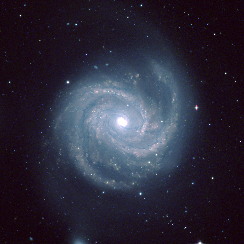
Galaxy clusters are dense regions packed with galaxies moving through a medium of hot gas. We know that galaxies in clusters evolve differently from those that are more isolated, but deciphering how exactly this evolution takes place remains an open question. Since the Virgo Cluster is the most nearby large galaxy cluster to us, it presents an opportunity to image its galaxies in incredible detail.
Several recent surveys have done just this, capturing images of Virgo galaxies in ultraviolet, optical, infrared, and a particular wavelength of light known as Hα. Each of these types of light trace out different parts of the galaxy: Hα shows us where stars are being born; ultraviolet shows us young stars; optical light shows us old stars; infrared shows us dust. Our work is looking to use this high-resolution, multiwavelength data to comprehensively map out where stars are forming in Virgo galaxies – and perhaps more importantly, where stars have stopped forming.
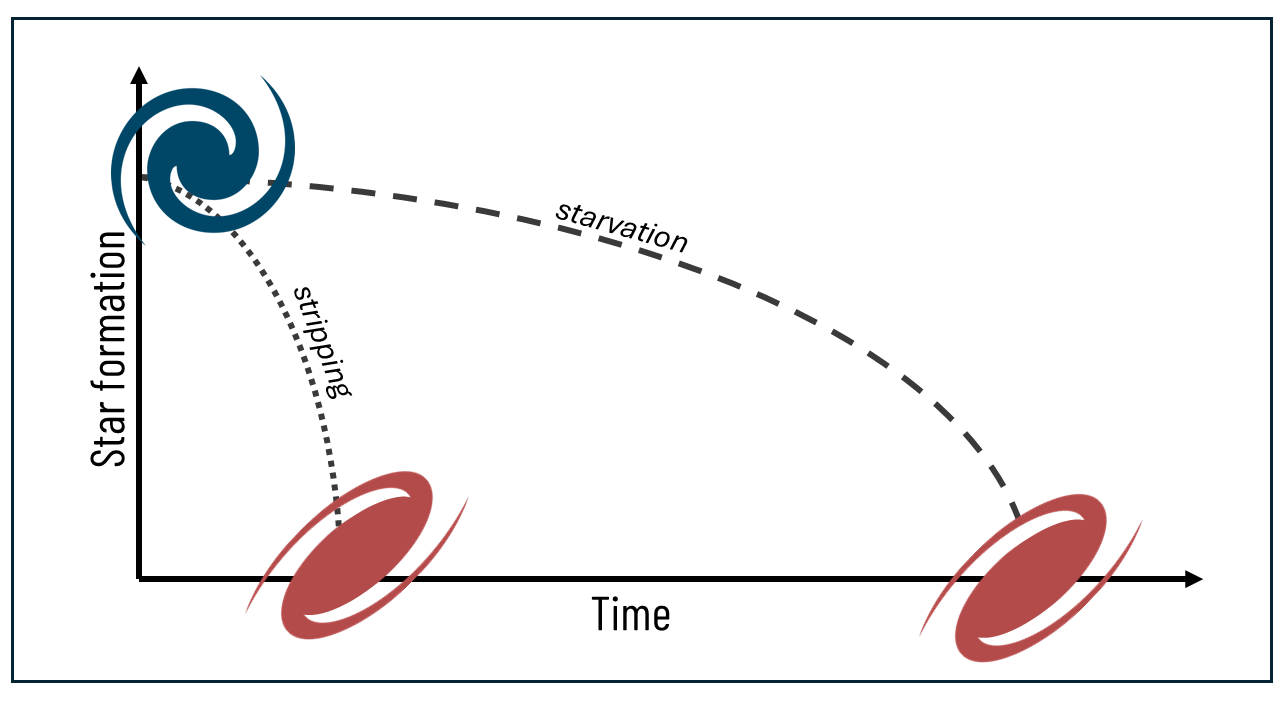
Our first project traced out the sizes of galaxies when we only look at where stars are forming, compared to when we look at where stars formed long ago (comparing Hα to optical light), and showed us that across the cluster, galaxies are truncating. Over time, the environmentally-driven evolution of these galaxies causes them to stop forming stars, particularly in their outskirts. This can be due to direct stripping of the gas needed to form stars, or by starving the galaxy of the fuel it needs to sustain ongoing star formation. These two processes can look similar in some ways, but act on different timescales. The schematic image to the left indicates the effects of these processes on the rate of star formation.
We built on this work by looking at the distribution of galaxies in the cluster as a function of how massive they are, and whether they are forming stars. We found that many galaxies in the outer parts of the cluster have already slowed down or completely stopped their star formation, which was unexpected. We don’t expect gas stripping to be effective in the outer parts of the cluster, which suggests that galaxies may be being pre-processed: in smaller groups or filamentary structures these galaxies are likely being starved or otherwise processed before they even enter the cluster!
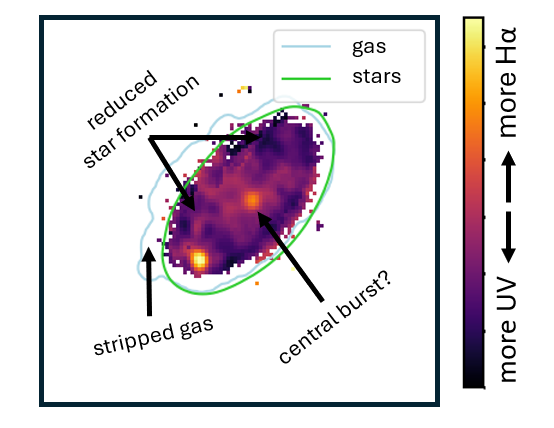
Our current work is leveraging the high resolution of our data to create maps of where stars are forming across the galaxies using Hα and UV. Comparing these two tells us where star formation is bursting, and where it is quickly shutting down, which we hope will shed more light on the processes at play in the environmental evolution of these nearby cluster galaxies.