Teaching Resilience Through Research: Climate Adaptation in the University of Alberta's Planning Department
Key Ideas
- Bringing current empirical research into the classroom helps students connect resilience theory with the varied realities of municipal climate adaptation in practice.
- Stepwise comparative assignments develop critical thinking by asking students to justify decisions, evaluate institutions and policies and communicate their findings.
- Faculty champions can build momentum, but long-term climate integration requires supportive leadership, adequate resources and shared responsibility across the program.
This article is part of the Waterloo Climate Institute's ACE Project.
Interviewee: Jeff Birchall – Associate Director, School of Urban and Regional Planning; Associate Professor, Local-scale Climate Change Adaptation/ Resilience; Director, Climate Adaptation and Resilience Lab (CARL)
Institution: University of Alberta
Program: BA, BSc, and MSc in Urban and Regional Planning and Master of Sustainability; Planning Resilient Cities and Regions and Climate Adaptation for Municipalities
At the University of Alberta, Jeff Birchall uses research, comparative case studies and professional perspectives to prepare planners for the complex realities of climate adaptation. He teaches two climate-focused courses: Planning Resilient Cities and Regions, a core course for approximately 20–25 master’s planning students each year, and Climate Adaptation for Municipalities, which began as an undergraduate elective and is now also required for the climate adaptation stream of the university’s Master of Sustainability.
Birchall’s approach draws on experience in both research and practice. While leading a climate change program at the Toronto and Region Conservation Authority (TRCA), he was also a sessional instructor at Ryerson University, now Toronto Metropolitan University, where he taught planners about climate science, impacts and policy. After moving to Alberta, he expanded this work by bringing findings from his research in the Arctic, Atlantic Canada and British Columbia directly into the classroom.

Photo of Jeff Birchall
Climate adaptation in practice
Birchall’s courses are built around the idea that planners need sufficient climate knowledge to think critically, communicate with specialists, and understand the policy implications of environmental change. Planners may not be climate scientists, but their decisions and recommendations influence infrastructure, development, land use, public participation and municipal resilience.
That training means understanding why climate impacts occur, how communities experience them differently and which institutional conditions enable or constrain adaptation.
In Alberta, the language used to introduce this material is important. Birchall’s graduate course is framed around “resilience” rather than placing “climate change” in its title. This framing responds to the province’s political context while preserving climate change as a central focus of the course. It also creates room to examine resilience broadly through institutions, infrastructure systems, governance, social conditions and the capacity of individuals and organizations to act.
Planners are so well positioned to do something about this, or at least to facilitate the process. But they need the training... Planners are keen to do it. They have the right connections. They just do not always have the right training.
The newer Climate Adaptation for Municipalities course makes the connection to local planning more explicit. Originally offered as an undergraduate elective, its popularity and relevance helped support its expansion into the new Master of Sustainability. The course will bring undergraduate and graduate students together, giving learners with different academic and professional experiences an opportunity to examine municipal adaptation collaboratively.
Birchall has also integrated climate content into courses on research methods and professional planning practice. Together, these courses create a progression through which students build analytical, research and professional skills before completing the requirements associated with becoming Registered Professional Planners.
Teaching and learning approach
Rather than organizing his courses around a single textbook, Birchall draws on current scholarship and empirical case studies from his own fieldwork. This enables students to work with evidence from communities facing different climate impacts and institutional conditions. It also helps him update course material as climate risks, policies and adaptation practices evolve.
Critical thinking is central to the approach. Birchall deliberately avoids presenting one definitive model for successful climate adaptation because every community has a different environmental, political, social and economic context. “Students want something definitive, so they know what to do moving forward,” he says. “That does not exist in this space. This space is all about seeing a problem and thinking through it.” Students are encouraged to question assumptions, evaluate evidence and consider how public participation and local knowledge shape planning decisions.
Guest speakers introduce additional perspectives and provide a check on Birchall’s own interpretations. Their role is not simply to reinforce course material, but to expose students to the disagreements, uncertainties and professional tensions that characterize climate adaptation. Birchall also involves doctoral students as teaching assistants to give emerging scholars opportunities to develop their lecturing and mentoring skills.
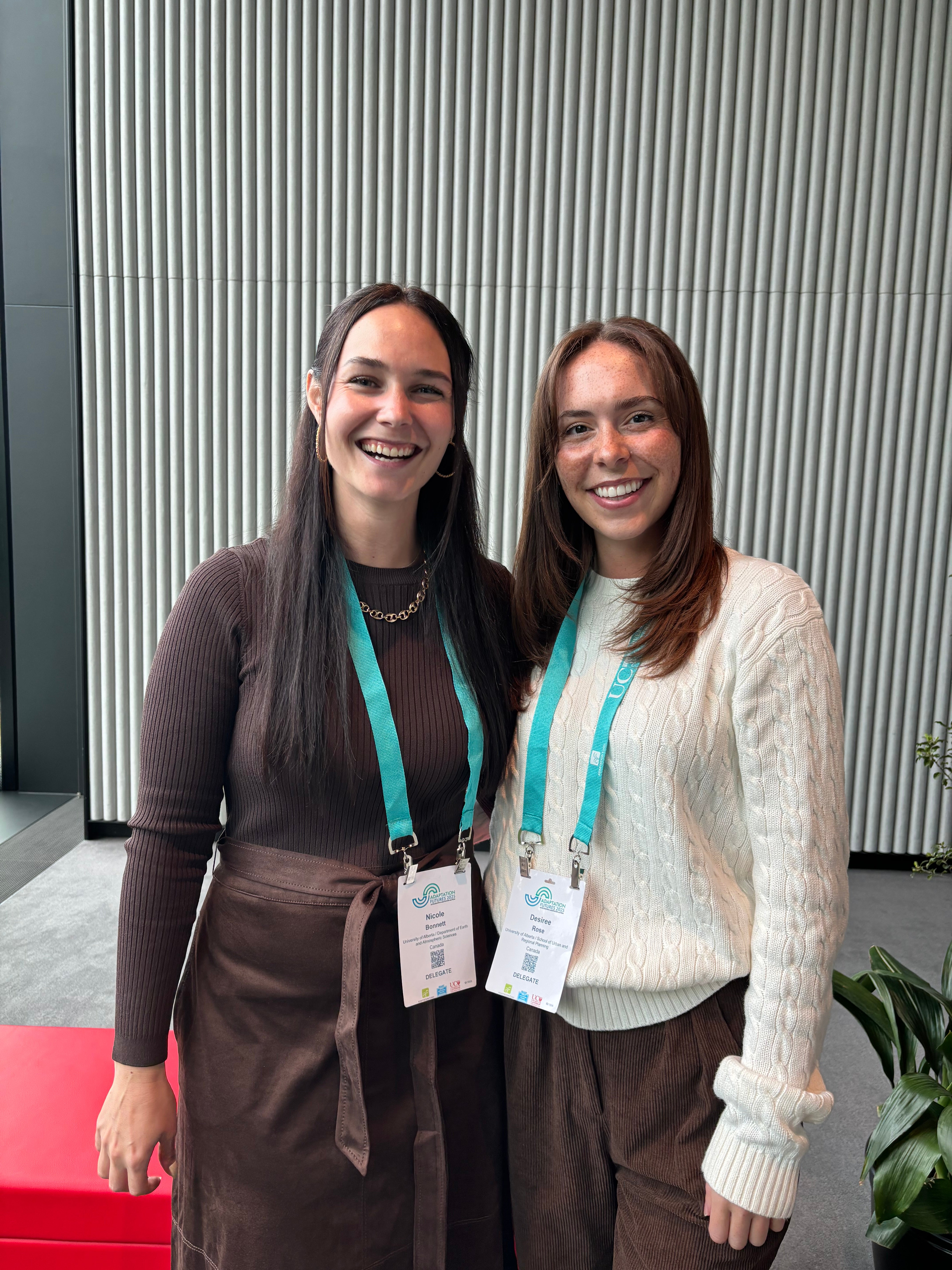
Photo of Birchall's PhD students presenting at the Adaptation Futures conference in Christchurch, New Zealand in 2025 (Nicole Bonnett and Desiree Rose)
Student experience
A signature assignment asks students to compare two cities associated with the Rockefeller Foundation’s 100 Resilient Cities initiative. Working in groups of two or three, students examine cities on different continents and at various stages of development that face a similar climate impact. Birchall assigns one city, while students research and justify their choice of the second. The assignment tends to stick with students. “Sometimes students would be like, yeah, that assignment was so cool,” he says. “I ended up going to that city on vacation because it was just so interesting.”
The assignment unfolds in stages. Students first defend their comparative city selection, then present the shared climate impact, analyze relevant policies, and assess the factors enabling or constraining adaptation. Their analysis applies resilience theory to institutions, systems and agents while considering social and economic conditions. The project concludes with a poster presentation, and the strongest presenters are invited to participate in an end-of-year showcase.
The assignment assesses more than the final product. Students are evaluated on their decision-making process, including how they select cases, define the problem, interpret evidence and connect theory with practice. This reflects the realities of professional planning, where framing the right question is often as important as proposing a solution. Former students tell Birchall that the assignments remain useful in their everyday work. “A lot of these students are in Alberta, and they still run into a lot of headwinds when it comes to climate change... particularly in rural communities,” he says. “But they have more tools to deal with those conversations now.”
In one case, an undergraduate student extended the work into a statistical analysis of 80 cities from the 100 Resilient Cities initiative and became a co-author on a research paper. At the time of the interview, the paper was undergoing a second round of review with Sustainable Cities and Society.
Lessons learned and conditions for success
Birchall describes the growth of climate teaching at the University of Alberta as partly serendipitous. His initial appointment brought together professional planning credentials, climate expertise and a director who recognized the value of that combination. A subsequent director with a sustainability mandate became another important ally, using the success of Birchall’s teaching and strong student interest to support additional climate content and connect the course to the Master of Sustainability.
At the same time, this case reveals the risks of relying heavily on one faculty champion. The planning school has a small faculty of six or seven members responsible for several undergraduate and graduate programs, a situation common among smaller planning schools. Resource constraints – namely time– limited opportunities for collaboration and curriculum development. Some faculty members address climate change indirectly, but Birchall remains the primary person responsible for adaptation-focused teaching.
His experience suggests that individual leadership can establish momentum, especially when research and teaching reinforce one another. However, lasting integration requires broader institutional capacity.