In
my previous
blog
post,
I
discussed
the
relatively
new
Apache
Arrow
project,
and
compared
it
with
two
similar
column-oriented
storage
formats
in
ORC
and
Parquet.
In
particular,
I
explained
how
storage
formats
targeted
for
main
memory
have
fundamental
differences
from
storage
formats
targeted
for
disk-resident
data.
There
was
a
surprising
amount
of
activity
surrounding
the
post
---
the
post
received
28,000
visits
(making
it
the
7th
most
popular
post
on
my
blog
all
time),
and 86
comments
in
a
HackerNews
thread discussing
the
post.
Given
this
clear
interest
of
my
readers
in
Apache
Arrow,
I
would
like
to
take
a
deeper
look
into
the
project
in
this
post,
and
present
my
analysis
of
both
some
specific
decisions
that
were
made
regarding
the
format
itself,
and
also
my
personal
experience
with
installing
and
running
experiments
on
the
code
base.
A
quick
caveat
before
we
begin:
Many
of
the
comments
on
the
HackerNews
thread
revolved
around
a
back-and-forth
between
fans
and
contributors
to
the
Apache
Arrow
project
who
went
ballistic
when
they
read
my
title
with
a
sarcastic
tone
(the
title
was:
“Apache
Arrow
vs.
Parquet
and
ORC:
Do
we
really
need
a
third
Apache
project
for
columnar
data
representation?”)
and
more
thoughtful
and
thorough
readers
who
tried
to
calm
them
down
and
explain
that
the
entire
post
was
there
to
explain
precisely
why
it
makes
sense
to
have
Arrow
as
a
separate
project.
However,
one
common
point
that
was
brought
up
by
the
pro-Arrow
crowd
was
that
my
post
was
narrow
in
the
sense
that
I
only
looked
at
Arrow
from
the
perspective
of
using
it
as
a
storage
format
in
the
context
of
database
and
data
analytics
engines,
whereas
Arrow,
as
a
general
standard
for
representing
data
in
main
memory
could
also
be
used
outside
of
this
space.
I
should
have
been
clearer
about
the
scope
of
my
analysis
in
that
post,
so
this
time
around
I
want
to
be
more
clear:
the
scope
of
my
analysis
in
this
post
is
solely
from
the
perspective
of
using
Apache
Arrow
as
a
storage
format
in
the
context
of
database
and
data
analytics
engines
and
tools.
I
limit
the
scope
to
this
context
for
two
reasons:
(1)
I
predict
that
the
majority
of
Arrow’s
use
cases
will
be
in
that
context
(where
I
define
data
analytics
tools
broadly
enough
to
include
projects
like Pandas)
(2)
As
someone
who
has
spent
his
entire
career
as
a
database
system
researcher,
this
is
the
only
context
in
which
I
am
qualified
to
present
my
opinion.
What exactly is Apache Arrow?
Arrow’s
homepage
self-describes
in
the
following
way:
“Apache
Arrow
is
a
cross-language
development
platform
for
in-memory
data.
It
specifies
a
standardized
language-independent
columnar
memory
format
for
flat
and
hierarchical
data,
organized
for
efficient
analytic
operations
on
modern
hardware.
It
also
provides
computational
libraries
and
zero-copy
streaming
messaging
and
interprocess
communication.”
In
other
words,
the
creators
of
Arrow
envision
the
project
having
impact
in
three
ways:
(1)
as
a
development platform,
(2)
as
a
columnar
memory
format standard,
and
(3)
as
a
set
of
useful libraries.
In
practice,
the
majority
of
the
code
in
the
Github
repository
at
the
time
of
my
interactions
with
the
codebase
was
for
constructing,
accessing,
and
testing
data
structures
using
the
Arrow
standard.
So
my
analysis
in
this
article
will
just
focus
on
the
Arrow
standard
and
the
set
of
code
that
is
provided
to
help
in
the
implementation
of
this
standard.
Is it even possible to have everybody agree on a data representation standard?
For
decades,
it
was
impossible
to
fathom
that
there
could
be
a
standard
representation
for
data
in
a
database
system.
Database
systems
have
historically
been
horribly
monolithic
and
complex
pieces
of
software.
The
many
components
of
the
system
---
the
storage
layer,
the
transaction
manager,
the
access
manager,
the
recovery
manager,
the
optimizer,
etc.
---
were
significantly
intertwined,
and
designed
assuming
particular
architectural
choices
for
the
other
components.
Therefore,
a
“page”
of
data
on
storage
was
not
a
simple
block
of
data,
but
also
contained
information
critical
to
the
recovery
manager
(e.g.
the
identifier
of
the
log
record
that
most
recently
wrote
to
this
page),
the
transaction
manager
(e.g.
timestamps
required
by
multi-version
concurrency
control
schemes),
access
manager,
and
so
on.
Each
unique
database
system
had
different
concurrency
control
schemes,
different
logging
structures,
and
different
index
implementations;
therefore
a
page
of
data
in
one
system
looked
vastly
different
than
a
page
of
data
in
other
system.
Therefore,
if
you
wanted
to
move
data
from
one
system
to
another
one,
you
would
have
to
“export”
the
data,
which
involved
rewriting
the
data
from
the
complex
page
format
stored
inside
the
system
to
a
simpler
representation
of
the
data.
This
simple
representation
would
be
passed
to
the
other
system
which
would
then
rewrite
the
simple
representation
into
its
own
proprietary
standard.
This
process
of
rewriting
the
data
before
export
is
called
“serialization”
and
rewriting
it
back
before
import
is
called
“deserialization”.
Serialization
and
deserialization
costs
when
transferring
data
between
systems
have
historically
been
necessary
and
unavoidable.
Over
the
past
few
decades,
the
database
system
world
has
changed
significantly.
First,
people
stopped
believing
that
one
size
fits
all
for
database
systems,
and
different
systems
started
being
used
for
different
workloads.
Most
notably,
systems
that
specialized
in
data
analysis
separated
from
systems
that
specialized
in
transactional
processing.
Systems
that
specialized
in
data
analysis
tend
to
either
be
read-only
or
read-mostly
systems,
and
therefore
generally
have
far
simpler
concurrency
control
and
recovery
logic.
Second,
as
the
price
of
memory
has
rapidly
declined,
a
larger
percentage
of
database
applications
fit
entirely
in
main
memory.
This
also
resulted
in
simpler
recovery
and
buffer
manager
logic,
which
further
simplified
data
representation.
Finally,
as
open
source
database
systems
started
to
proliferate,
a
greater
emphasis
was
placed
on
modular
design
and
clean
interfaces
between
the
components
of
the
system,
in
order
to
accommodate
the
typical
distributed
development
of
open
source
projects.
All
of
this
has
lead
to
much
simpler
data
representations
in
main
memory
and
analytical
database
engines,
especially
those
in
the
open
source
sphere.
Fixed
width
data
types
are
often
just
represented
in
arrays,
and
variable-width
data
types
in
only
slightly
more
complicated
data
structures.
All
of
a
sudden,
the
prospect
of
standardizing
the
data
representation
across
main
memory
analytical
database
systems
has
become
a
realistic
goal,
thereby
enabling
the
transfer
of
data
between
systems
without
having
to
pay
serialization
and
deserialization
costs.
This
is
exactly
the
goal
of
Apache
Arrow.
Arrow
is,
in
its
essence,
a
data
representation
specification
---
a
standard
that
can
be
implemented
by
any
engine
that
processes
data
in
main
memory.
Engines
that
use
this
standard
internally
can
avoid
any
kind
of
serialization
and
deserialization
costs
when
moving
data
between
each
other,
which
several
other
blog
posts
(e.g. here and here)
have
shown
to
result
in
significant
performance
gains.
13
major
open
source
projects,
including
Pandas,
Spark,
Hadoop
and
Dremio
have
already
embraced
the
standard,
which
I
believe
is
enough
critical
mass
for
the
Arrow
standard
to
become
ubiquitous
in
the
data
analytics
industry.
Even
if
existing
systems
do
not
adopt
the
standard
for
their
own
internal
data
representation,
I
expect
they
will
at
least
support
data
exports
in
Arrow.
This
increases
the
motivation
for
any
new
main
memory
analytics
engine
being
designed
to
adopt
it.
While
ubiquity
is
usually
a
good
indicator
of
quality,
there
are
plenty
of
languages,
APIs,
and
pieces
of
software
that
become
ubiquitous
for
reasons
entirely
unrelated
to
their
quality.
For
example,
the
SQL
interface
to
database
systems
took
off
due
to
the
business
dominance
of
the
systems
that
used
SQL,
even
though
there
were
arguably
better
interfaces
to
database
systems
that
had
been
proposed
prior
to
SQL’s
take-over.
Furthermore,
even
high
quality
things
are
often
optimized
for
certain
scenarios,
and
yield
suboptimal
performance
in
scenarios
outside
of
the
intended
sweet
spot.
Therefore,
I
took
a
deeper
look
at
Apache
Arrow
without
any
preconceived
biases.
Below,
I
present
my
analysis
and
experience
with
playing
with
the
code
of
the
project,
and
discuss
some
of
the
design
decisions
of
Arrow,
and
the
tradeoffs
associated
with
those
decisions.
Columnar
It
would
be
easy
for
someone
who
sees
Arrow’s
self-description
of
being
“columnar”
to
mistakenly
assume
that
Arrow’s
scope
is
limited
to
two
dimensional
data
structures
that
have
rows
and
columns,
and
that
by
being
“columnar”,
it
is
possible
to
derive
that
Arrow
stores
data
column-by-column
instead
of
row-by-row.
In
fact,
Arrow
is
actually
a
more
general
standard
---
including
specification
for
one-dimensional
data
structures
such
as
arrays
and
lists,
and
also
data
structures
with
more
than
two
dimensions
through
its
support
for
nesting.
Nonetheless,
we
have
all
become
accustomed
to
interacting
with
data
through
relational
database
systems
and
spreadsheets,
both
of
which
store
data
in
two
dimensional
objects,
where
each
row
corresponds
to
an
entity,
and
each
column
an
attribute
about
that
entity.
By
being
columnar,
Apache
Arrow
stores
such
two
dimensional
objects
attribute
by
attribute
instead
of
entity
by
entity.
In
other
words,
the
first
attribute
of
each
entity
is
stored
contiguously,
then
the
second
attribute
of
every
entity,
and
so
on.
This
columnar
representation
means
that
if
you
want
to
extract
all
attributes
for
a
particular
entity,
the
system
must
jump
around
memory,
finding
the
data
for
that
entity
from
each
of
the
separately-stored
attributes.
This
results
in
a
random
memory
access
pattern
which
results
in
slower
access
times
than
sequential
access
patterns
(my previous
post discusses
this
point
in
more
detail).
Therefore,
Arrow
is
not
ideal
for
workloads
that
tend
to
read
and
write
a
small
number
of
entire
entities
at
once,
such
as
OLTP
(transactional)
workloads.
On
the
other
hand,
data
analytics
workloads
tend
to
focus
on
only
a
subset
of
the
attributes
at
once;
scanning
through
large
quantities
of
entities
to
aggregate
values
of
these
attributes.
Therefore,
storing
data
in
a
columnar
fashion
results
in
sequential,
high
performance
access
patterns
for
these
workloads.
Storing
data
column-by-column
instead
of
row-by-row
has
other
advantages
for
analytical
workloads
as
well
---
for
example
it
enables
SIMD
acceleration
and
potentially
increases
compression
rates
(my previous
post goes
into
more
detail
on
these
subjects).
The
bottom
line
is
that
by
choosing
a
columnar
representation
for
two-dimensional
data
structures,
Arrow
is
clearly
positioning
itself
for
adoption
by
data
analytics
workloads
that
do
not
access
individual
data
items,
but
rather
access
a
subset
of
the
attributes
(columns)
from
many
data
items.
Indeed,
many
of
the
open
source
projects
that
have
been
built
natively
on
Arrow,
such
as Dremio and
NVIDIA’s Open
GPU
Accelerated
Analytics (GOAI),
are
focused
on
analytics.
Fixed-width data types
Note
that
attributes
of
entities
tend
to
have
a
uniform
data
type.
Therefore,
by
choosing
a
columnar
data
representation,
Arrow
can
store
columns
of
two
dimensional
tables
in
an
identical
way
to
how
it
stores
data
in
one
dimension
of
uniform
type.
In
particular,
fixed-width
data
types
such
as
integers
and
floats
can
simply
be
stored
in
arrays.
Arrow
is
little
endian
by
default
and
pads
arrays
to
64-byte
boundaries.
Aside
from
the
extra
padding,
Arrow
arrays
store
data
in
memory
in
an
equivalent
fashion
to
arrays
in
C,
except
that
Arrow
arrays
have
three
extra
pieces
of
metadata
that
are
not
present
in
C
arrays:
(1)
the
length
of
the
array,
(2)
the
number
of
null
elements
in
the
array,
and
(3)
a
bitmap
indicating
which
elements
of
the
array
are
null.
One
interesting
design
decision
made
by
Arrow
is
that
null
elements
of
the
array
take
up
an
identical
amount
of
space
as
non-null
elements
---
the
only
way
to
know
if
an
element
is
null
is
by
checking
to
see
if
there
is
a
1-bit
in
the
associated
bit
for
that
element
in
null-bitmap
that
is
part
of
the
metadata
for
the
array.
The
alternative
design
would
have
been
to
not
waste
storage
at
all
on
the
null
elements,
and
instead
derive
the
location
of
null
elements
by
inspection
of
the
null
bitmap.
The
tradeoff
here
is
storage
space
vs
random
access
performance.
By
expending
space
on
null
elements,
the
nth
element
of
the
array
can
be
quickly
located
by
simply
multiplying
n
by
the
fixed-width
size
of
each
element
in
the
array.
However,
if
the
null
elements
are
removed
from
the
array
(and
their
location
derived
from
the
null
bitmap),
the
amount
of
space
needed
to
store
the
array
will
be
smaller,
but
additional
calculations
and
bit
counting
must
occur
before
finding
the
value
for
an
element
in
the
array
at
a
particular
index.
On
the
other
hand,
sequential
scans
of
the
entire
array
may
be
faster
if
the
system
is
bottlenecked
by
memory
bandwidth,
since
the
array
is
smaller.
Since
Arrow’s
design
decision
was
made
to
optimize
for
random
array
element
access,
I
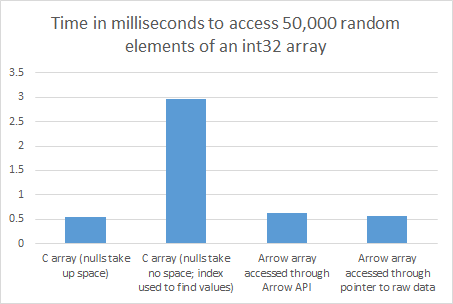
ran
a
simple
benchmark
where
I
created
an
array
of
size
100,000,000
32-bit
integers,
put
random
values
in
each
element
of
the
array,
and
then
searched
for
the
value
at
50,000
different
locations
in
the
array.
I
first
tried
this
experiment
in
a
regular
C
array
that
allowed
null
elements
to
take
up
an
identical
amount
of
space
as
non-null
elements
(similar
to
Arrow).
I
then
tried
a
different
C
array
where
nulls
take
up
no
space,
and
a
high
performance
index
is
used
to
speed
up
random
access
of
the
array
.
I
then
installed
Apache
Arrow,
built
the
same
array
using
the
Int32Builder
in
the
Arrow
C++
API
and
accessed
it
through
the
Arrow
Int32Array
API.
I
ran
these
experiments
on
an
EC2
t2.medium
instance.
The
results
are
shown
below:
As
expected,
the
version
of
the
C
array
where
nulls
take
up
no
space
was
much
slower
than
the
other
options
for
this
random
access
workload.
Even
though
we
used
a
high
performance
index,
direct
address
offset
calculations
are
always
faster.
Accessing
data
through
the
API
that
comes
with
the
Arrow
codebase
was
slightly
slower
than
accessing
data
from
an
array
directly.
However,
this
is
not
because
of
the
Arrow
data
format
itself.
When,
after
building
the
Arrow
Array,
instead
of
accessing
the
array
through
the
Arrow
API,
I
instead
accessed
a
pointer
to
the
raw
data
in
the
array,
cast
it
as
a
const
int*,
and
then
proceeded
to
access
this
raw
data
directly
in
C,
I
saw
equivalent
performance
to
a
normal
C
array.
This
cause
of
the
slowdown
from
accessing
data
through
the
Arrow
API
is
presumably
from
the
C++
compiler
failing
to
inline
all
of
the
extra
function
calls
(despite
the
-O3
flag).
I
therefore
conclude
that
for
applications
the
are
extremely
performance
sensitive,
it
is
better
to
access
raw
data
created
in
accordance
to
the
Arrow
specification
than
to
use
the
API
to
access
the
data.
But
for
most
cases,
using
the
API
will
be
sufficient.
As
far
as
the
decision
to
allow
nulls
to
take
up
space,
that
was
certainly
a
win
for
this
random-access
workload.
But
for
a
workload
that
scans
through
the
entire
dataset,
it
would
have
been
up
to
10%
faster
for
the
C
array
in
which
nulls
take
up
no
space,
since
in
our
experiment,
10%
of
all
the
values
were
null,
and
thus
that
version
of
the
C
array
was
10%
smaller
than
for
the
Arrow-specified
arrays.
Variable-width data types
For
variable
width
data
types,
Arrow
stores
the
data
for
each
element
contiguously
in
memory
without
any
separator
bytes
between
the
elements.
In
order
to
determine
where
one
element
ends
and
the
next
one
begins,
Arrow
stores
the
byte
offset
of
the
first
byte
of
each
element
of
the
array
inside
an
integer
array
next
to
the
raw
data
(there
is
an
example
in
the
next
section
below).
In
order
to
access
a
random
element
of
the
variable-width
array,
the
integer
array
is
accessed
to
find
out
the
starting
position
of
this
and
the
next
element
in
the
raw
data
(the
difference
between
these
positions
is
the
length
of
the
element),
and
then
the
raw
data
is
accessed.
The
decision
not
to
include
separator
bytes
in
the
raw
data
between
the
elements
makes
the
solution
more
general
---
you
don’t
have
to
reserve
special
byte
values
for
these
separators.
However,
it
slows
down
certain
types
of
sequential
access
patterns.
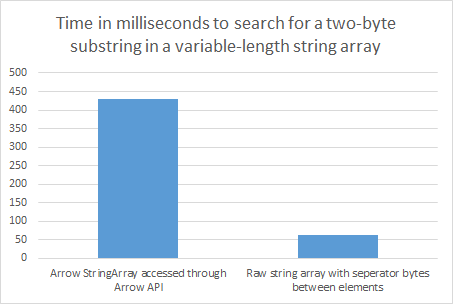
For
example,
I
ran
an
experiment
where
I
created
an
array
of
12,500,000
variable-sized
strings
(average
of
8
characters
per
string)
using
the
StringBuilder
API,
and
searched
for
a
substring
of
size
two
characters
within
all
elements
of
the
array
(extracting
the
index
of
all
elements
that
contain
the
substring).
I
measured
how
long
this
query
took
when
accessing
the
array
both
through
the
Arrow
StringArray
C++
API,
and
also
over
the
raw
Arrow
data
directly.
Thirdly,
I
measured
how
long
the
same
query
took
over
a
string
array
that
included
a
separator
byte
between
each
element.
The
results
are
shown
below:
In
this
case,
the
best
performance
was
the
array
that
was
not
created
according
to
the
Arrow
specification.
The
reason
for
this
is
that
the
raw
data
could
not
be
searched
directly
for
the
two-byte
substring
in
the
dataset
created
according
to
the
Arrow
specification,
because
the
companion
integer
array
containing
the
list
of
element
boundaries
needed
to
be
repeatedly
consulted
to
ensure
that
substring
matches
did
not
span
multiple
elements.
However,
when
seperator
bytes
were
located
inside
the
array
itself,
no
secondary
array
needed
to
be
scanned.
It
should
be
noted
that
string
separators
only
accelerate
certain
types
of
queries,
and
I
purposely
chose
one
such
query
for
this
example.
For
queries
that
they
do
not
accelerate,
they
tend
to
have
to
opposite
effect,
decreasing
performance
by
bloating
the
size
of
the
array.
Furthermore,
it
should
be
reiterated
at
this
point
that
reserving
byte
values
for
string
separators
would
have
prevented
any
application
that
do
not
reserve
the
same
byte
values
from
using
Arrow,
thereby
limiting
the
scope
of
Arrow’s
utility.
In
addition,
many
other
queries
can
actually
benefit
from
having
the
companion
integer
array.
For
example,
an
equality
comparison
(name
==
"johndoe")
can
utilize
the
integer
array
to
ignore
any
value
that
has
a
different
length.
It
should
also
be
noted
that
any
application
that
wishes
to
have
string
separators
can
simply
add
them
to
their
strings
directly,
before
creating
the
array
using
the
StringBuilder
API.
So
this
experiment
does
not
show
a
fundamental
weakness
of
the
Arrow
standard
---
it
just
indicates
that
in
some
cases
you
may
have
to
add
to
the
raw
data
in
order
to
get
optimal
performance.
Nested Data
As
self-describing
data
formats
such
as
JSON
become
more
popular,
users
are
increasingly
dropping
the
two-dimensional
restrictions
of
relational
tables
and
spreadsheets,
and
instead
using
nested
models
for
their
data.
Arrow
elegantly
deals
with
nested
data
without
requiring
conceptual
additions
to
the
basic
layout
principles
described
above,
where
raw
data
is
stored
contiguously
and
offset
arrays
are
used
to
quickly
find
particular
data
elements.
For
example,
in
a
data
set
describing
classes
at
the
University
of
Maryland,
I
may
want
to
nest
the
list
of
students
in
each
class.
For
example,
the
data
set:
Classes:
Name:
Introduction
to
Database
Systems
Instructor:
Daniel
Abadi
Students:
Alice
Bob
Charlie
Name:
Advanced
Topics
in
Database
Systems
Instructor:
Daniel
Abadi
Students:
Andrew
Beatrice
could
be
stored
as
follows:
Name
offsets:
0,
32,
67
Name
values:
Introduction
to
Database
SystemsAdvanced
Topics
in
Database
Systems
Instructor
offsets:
0,
12,
24
Instructor
values:
Daniel
AbadiDaniel
Abadi
Nested
student
list
offsets:
0,
3,
5
Student
offsets:
0,
5,
8,
15,
21,
29
Student
values:
AliceBobCharlieAndrewBeatrice
Note
that
the
nested
student
attribute
required
two
different
offset
lists:
(1)
Students
are
variable
length
and
thus
we
need
one
offset
list
to
specify
where
one
student
ends
and
the
next
one
begins,
just
as
for
any
variable
length
attribute;
and
(2)
We
need
second
offset
list
to
indicate
how
many
students
exist
per
class.
The
"Nested
student
list
offsets"
accomplish
this
second
goal
---
it
indicates
that
the
first
class
has
(3-0)
students,
and
the
second
class
has
(5-3)
students,
etc.
Arrow
currently
allows
list,
struct,
and
various
types
of
union
type
data
to
be
nested
in
an
attribute
value.
Conclusion
It is important to separate out the specification of a standard from the tools and libraries that are provided in the current codebase that help developers with implementing this standard. As long as you are performing in-memory analytics where your workloads are typically scanning through a few attributes of many entities, I do not see any reason not to embrace the Arrow standard. The time is right for database systems architects to agree on and adhere to a main memory data representation standard. The proposed Arrow standard fits the bill, and I would encourage designers of main memory data analytics systems to adopt the standard by default unless they can find a compelling reason that representing their data in a different way will result in a significantly different performance profile (for example, Arrow’s attribute-contiguous memory layout is not ideal if your workloads are typically accessing multiple attributes from only a single entity, as is common in OLTP workloads). I also found the tools available in the codebase to read and write data using this standard to be easy to use and quick to get started with. However, I did find that at times, the code was slightly slower than the raw (and less general) implementation of the standard I wrote myself. Nonetheless, the existing codebase is good enough for most use cases and will likely help to further the acceleration of the adoption of the standard. Furthermore, additional performance enhancements to the codebase appear to be on their way, such as optimized LLVM-based processing modules.