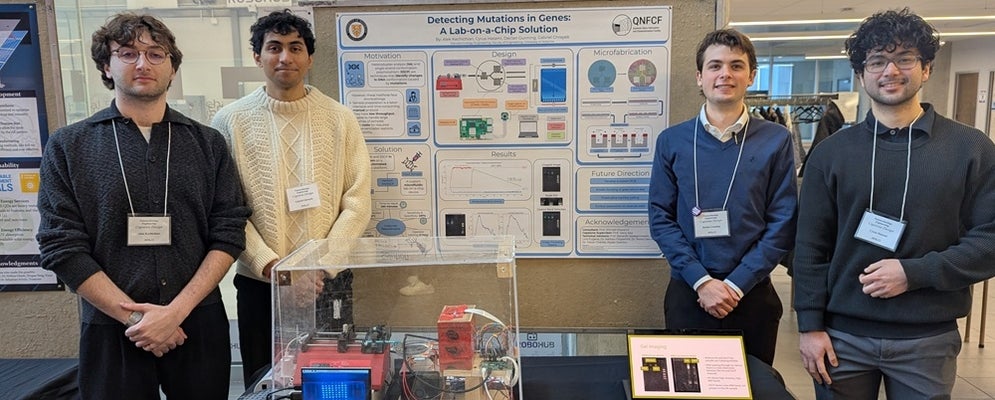
Group 22, from left to right: Alek Kechichian, Gabriel Ghrayeb, Declan Gunning and Cyrus Hatami
Nanotechnology Engineering (NE) Group 22 placed second for their Capstone Design Project titled Detecting Mutations in Genes: A Microfluidic Lab-on-a-Chip Solution.
The group designed a benchtop microfluidic device which detects DNA mutations. DNA mutation detection can be used to tailor cancer treatments, identify genetic disorders like cystic fibrosis, prenatal testing and more.
DNA mutation detection is a time-consuming process. It takes between four to six hours to get the results from the current process of testing. The device designed by group members Gabriel Ghrayeb, Declan Gunning, Cyrus Hatami, and Alek Kechichian takes a small DNA sample and can process and produce results quickly and with minimal manual intervention.
“Our device works with and can be tuned for any DNA segment of interest, whether you're working in genetic engineering and you want to check if you have successfully caused or edited a gene mutation, or in genetic screening where we want to check if a person's genetic code has a mutation that might make them at higher risk for breast cancer or some other condition down the line,” says Kechichian.

Microfluidic Lab-on-a-Chip prototype with labels
The sample is fed along a microchannel with integrated controlled heating and cooling zones to perform tandem Heteroduplex Analysis (HA) and Single-Strand Conformation Polymorphism (SSCP). DNA is put into the device through a syringe pump onto a microfluidic chip that the group fabricated in the cleanroom exclusively dedicated for use by our NE undergraduate students.
After that the DNA comes out into an agarose gel which contains a dye that fluoresces, so a genetic mutation is visible. The DNA travels through the gel when an electric current is applied, a process called electrophoresis.
A Raspberry Pi 4B microcomputer controls the entire process, managing the heating and cooling stages and triggering a camera to capture images of the fluorescent bands in the gel. A computer vision algorithm then analyzes the band patterns to determine whether a mutation is present.
Currently testing for genetic mutations takes hours and uses larger sample volumes. With this device the sample is loaded then a lab technician can simply press a button, and the automated device will generate results in 35 minutes.
The device minimizes manual handling, speeds up analysis, and delivers a portable, cost‑efficient platform suitable for genetic screening and biomedical diagnostics.
The Capstone project was influenced by one of Gunning’s last co-op jobs.
“The term before we started this project, I was working in a biotech company in a lab doing research and development, working with microfluidic devices and DNA samples. I gained extensive lab experience and learned how time‑consuming lab work can be. That was the impetus for our problem statement,” says Gunning.
The group felt their coursework prepared them well for the project, with upper-year microfabrication labs providing the skills to build their microfluidic chip. They credited their success to NE’s multidisciplinary classes and labs. “My favourite part of NE is that the classes and labs just got cooler as the years went on,” says Kechichian.
Hatami had a co-op with the National Research Council Canada working as a lab systems engineer, which helped him bring a unique set of skills to the project.
“That role helped with being familiar with interfacing with different components. A lot of my experience is also in software as it relates to science,” says Hatami. “That helped with the computer vision programming.”
The group, who was supervised by Dr. Ahmad Ghavami, worked long hours to create their award-winning project. For Ghrayeb, one of his favourite moments working on the project came after a long day of working in the lab for hours.
‘We initially got our temperature control loop working for the first time at 11:30 pm, and we worked on it for hours. It was an incredible sense of satisfaction when we finally got the control system working and all the coding done. That was my favourite part of our project.”