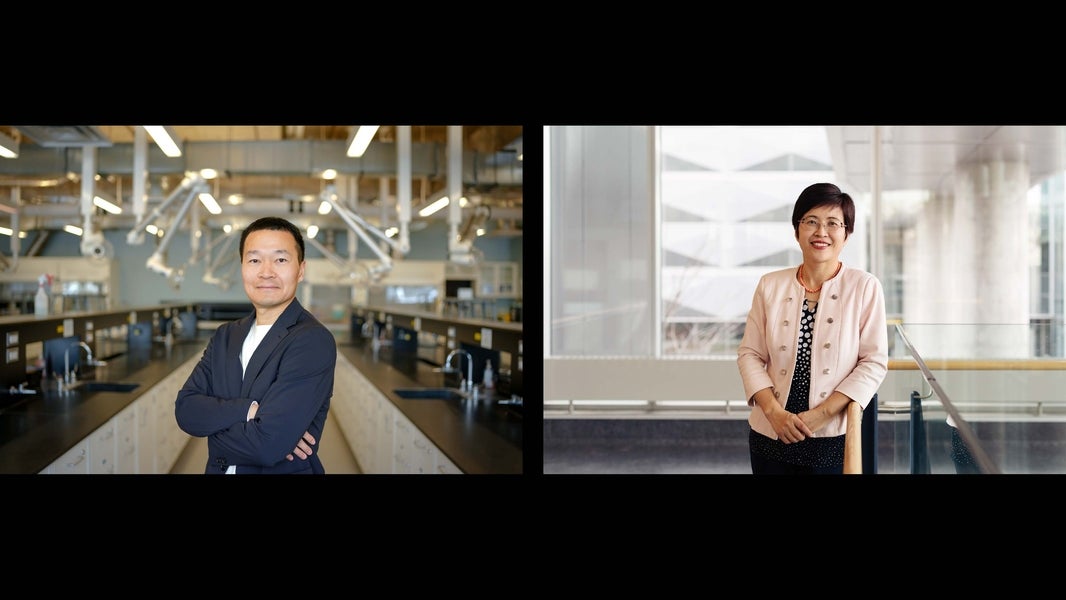
From left to right: Professors Juewen Liu and Aiping Yu
Professors Aiping Yu and Juewen Liu have been named to this year’s Highly Cited Researchers™ 2025 list recently published by Clarivate. The exclusive list highlights the world’s most influential researchers and scientists. It includes only those whose work features multiple Highly Cited Papers, publications that rank within the top one percent of citations in their respective fields.
Yu is a University Research Chair advancing next-generation energy storage by designing new nano-materials for metal-ion batteries. She uses thin, 2D materials, to make these batteries store more energy and deliver power with greater efficiency. As Director of the Applied Carbon Nanotechnology Laboratory, Yu works on improved ways to recycle batteries. Because lithium is becoming harder to obtain, her team is developing methods to recover lithium and other useful materials from old batteries.
Yu also conducts research with other layered materials such as metal oxides, MXenes, and layered double hydroxides. She employs several engineering techniques to improve these materials. This includes chemical functionalization (adding specific chemical groups to the material), as well as controlling their shape and porosity to increase surface area. By carefully adjusting these features, she can give the materials new and useful properties for different applications.
Liu, a Canada Research Chair in Biosensors and Bionanotechnology applies principles of chemistry, biology and physics to design nanoscale materials, devices, and systems to advance technology, and impact medicine.
His research investigates using DNA and lipids as functional materials that can connect with nanoclusters, hydrogels, carbon-based materials and metal nanoparticles. To study and build these systems. Liu, Director of the Bionanotechnology & Interfaces Laboratory, and his team use a wide range of tools and methods, including synthetic chemistry, analytical techniques, physical characterization, and biochemical approaches.
The Nanotechnology Engineering Program has outstanding faculty from the Departments of Chemical and Electrical Engineering, as well as from the Department of Chemistry, giving students the opportunity to learn from experts across all three disciplines.