Nanotechnology Engineering students named as Canada’s leading innovators for second year in a row
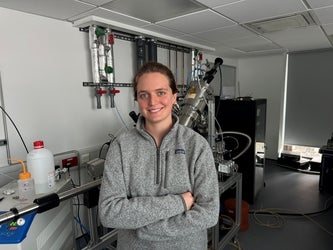
Pictured above: Shawn Benedict on a co-op term in Norway.
The Nanotechnology Engineering (NE) Program is proud to celebrate that, for the second consecutive year, an NE student has been named to The Logic’s ‘Canada’s Leading Innovators’ list. The Logic is a Canadian news outlet that is one of the leading sources of technology and business news.
Helen Engelhardt (BASc 2024) was named as one of Canada’s leading innovators from the class of 2024. Engelhardt is a Clarendon scholar for a PhD in Materials at Oxford. She began her PhD in the fall of 2024, studying earth abundant catalysts for green hydrogen production.
Engelhardt, who won eight awards during her undergraduate degree, is focused on research to eliminate CO2 emissions from the hydrogen sector by designing hydrogen production systems that function with green energy sources, such as solar and wind. She has been conducting research at synchrotrons-powerful X-ray facilities used for materials analysis-both near Oxford (Diamond Light Source, Harwell) and in France (European Synchrotron Radiation Facility, Grenoble, France).
Shawn Benedict (BASc 2025) was named as one of Canada’s leading innovators from the class of 2025. Benedict won 13 awards during his undergraduate degree in Nanotechnology Engineering and recently won an NSERC award for his PhD which he is pursuing in the Department of Chemical Engineering at the University of Waterloo.
Benedict is part of an international center that involves 40 researchers from 18 institutions and 20+ companies tasked with reimagining how waste materials such as plastics and CO2 emissions can be converted into valuable products sustainably. He is working on the optimization and machine learning team whose work will be the glue that brings the Center for Innovative Recycling and Circular Economy (CIRCLE Project) together.
Both students credit the NE Program’s hands-on approach and interdisciplinary focus for their success.
Helen Engelhardt
Ms. Engelhardt, how did the NE Program contribute to your success?
I attribute most of my later success to being a volunteer, then co-op, then research student in Professor Anna Klinkova’s lab, starting right from 1A. Not all students start research this early, but most do it at some point, and the ability to be engaged hands-on with research and industry projects that matter are unique to the co-op program. I was consistently given bigger and bigger challenges in my co-ops, which I was able to rise to.
The NE labs and lab staff are also fantastic, from first year up to working on my Fourth Year Design Project. The NE lab curriculum is really standout in how much it teaches students, how approachable the faculty are, and how enjoyable the projects are.
Ms. Engelhardt, what did you enjoy and find valuable about the NE Program?
The hands-on experience right from the start was crucial. I was engaged and enthusiastic because I felt like I was actually solving the (climate) problems that really bothered me and were begging my attention. I nearly went into the environmental space but thought that NE would give me the tools to both observe and solve problems like renewable energy, pollution, and transport.
NE gives a very interdisciplinary perspective; I worked in both research and industry for electrochemical systems and also did a coop in biomedical engineering. Though I am working in electrochemistry now, it surprises me daily how much I use the skills and knowledge gained in my biomedical coop, which at the time I thought would be irrelevant. Classroom and hands-on work in varying disciplines have helped me to be extremely flexible and creative in my research.
Mr. Benedict, what do you think it is about the NE program that makes students so engaged and enthusiastic?
I think it could be the multidisciplinary nature of the program. NE students get insights from professors from three different departments: Chemical Engineering, Electrical and Computer Engineering and Chemistry. That gives students a well-rounded perspective and allows them to find what they enjoy most. Maybe some people don't prefer biology, but they end up loving to code, or they realize they don't prefer circuits, but they really enjoy building microchips in clean rooms. The program is broad and covers many different subjects and skills so most students can latch onto some aspect of NE.
I also feel it’s because NE is one of the smaller programs, so our cohorts become very close-knit. Our professors are amazing and really care for the students.
Mr. Benedict, what does it mean to you to be recognized as a leading innovator from the Canada’s class of 2025 at the beginning of your PhD?
There are so many strong students in Canada. I am so humbled to have been recognized. It shows what you can achieve with hard work and a strong support system from peers and staff. This is such an honour, and it motivates me even more to make a big difference during my PhD.
Congratulations to both NE alumni!