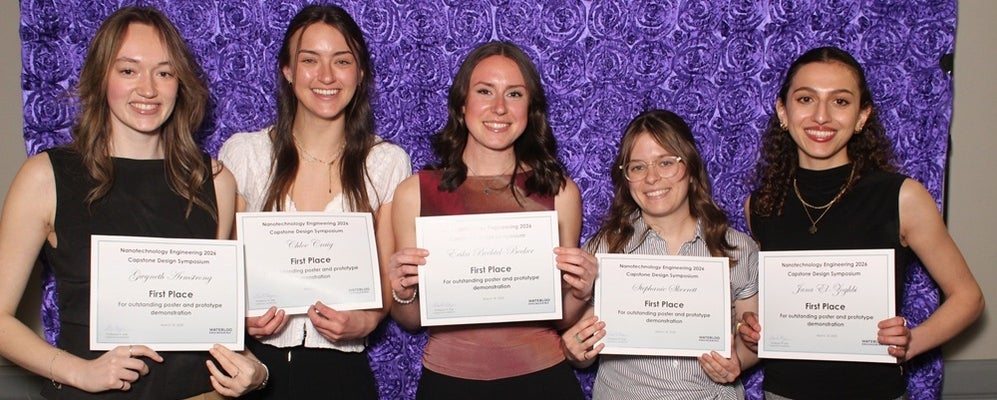
Group 7, from left to right: Gwyneth Armstrong, Chloe Craig, Erika Bechtel-Becker, Stephanie Skerrett and Jana El-Zoghbi
Nanotechnology Engineering (NE) Group 7 took first place for their Capstone Design Project VitEx, that reimagines hospital emergency room triage through a new approach in wearable nanotechnology.
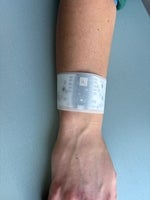
Group 7: wristband prototype
The group created a wristband for use in hospital emergency rooms embedded with sensors to enable continuous monitoring of the patients’ vitals.
The wristband uses a sweat-based enzymatic sensor to continuously measure patients’ glucose levels and heart rate. When a voltage is applied to the glucose sensor, glucose is oxidized and then that produces a measurable current that can be measured using an electrode.
The heart rate sensor is a pressure-based sensor that uses piezoelectric PVDF as the sensing layer with the addition of zinc oxide nanorods underneath to increase the overall sensitivity.
Data would be transmitted in real-time to hospital staff, enabling the rapid visualization of patient deterioration and the prioritization of care. The wristband integrates two types of sensors; a heart rate and glucose sensor are interfaced with an electronic board. The wristband itself is a flexible printed circuit board.
All the components send their data to a main microcontroller that transmits data wirelessly via Bluetooth to a main server where hospital staff can access the patient data.
This technology has the potential to facilitate a data-driven triage process, cutting wait times, and reducing adverse outcomes.
Group members, Gwyneth Armstrong, Erika Bechtel-Becker, Chloe Craig, Jana El-Zoghbi, and Stephanie Skerrett were supervised by Professor John Saad.
“Our project succeeded thanks to the diverse expertise we gained from our study terms and co‑op experiences, which allowed us to create a fully integrated and effective system. Having all those diverse skills come together was surprising—I didn't realize how far they could take us,” says El- Zoghbi.
Craig and Armstrong worked on the heart rate sensor. Armstrong developed software and a user interface for their wristband. Her first co-op was at SNOLAB, an underground research lab, using Python Data management to create a database. Craig credits her experiences in the NE third- and fourth-year labs for the expertise necessary to work on the heart rate sensor.
Skerrett and Bechtel-Becker designed the glucose sensor. Bechtel-Becker worked as a co-op and at STEMCELL Technologies, a Vancouver-based biotechnology company. Skerrett’s co-ops were in bio-focused research settings, including her last co-op at the National Research Council Canada.
El-Zoghbi worked on the electrical design and firmware code of the project, including the analog circuitry, flexible pcb design and assembly, as well as firmware coding.
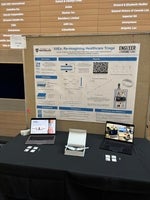
Group 7: Poster and set-up
For the group, winning Best NE Capstone Project was the icing on the cake of an already positive experience in the program.
“The combination of hands‑on labs and the diverse coursework in the NE program prepares you well. The support you get from the lab instructors is great; it creates a good environment. It's nice to have that close interaction with faculty and staff members,” says Skerrett.
For Armstrong, it was the people that made her undergraduate experience so satisfying.
“We're all passionate about what we're interested in. It's nice to be around like‑minded people. Being in the NE program has been a good experience overall — it's been a fun five years!” says Armstrong.