Growing smarter to tackle Ontario's farm challenges
Waterloo researchers collaborate on new technologies to help solve longstanding agricultural issues
Researchers at the University of Waterloo are working with government, academic and industry partners to tackle several challenges in Ontario’s agricultural sector, including short growing seasons, rising production pressures and crops that can fail long before anyone sees warning signs.
“The problems we face today are complex, and their solutions demand equally complex expertise,” says Dr. Christian Euler, a chemical engineering professor at Waterloo. “By collaborating across disciplines, we move toward addressing these problems and strengthening Ontario's food resilience.”
To address issues related to growing seasons, the provincial government has built a 5,200-acre greenhouse industry worth $1.8 billion annually.
But while controlled environments boost productivity through precise management of growing conditions, they also increase the risk of rapid pest and disease spread, and reliance on manual monitoring delays response times.
A team from Waterloo and the University of Guelph partnered with the Ontario Ministry of Agriculture, Food and Agribusiness (OMAFA) to take on those problems by designing a system that monitors greenhouse crops for early signs of disease, infection and plant stresses before they are visible.
“This initiative uses cutting-edge computer vision, metabolic modelling and machine learning-based state estimation to catch problems early in order to protect yield, reduce crop losses, and make better use of resources like water, energy, and fertilizers,” says Dr. Nasser Mohieddin Abukhdeir, a professor in the Department of Chemical Engineering at Waterloo.
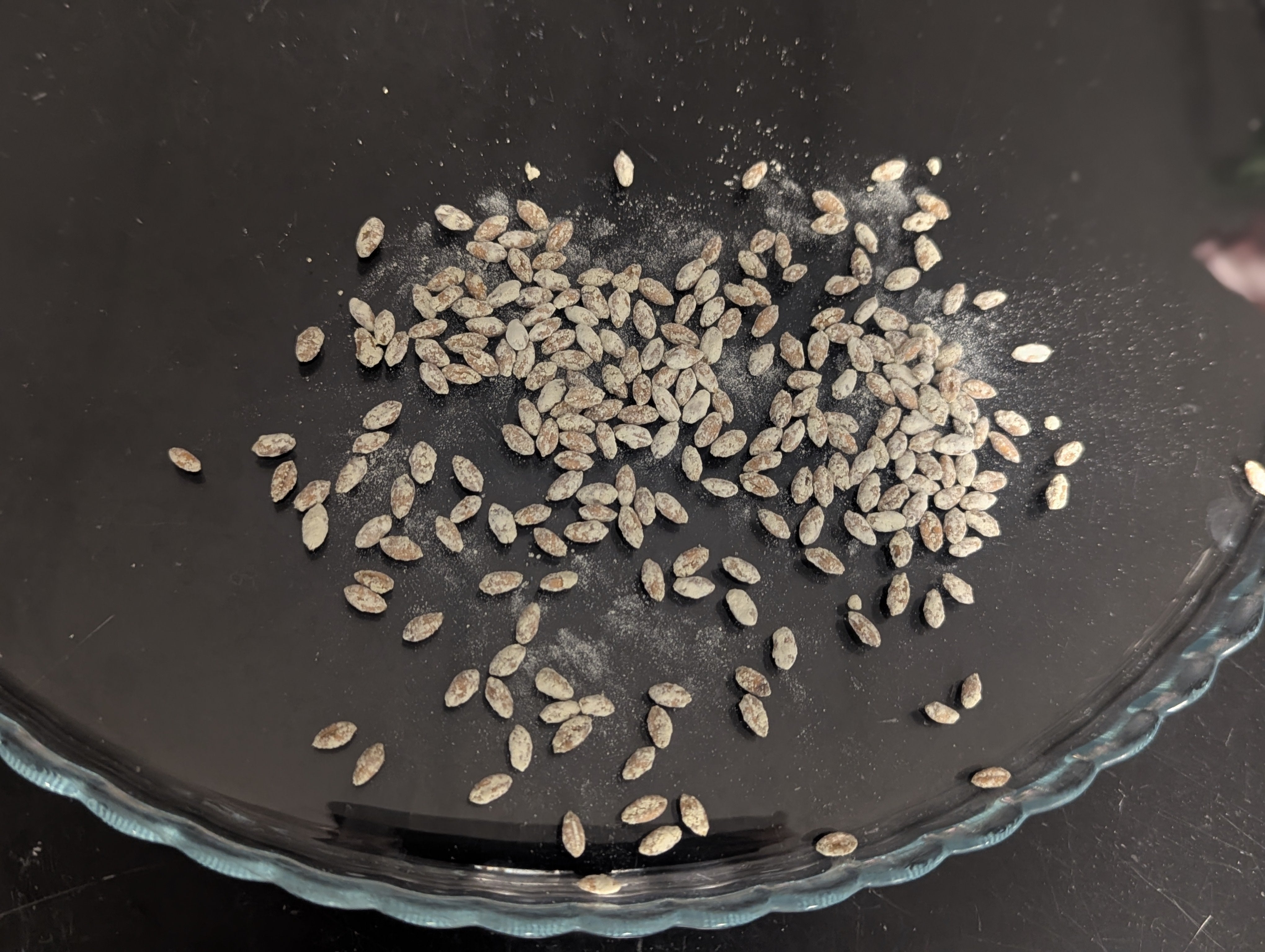
Researchers coated these seeds with a biodegradable polymer material to hold moisture and improve their survival rate after planting.
Dr. Medhat Moussa of the University of Guelph and Dr. Fadi Al-Daoud, Greenhouse Vegetable Specialist at OMAFA, are also part of a research group that combines complementary skills for the project. Moussa, for example, uses multispectral and depth cameras to capture growth metrics and stress indicators.
“It’s a pleasure to collaborate with Professor Abukhdeir and his team to address important questions that will help improve the production of greenhouse fruits and vegetables for Ontario growers,” says Al-Daoud. “This project will develop technologies that will allow greenhouse growers to identify stresses earlier, helping growers to proactively reduce negative effects on crop yield.”
Euler is developing metabolic models that reveal information about plants before symptoms appear.
“The models build on what we know about plant metabolism and genomic information to understand what’s happening inside the plant,” he says. “Metabolic changes precede visible changes by at least three days.”
That initiative — funded by the governments of Canada and Ontario through the Sustainable Canadian Agricultural Partnership, a federal, provincial and territorial initiative — could yield an important predictive tool for greenhouse production.
Another collaborative project, which includes industry partner Corteva Agrisciences, addresses a challenge in eastern Ontario, where farmers struggle with a short growing season and a narrow window for planting winter wheat, often before soybeans have been harvested.
The project involves the use of drones to scatter winter wheat seeds into standing soybeans, offering a promising workaround, but early trials revealed a major flaw.
Aiming to improve seed survival
“With drone-planting, the seed is on the surface of the soil and not planted as it normally is,” says Dr. Joshua Nasielski, a Guelph professor who leads the project. “As a result, seeds dried out before they could sprout. We might plant 1.6 million seeds an acre but get less than half to survive.”
That’s when Waterloo chemical engineering professor Dr. Tizazu Mekonnen was brought in to innovate a seed coating made from a polymer material to improve water retention.
Drawing on his expertise in sustainable polymers, Mekonnen designed a biodegradable, super-absorbent hydrogel from potato starch that acts like a sponge to hold moisture close to the seed so it can survive until rain arrives. And unlike synthetic plastic coatings used to plant wheat, the coating fully degrades.
“The current method functions,” says Mekonnen, Canada Research Chair in Sustainable Multiphase Polymers. “The problem is that after the seed grows, the plastic stays in the soil. Imagine decades of applications of those very tiny plastics buried in the soil and turning into microplastics that contaminate soil and water systems.”
The research group, which includes technician Ian DeSchiffart, is hopeful it will see an increase in the number of surviving wheat plants.
Feature photo: Tewodros Taddese Tiruneh, an engineering PhD student, displays seeds he helped coat with a biodegradable hydrogel to hold moisture in a project led by Dr. Tizazu Mekonnen.