Waterloo welcomes Hilary Mason, global leader in big data
People interested in the startup world of data science need a hacker mindset: the “ability to solve problems without a map,” says renowned data scientist Hilary Mason.
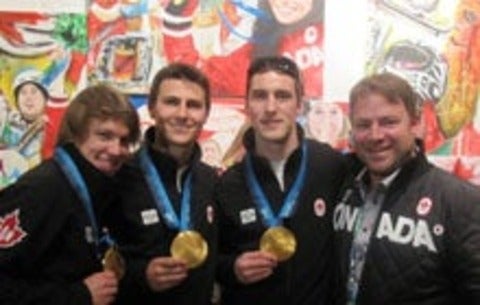

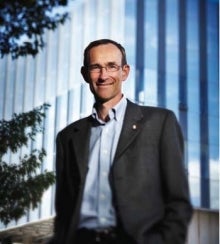
As the world turns its eyes on Sochi, Richard Robinson is fixing his on the form and motion of Canadian Olympians.
Robinson’s skill in chiropractic medicine, primed by his kinesiology degree from the University of Waterloo (BSc. 1993), has earned him a spot on the support team for Canada’s athletes in the Russian city.
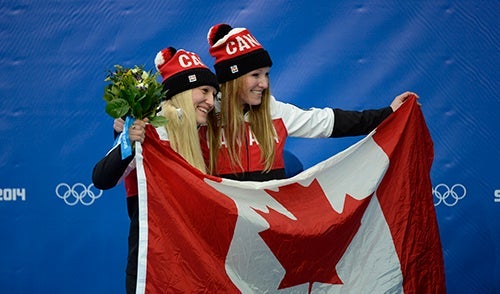
Heather Moyse and her longtime sled partner Kaillie Humphries made Olympic history in Sochi this week. The pair became the first women to win gold medals in consecutive Olympics for the two-man bobsled event. The pair triumphed over their close competitors on the U.S. team in the final heats on Wednesday.

Photo credit: Canadian Olympic Committee
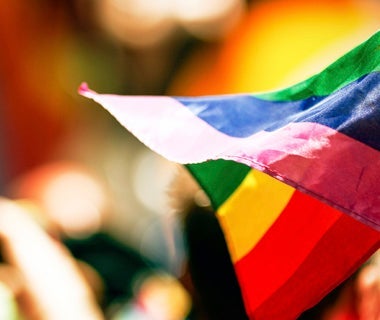
Involvement in lesbian, gay, bisexual, or transgender (LGBT) sport groups makes gay and lesbian athletes feel better about their sexual identity and helps them come out in their everyday lives, according to research from the University of Waterloo.

An innovative collaboration will provide University of Waterloo students and entrepreneurs the opportunity to work together when Stratford's Accelerator Centre relocates to the University of Waterloo Stratford Campus this spring.
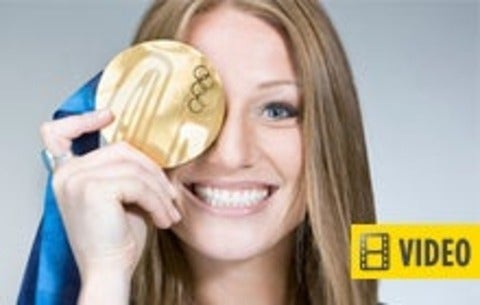
When 2010 Olympic gold medalist Heather Moyse arrived at Canada’s national bobsleigh training facility for testing in August, expectations were low.
Less than a year before, the Waterloo kinesiology graduate had undergone surgery to repair a torn labrum in her right hip. The surgery left her unable to train for weeks, and jeopardized her ability to return to the sport at an elite level.
But with a 5.50 second-start that day, Moyse proved to herself and her coaches that not only was she back— but she was faster and stronger than before.
Our response to societal pressures about vaccination has a direct effect on the spread of pediatric infectious diseases in areas where inoculation is not mandatory, says new research published this week in Proceedings of the Royal Society B.
By incorporating social norms into predictive mathematical modelling, a research team from the University of Guelph and the University of Waterloo found that they can foresee the observed patterns of population behaviour and disease spread during vaccine scares—times when anti-vaccine sentiment is strong.
Professor Raymond Laflamme, executive director of the Institute for Quantum Computing at the University of Waterloo, will speak at the Canadian Club of Ottawa on Tuesday, February 18, 2014.

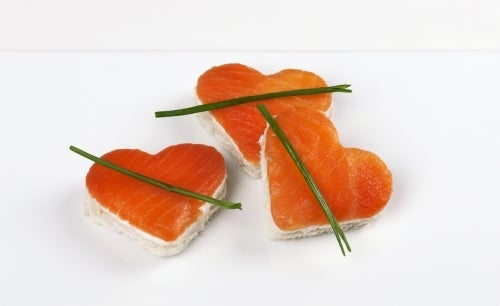
Salmon can spot their true love across a crowded stream, according to research from a university-industry partnership involving the University of Waterloo. Allowing female salmon to follow their heart and mate with the male of their choice produces healthier babies than those who have their mates selected for them.

Heart-shaped salmon crudités (©iStock.com/beyhanyazar)
Canadian luge athletes speed down icy tracks in open sleds at upwards of 130 kilometres an hour. It’s thrilling to watch, but for Pro Stergiou, a Waterloo alum, the most interesting part is the start.
Stergiou, a biomechanics expert, uses high-speed video and accelerometers to help him analyze those early moments in the race when Olympic luge athletes pull off the starting handles.
“We know that their start is very vital to the race,” says Stergiou, who has been working with luge Olympic athletes for almost ten years.