New funding set to accelerate Canada’s quantum industry capabilities
A research project led by Institute for Quantum Computing (IQC) faculty Dr.
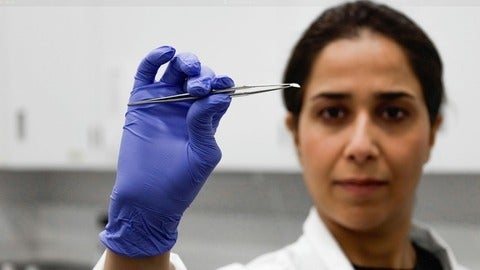
Kinesiology and Health Sciences Professor Lora Giangregorio has been awarded a Tier 1 Canada Research Chair (CRC) in Bone Health and Exercise Science, with a funding allotment of $1.4 million.
She also received a $75,000 grant from the Canada Foundation for Innovation John R. Evans Leaders Fund (JELF) that is associated with this CRC.
Imagine a painless patch that continuously sends your health status to your phone. A team of researchers from the University of Waterloo is on a mission to deliver just that by developing next-generation technologies that can monitor and dispatch personalized medicine.
A new way to measure male fertility has been discovered by researchers at the University of Waterloo, opening the door to the development of simple, inexpensive tests for clinical and at-home use.
The research team combined expertise in sperm cell behaviour and interface science to determine that the movement of healthy sperm within semen reduces the force with which droplets stick to a water-repellent surface.
Recent rhetoric has emerged alleging that U.S. banks aren’t allowed to do business in Canada, which is untrue. U.S. banks have been operating in Canada for well over a century with 16 U.S.-based bank subsidiaries and branches managing $113 billion in assets here in the country. University of Waterloo finance professor and co-director of the Computing and Financial Management undergraduate program James Thompson explains how U.S. banks can navigate Canada’s banking sector.
One-third of Canadian adults aged 55 or older are nutritionally at risk, potentially leading to increased hospital stays, more emergency visits and physician consultations for possible infections, a new study found.
The University of Waterloo researchers assessed data from more than 22,000 community-dwelling adults aged 55 and over from the Canadian Longitudinal Study on Aging. After an initial evaluation, they followed up with participants up to three years later to track their health-service use over the previous year.
Velocity’s Health Innovation Challenges, in partnership with the Grand River Hospital Foundation (GRHF), offer University of Waterloo students an experiential learning opportunity with local hospitals and organizations. Students hear about the real-world challenges faced by patients and health-care workers in local hospitals and work with Velocity experts to develop practical solutions.

Dr. Krystle Shore (PhD ‘23)
Faculty of Arts, Department of Sociology and Legal Studies
> Postdoctoral research scholar, Lupina Foundation
A new mathematical model developed at the University of Waterloo can determine a baby’s overall drug exposure when their mother is taking medication. This is the first study to include drug transfer from the umbilical cord and through breastfeeding in determining the baby's total drug levels.
The research team from the School of Pharmacy at Waterloo looked specifically at Levetiracetam. It is a drug commonly prescribed long term for women with epilepsy, yet there was minimal data on the risk of adverse effects on breastfed infants.
A study led by a University of Waterloo researcher has learned that climate change is increasing the potential for algal blooms in the United Kingdom’s River Thames despite a four-decade-long decline in phosphorus loads. The study completed a detailed analysis of the river’s 150-year water quality record to learn this information.