Research

Tuesday, June 4, 2013

New graduate program in water management

by Staff, Communications and Public Affairs

Graduate students who specialize in water-related studies at the University of Waterloo will have the opportunity to be part of a new Integrated Water Management program that will give them a broad foundation in water science, engineering, technology and management.


Friday, May 31, 2013

Is climate change washing away history?

by Bob Burtt, Communications and Public Affairs

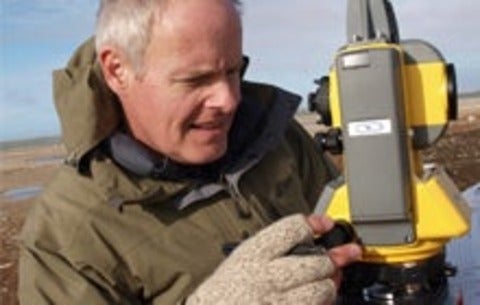
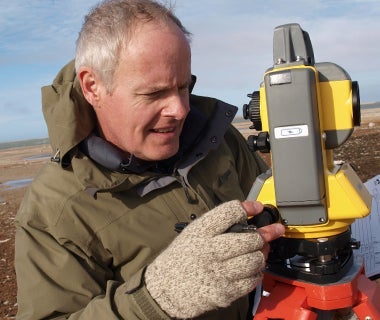
Sannirut, a tiny peninsula, located on Bylot Island, Nunavut,  is home to some of the best-preserved prehistoric artifacts in Canada’s Far North, but the treasure trove of archeological gems are being threatened by global climate change.

Robert Park checking a theodolite.

Friday, May 31, 2013

GDP is up 2.5 per cent, but our wellbeing is not in step

by Media Relations

WATERLOO, Ont. (Friday, May 31, 2013) — Canada’s economy is growing, but according to Professor Bryan Smale, Director of the Canadian Index of Wellbeing (CIW) at the University of Waterloo, Canadians’ health and quality of life are not keeping pace.

Statistics Canada announced today that Canada’s GDP rate grew 2.5 per cent in the first quarter, the fastest in six quarters.

WATERLOO, Ont. (Monday, Nov. 12, 2012) - A research project with its roots at the University of Waterloo has found that human activity is raising levels of carbon dioxide (CO2) in the uppermost layers of the atmosphere.

It is the first hard evidence that such levels are increasing there at a faster rate than can be explained by solar activity or exhaust from rocket launches. The project’s CO2 measurements are reported in the latest issue of Nature GeoScience.

Tuesday, May 28, 2013

Study: Stronger tobacco marketing ban needed in Brazil

by Media Relations

BRAZIL STUDY FINDS THAT A STRONGER TOBACCO MARKETING BAN IS NEEDED TO CURB TOBACCO INDUSTRY EFFORTS TO ATTRACT NEW SMOKERS

*Survey reveals huge support from Brazilians for further legislation to restrict the marketing activities of the tobacco industry*

* A comprehensive TAPS bans alone would reduce smoking prevalence in Brazil by 2-7 percent by 2050 and help protect youth*

(Tuesday May 28th, 2013, Brasília, Brazil and Waterloo, Ontario, Canada):

Thursday, May 23, 2013

Will your electric car use a battery with nano-material?

by Dave Pink, Communications and Public Affairs

In a world that needs increasing capabilities for energy storage, Linda Nazar finds herself in an international race to build a better battery.

Nazar, a professor in the Faculty of Science who is cross-appointed to the Faculty of Engineering, says the race is a matter of cost and energy density.  The goal is to build a low-cost battery that can provide power for longer periods of time.