On behalf of the entire UWaterloo Women in Mathematics Committee, congratulations to Hong Wang in receiving the Fields Medal for her groundbreaking work in harmonic analysis and geometric measure theory.
Established in 1936, the Fields Medal is awarded every four years at the International Congress of Mathematicians (ICM) to at least two mathematicians, recognizing outstanding mathematical research and for the prospect of future achievements. Dr. Wang, permanent professor at the Institut des Hautes Études Scientifiques and professor at NYU's Courant Institute, is the third woman to win the award.
Earlier this year, in April 2026, WIM hosted Wang as part of the Dean’s Distinguished Women in Mathematics, Statistics, and Computer Science Lecture Series. Students across the faculty had the opportunity to learn more about her work on the three-dimensional Kakeya set conjecture.



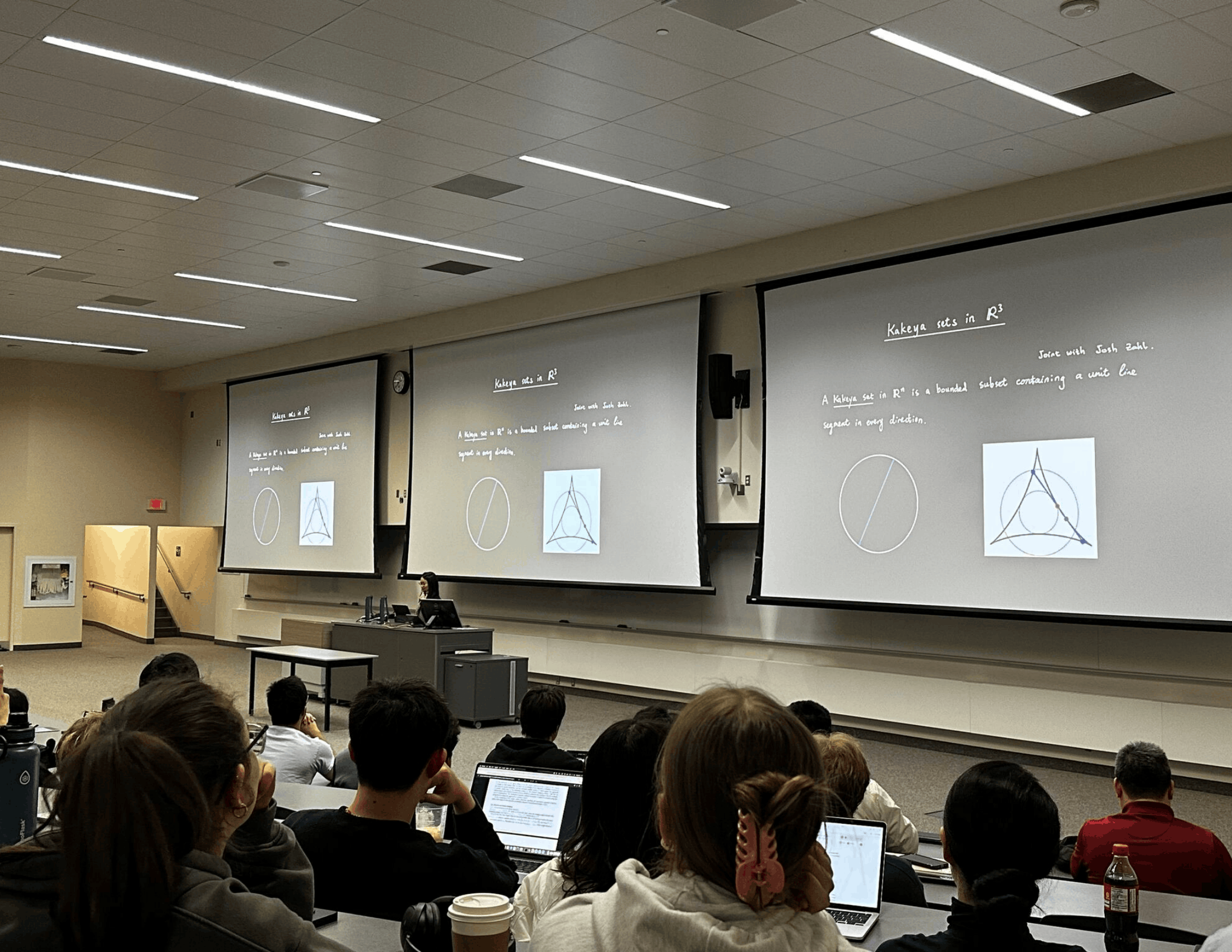
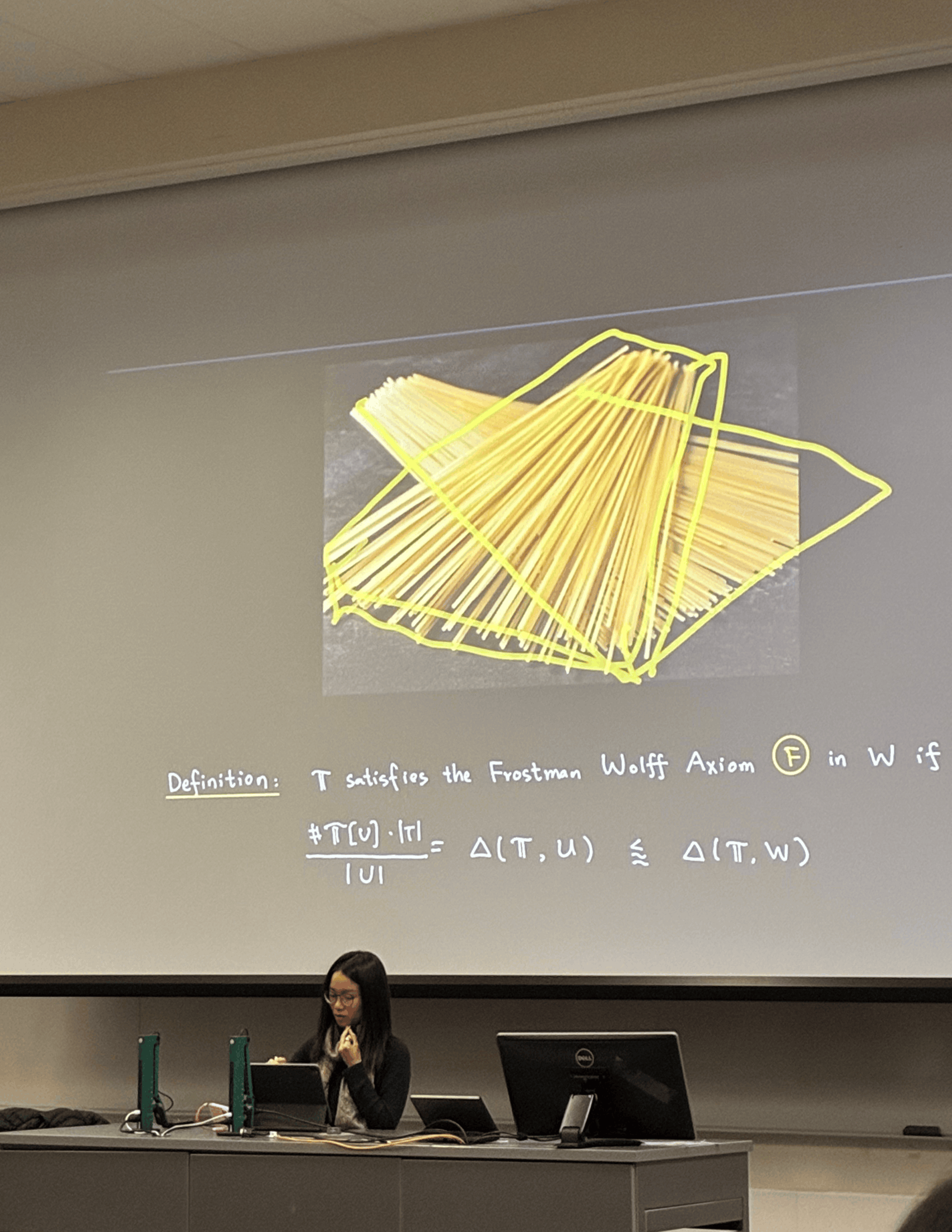
A Kakeya set is a compact subset of \(\mathbb{R}^n\) that contains a unit line segment pointing in every direction. Wang’s research revolves around a fundamental question: just how small can a Kakeya set be? The Kakeya set conjecture addresses this question in terms of dimension, saying that every Kakeya set has Minkowski and Hausdorff dimension n.
In 1971, Davies proved that the conjecture holds for dimension 2, but the problem remained open for three and higher dimensions since.[1] That is, until Wang and co-author Joshua Zahl announced they had the proof for the three-dimensional case in early 2025.[2]
First they proved that \(\delta\) neighbourhoods of unit line segments, known as \(\delta\)-tubes, that meet certain non-clustering conditions have almost maximal volume. They then used this result to rule out potential Kakeya counter examples, ultimately proving that the Kakeya set conjecture holds in three dimensions.
Although the four and higher dimensional cases remain open, we now have a better understanding of how to estimate unions of \( \delta\)-tubes in \( \mathbb{R}^2\) and \(\mathbb{R}^3\). Beyond Kakeya sets, such tubes form the geometric basis of wave packets, extensively studied in harmonic analysis.
To see a list of all Fields medallists, visit the International Mathematical Union’s website at www.mathunion.org/imu-awards/fields-medal/fields-medals-2026.
To see a list of past Dean’s Distinguished lectures, visit WiM's website at uwaterloo.ca/women-in-mathematics/research.
References
- Davies, R. O. (1971). Some remarks on the Kakeya problem. In Mathematical Proceedings of the Cambridge Philosophical Society (Vol. 69, No. 3, pp. 417-421). Cambridge University Press. doi:10.1017/S0305004100046867.
- Wang, H., & Zahl, J. (2025). Volume estimates for unions of convex sets, and the Kakeya set conjecture in three dimensions. arXiv preprint arXiv:2502.17655.