What is Accessible Teaching?
"Course accessibility can make or break a class experience." (Student Quote from Zaza, 2025)
Accessible teaching means being intentional about reducing barriers so that all students can participate and engage in their education. Accessibility means more than just meeting legal requirements. It is a fundamental component of effective teaching: It is essential for some, and beneficial for all.
Accessibility and accommodation are related but distinct.
Accessibility
Accessibility means striving to meet established guidelines, requirements, and standards in order to remove barriers that exclude people. For example: Preparing digital versus hand-written lecture materials.
Accommodation
Accommodation means making adjustments to policies, rules, requirements and/or the built environment to ensure that people with Code-related needs have equal opportunities, access and benefits (Policy on the Duty to Accommodate under the Ontario Human Rights Code). For example: A student requires lecture materials in an alternate format prepared by AccessAbility Services.
"Course accessibility has been one of the most, if not the most, important factor of my success as a student with a learning disability. Without my accommodations, I would not be the student I am today, graduating with honours..." (Student Quote from Zaza, 2025)
Accessibility and accommodation do not lower academic standards – they aim to support students’ ability to be successful.
Why is accessible teaching important?
On a recent survey about course accessibility (n=1758), students rated all 38 accessibility practices as 3 (Somewhat Important) to 5 (Extremely Important) on the 5-point scale of importance (Zaza, 2025).
Disabilities are common. In Canada, the prevalence of disability is approximately 27% among Canadians 15 years and older (Statistics Canada). Despite the high prevalence of disability, students with disabilities have historically been excluded from higher education due to systemic barriers and academic ableism.
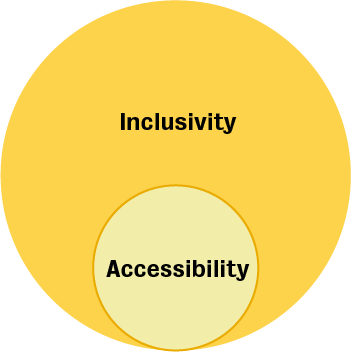
Accessibility is a core component of inclusivity.
Disability is one of many intersecting identities, along with race, gender identity, sexual orientation, worldviews, age, neurodivergence, sex, socio economic status, and other identities.
What is this website based on?
This website is based on the main guidelines, requirements, and standards, and on the voices of students with and without disabilities. To learn more, please follow the links.
- Web Content Accessibility Guidelines (WCAG)
- Accessibility for Ontarians with Disabilities Act (AODA)
- AODA’s Proposed Post-Secondary Education Standards
- Ontario Human Rights Code (OHRC)
- Universal Design frameworks (e.g., Universal Design for Learning)
- University of Waterloo Framework for Teaching Effectiveness (FTE)
-
Student voices:
How can I tell if my course is accessible?
Refer to the UWaterloo Course Accessibility Guide (UWCAG).

How can I request support for course accessibility?
Submit a support request to Teaching Support and Innovation's Agile Development Team.

Ramping Up - Quick Access
For quick access to additional ways to increase accessibility in your teaching, visit any of the following Ramping Up pages:
The Accessible Teaching site is a product of the Teaching Innovation and Educational Leadership Accessible Education project
and is sponsored by the Office of the Associate Vice-President, Academic (AVPA).