


...where the Universe is our laboratory.
The Waterloo Centre for Astrophysics (WCA) looks to the cosmos to solve the greatest mysteries of the universe. Here, world-class researchers and students come together in an atmosphere of curiosity, creativity and collaboration; exploring our cosmic origin to truly understand the physical processes at work in the Universe. From black holes to cosmology, we aim to understand what lies beyond the Earth. The possibilities for new discovery are limitless.
News
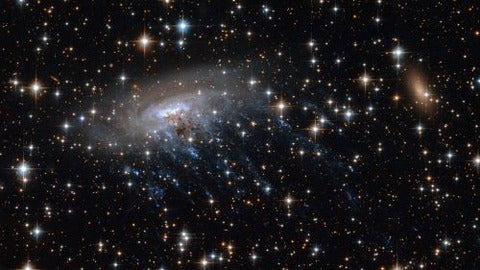
Highest redshift jellyfish galaxy
WCA researchers Ian Roberts and Michael Balogh lead the team that have discovered the highest redshift jellyfish galaxy, named for the long, tentacle-like streams that trail behind them.
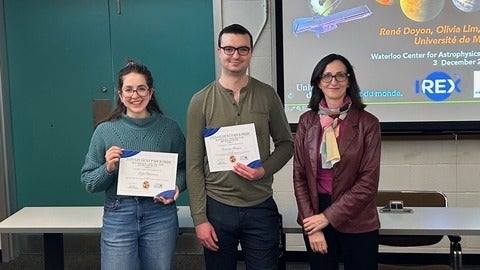
WCA Student Paper Prize 2025
Congratulations to graduate students Sofia Chiarenza and Cameron Morgan, who were awarded the 2025 WCA Student Paper prize. They were presented with their certificates by Dr Sara Seager, who sits on the WCA Governing Board.
The WCA student paper prize is awarded to the papers judged to be the best graduate student-led papers submitted in the past year (July 1 2024 - June 20 2025). They are evaluated on their importance to their field, originality of conception, difficulty of execution, clarity of the manuscript, and reproducibility.
Here, Cameron and Sofia describe their prize winning work.
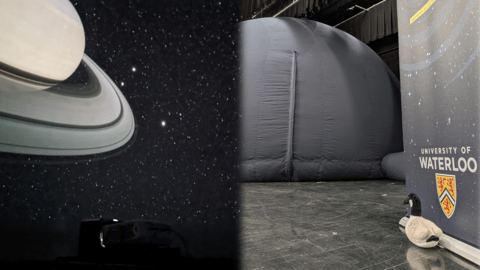
Astro-Bubble on Tour
In October, three WCA members took the "Astro-Bubble" planetarium on tour, sharing space and astronomy with students and communities across Northern Ontario.
Events
Astroseminar - Michael Balogh
"Atmospheric compositions of hot Jupiters as tracers of planet formation history"
Astroseminar - Margaret Buhariwalla
Dr. Margaret Buhariwalla (She/They) recently graduated with their PhD from St. Mary's University in 2025. Her research focuses on hot plasmas associated with actively accreting supermassive black holes. Margaret has a passion for (and several years of experience in) science communication and is particularly interested in sharing the human perspective on space science.
Astroseminar - Emily Deibert
Emily Deibert is a Banting Postdoctoral Fellow at the University of Waterloo, where her research focuses on characterizing the atmospheres of ultra-hot Jupiters and other exoplanets. Prior to starting at Waterloo, Emily was a Gemini Science Fellow and NSERC Postdoctoral Fellow at the Gemini South Observatory in La Serena, Chile, where she worked as a member of the instrument science team for the observatory's new high-resolution optical spectrograph, GHOST. Emily completed a PhD in Astronomy & Astrophysics, and an undergraduate degree in Astronomy, English, and Mathematics, from the University of Toronto's St George campus.