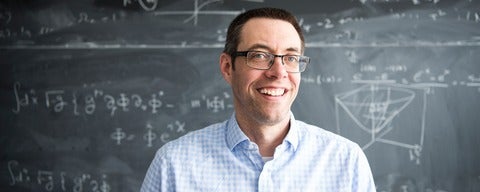
Will Percival recipient of 2025 Excellence in Science Research Award
WCA Director, Will Percival, has been named as one of the three winners of the 2025 Excellence in Science Research Awards.
Lisa Dang, an incoming Assistant Professor at the University of Waterloo, has been awarded 100 hours of JWST observing time in Cycle 4 for her program, "Surveying Hellish Worlds: Lava Planets as Time Capsules of Thermal Evolution."
New results from the Dark Energy Spectroscopic Instrument (DESI) collaboration use the largest 3D map of our universe ever made to track dark energy’s influence over the past 11 billion years. Researchers see hints that dark energy, widely thought to be a “cosmological constant,” might be evolving over time in unexpected ways.
On the same day, DESI has released the largest 3D map of the Universe to date to the public.
The first batch of survey data released by the Euclid mission gives us a glimpse into hundreds of thousands of galaxies reaching back 10.5 billion light years - and it's only the beginning.
Andrew Reeves summarizes the paper that jointly won the WCA 2024 Student Paper Prize.
Discover the science behind a total lunar eclipse in preparation for the Blood Moon on March 13
There's lots to see in the night sky this year, so we've taken a look at all the events you don't want to miss in 2025!
This February, the night sky is putting on a show with a grand planet parade that will have a seven-planet alignment!
Chloe Cheng was one of the two winners of the 2023-2024 WCA Student Paper Prize. Here, she summarizes her prize-winning paper for us.
After sharing the world’s first images of a black hole with the world in 2019, the Event Horizon Telescope (EHT) team recently released a follow-up to the 2024 paper reporting on the results from the 2018 observations of M87* entitled “The persistent shadow of the supermassive black hole of M87”.