

The University of Waterloo Climate Institute brings together the research community and partners to advance strategic research and capacity building priorities at the local, national, and international scales. Our work empowers business, government and civil society to respond effectively to the climate crisis.
Based at the University of Waterloo, the Climate Institute harnesses a unique combination of strengths and depth of expertise to enhance the impact and excellence of innovative interdisciplinary research and education, and to deal head-on with the complexity and interconnectedness of social, political and technological dimensions of climate change.
Our key focus areas:

RESEARCH
Strategic research development and management across priority research areas (deep decarbonization and sustainability transitions; climate risks, resilience and adaptation; and climate science, modelling and observation).

TRAINING AND CAPACITY BUILDING
Supporting climate action through targeted professional development opportunities and the integration of climate education in academic programs.

KNOWLEDGE SHARING
Informing decision makers in policy, practice and innovation through tailored reports, briefs, facilitated workshops, data visualization, media engagement, and partnerships.
Learn more about the work at the Waterloo Climate Institute:

Discover the Waterloo Climate Institute's Municipal Climate Adaptation Certificate. This forward-thinking professional development opportunity is funded by the Federation of Canadian Municipalities (FCM) and is designed specifically for municipal staff who are looking to strengthen their climate resilience skills.
News

New policy brief calls for Canada to adopt a national climate risk data commons
A new policy brief from the Waterloo Climate Institute, led by Prof. Dan Henstra and Prof. Jason Thistlethwaite, explores the need for Canada to establish a national climate risk data commons. The proposed federated data-sharing system would improve access to climate risk information while allowing organizations to retain control over sensitive data.
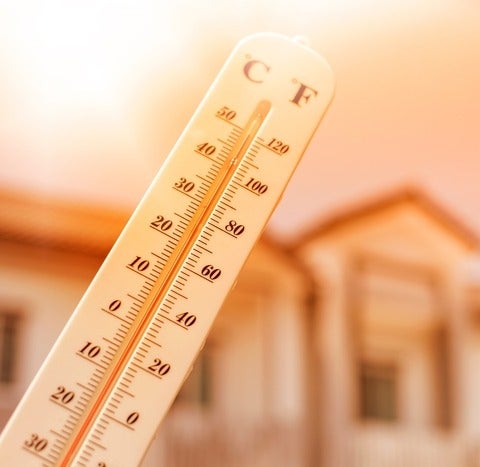
Preparing communities for extreme heat
New research led by the University of Waterloo Climate Institute is calling for urgent, equity-focused action to address public health risks from extreme heat.
Developed in partnership with Southwestern Public Health, A Policy Guide of Best Practices: Addressing Extreme Heat Through a Health Equity Lens brings together international research, Canadian case studies and regional expertise to help communities respond to one of the fastest growing climate risks.

New policy brief proposes harmonized sustainability reporting for the aviation industry
A new policy brief from the Waterloo Climate Institute led by Nesma Hassan and Prof. Amr ElAlfy is calling for a more consistent approach to airline sustainability reporting.
Aviation contributes significantly to climate change, and its emissions could triple by 2050 without stronger mitigation efforts. Airlines are facing growing pressure from regulators, investors, and the public to demonstrate credible sustainability performance, yet current reporting remains inconsistent and incomplete.
Events

Climate pedagogy across the curriculum: approaches for higher education
Join the Waterloo Climate Institute and partners for a hands-on interdisciplinary workshop to explore the what’s, why’s and how’s of climate emotions and climate pedagogy.