Current graduate students
Applications are now open for the Writing and Communication Centre's Dissertation Boot Camp program. Build a sustainable plan and make progress on your writing with Dissertation Boot Camp. This four-day program combines virtual workshops with individual writing time and individual consultations to help thesis and dissertation writers set goals and make progress in their work. DBC will take place over Microsoft Teams from May 9th
Speak Like a Scholar Applications are now open!
Interested in sustainable transportation in the Region of Waterloo? You're invited to participate in a discovery lab hosted by GreenHouse, the Geographies of Health in Place lab, and the Faculty of Environment. Join us to exchange ideas, identify unique challenges and opportunities in the Waterloo Region, and explore future opportunities for innovation.
Register at https://www.eventbrite.ca/e/the-future-of-sustainable-transportation-registration-311961153207 by May 20th. Limited quantity of tickets available.
The Vision Science Graduate Research Conference is an annual event that allows our graduate students to showcase their research. This year our Larkworthy Memorial keynote is Anne Dagg! Please visit our event page for more details.
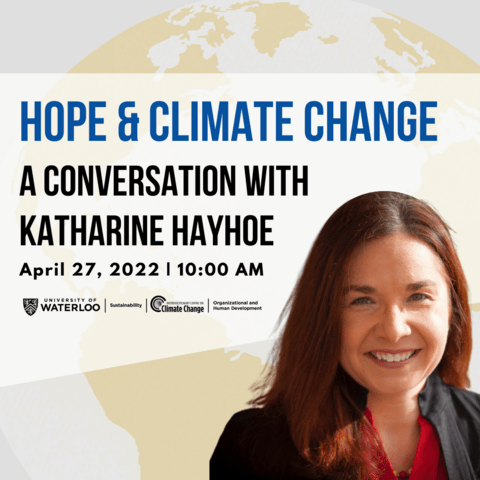
The science on climate change is clear – urgent action is required to deal with the increasing risks of a warming planet. So, what can we do? On April 27, join Professor Sarah Burch as she speaks with climate scientist Katharine Hayhoe, who The New York Times called “one of the nation's most effective communicators on climate change.” They’ll discuss strategies for scaling up individual and collective climate action, and how to navigate difficult conversations about our changing planet. They’ll also address your most pressing questions and weigh in on what we’re all wondering – is there hope?
Health system decision-making in a post COVID-19 Canada
The Office of Research is hosting the spring edition of Research Talks on Tuesday, April 26 from 12 - 1:30 p.m.
Guest speakers include: Helen Angus (Public Health Ontario), Dr. Sacha Bhatia (Ontario Health), John Hirdes (University of Waterloo), Anita Layton (University of Waterloo), David O’Toole (CIHI), Peter Wallace (Munk Institute of Global Affairs and Public Policy)
Building on the success and impact of a previous partnership, Print + Retail Solutions and the Office of Indigenous Relations have worked closely together to curate a new collection of Indigenous products in collaboration with a local Indigenous artist, Alanah Astehtsi Otsistohkwa (Morningstar) Jewell of Morningstar Designs.
Join us at noon on April 18th to celebrate the launch of this collection.
Refreshments will be served. Event is free and open to the Waterloo community.
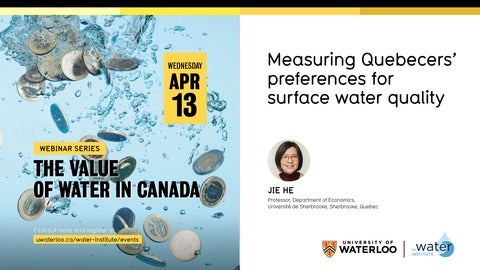
Measuring Quebecers' preferences for surface water quality
April 13, 2022 - 12:00 p.m. EST.
Jie He, Professor, Department of Economics, Université de Sherbrooke
Join us for a new webinar series highlighting state-of-the-art water valuation practices in Canada and identifying practitioners’ demand for information about the value of water.
The webinar series targets anyone from academia to non-government agencies and practitioners who are interested in better understanding the value of water in Canada from a broad social science perspective, and how this value is captured, acknowledged and integrated in Canadian water policy and decision-making.
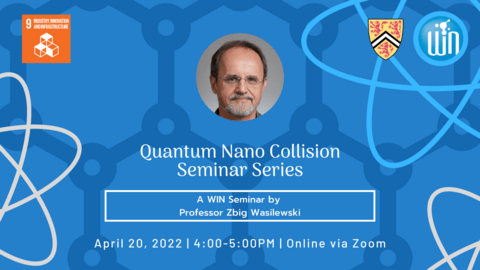
The Waterloo Institute for Nanotechnology (WIN) has launched a new seminar series, Quantum Nano Collision (QNC) Seminar Series, to deepen the engagement of the Waterloo researchers who work at the interface of quantum and nanotechnologies. This seminar series will also provide opportunities for senior graduate students, post-doctoral fellows, and research associates to present their innovative work along with the faculty members to bring together the excitement around these cutting-edge technologies that would shape our future.
The next talk for the QNC Seminar Series will be delivered by Professor Zbig Wasilewski.
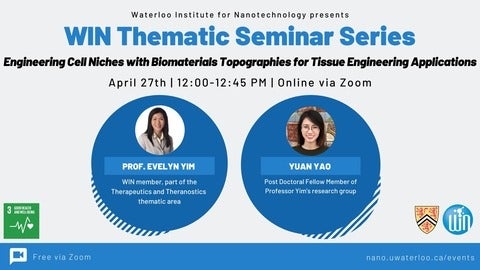
Cells interact with biochemical signals and biophysical signals, such as rigidity and topography, in their extracellular matrix microenvironment. An ideal scaffold for tissue engineering application should mimic the microenvironment and present the appropriate biochemical and biophysical cues such as topographies to regulate cellular responses. Our research group is interested in studying the interfacial interactions of cells with the extracellular substrate and how to apply this knowledge to stem cell differentiation and tissue engineering applications. In this presentation, strategies on engineering cell-materials interface, such as incorporating topographies on biomaterials for different application for vascular and corneal repair will be discussed.