Staff

Friday, April 17, 2026 12:00 pm - 5:00 pm EDT (GMT -04:00) Saturday, April 18, 2026 12:00 pm - 5:00 pm EDT (GMT -04:00) Wednesday, April 22, 2026 12:00 pm - 5:00 pm EDT (GMT -04:00) Thursday, April 23, 2026 12:00 pm - 5:00 pm EDT (GMT -04:00) Friday, April 24, 2026 12:00 pm - 5:00 pm EDT (GMT -04:00) Saturday, April 25, 2026 12:00 pm - 5:00 pm EDT (GMT -04:00) Wednesday, April 29, 2026 12:00 pm - 5:00 pm EDT (GMT -04:00) Thursday, April 30, 2026 12:00 pm - 5:00 pm EDT (GMT -04:00) Friday, May 1, 2026 12:00 pm - 5:00 pm EDT (GMT -04:00) Saturday, May 2, 2026 12:00 pm - 5:00 pm EDT (GMT -04:00)

Sandra Jabbour: MFA Thesis exhibition

Sandra Jabbour's MFA Thesis exhibition "Ahsan Hdeyeh 3ana" explores themes of memory, family dynamics, multilingualism, diaspora, and Jabbour’s relationship to her Syrian and Lebanese cultures. Notably, her paintings are infused with her personal interpretations of imagery drawn from her familial archive of VHS tapes from the late 90s and early 2000s.
Friday, May 1, 2026 2:00 pm - 4:30 pm EDT (GMT -04:00)

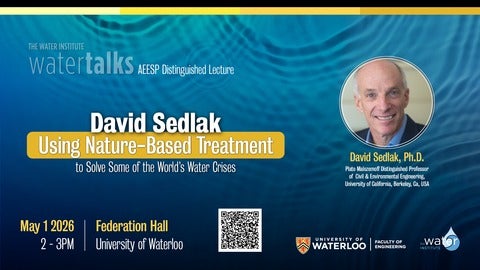
Using Nature-Based Treatment to Solve Some of the World’s Water Crises

The Water Institute and the Faculty of Engineering are pleased to present the 2025–26 AEESP Distinguished Lecture, Using Nature-Based Treatment to Solve Some of the World’s Water Crises, presented by David Sedlak, PhD, Plato Malozemoff Distinguished Professor of Civil and Environmental Engineering at the University of California, Berkeley.

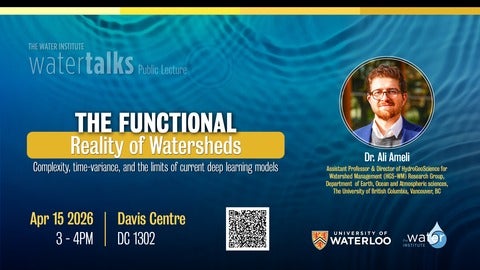
As part of the Water Institute's WaterTalks lecture series, Ali Ameli, Professor & Director of HydroGeoScience for Watershed Management (HGS-WM) Research Group, UBC, will present The functional reality of watersheds: Complexity, time-variance, and the limits of current deep learning models.

Wednesday, May 13, 2026 5:30 pm - 7:30 pm EDT (GMT -04:00)

Clara Hughes: Open Heart, Open Mind - Hallman Lecture

Clara Hughes, a six-time Olympic medalist and mental health advocate, shares her candid experience living with depression to inspire others to face their fears and find their voice. As the founding spokesperson for Bell Let's Talk, she explores the power of movement to change lives and emphasizes the importance of deep connection with oneself and others.

Monday, April 13, 2026 2:00 pm - 4:00 pm EDT (GMT -04:00)

Speaker Series: The English Does Not Tilt

Join us for a hybrid event with award‑winning Afrosurrealist and Afrofuturist storyteller Shingai Njeri Kagunda. Shingai will read from their essay “The Story is Not Yours” followed by a facilitated discussion.

Tuesday, May 5, 2026 7:00 pm - 9:00 pm EDT (GMT -04:00)

Trusting health care in the age of AI

Join the University of Waterloo and the Balsillie School of International Affairs (BSIA) for a timely conversation on health and AI. Together, we will explore how AI is changing everyday care, professional practice, and public confidence in medicine. 

Wednesday, May 13, 2026 11:30 am - 5:00 pm EDT (GMT -04:00)

From Particles to Markets: From Particles to Markets: Complex Systems Across Disciplines

The Waterloo Institute for Complexity & Innovation (WICI) is pleased to host Complexity Day, a cross‑disciplinary gathering exploring how complex systems thinking connects mathematics, physics, and economics.

Monday, April 27, 2026 2:00 pm - 4:00 pm EDT (GMT -04:00)

Campus living labs for climate learning and action in all disciplines

Join the Waterloo Climate Institute and our campus partners for a hands-on workshop to explore the what’s, why’s and how’s of using campus living labs for climate learning and action in any discipline. We’ll tour the campus to explore existing and potential opportunities for diverse disciplines, connect with Indigenous living lab initiatives and available resources and support from the Sustainability Office.

Monday, April 27, 2026 12:00 pm - 1:00 pm EDT (GMT -04:00)

CareNext Collective: AI‑empowered patients

Manulife presents CareNext Collective, a monthly virtual forum hosted by the CareNext Coalition.

A major shift is underway in health care: patients are increasingly turning to AI to make sense of symptoms, test results, and care options before they ever speak to a clinician. How should health systems respond?