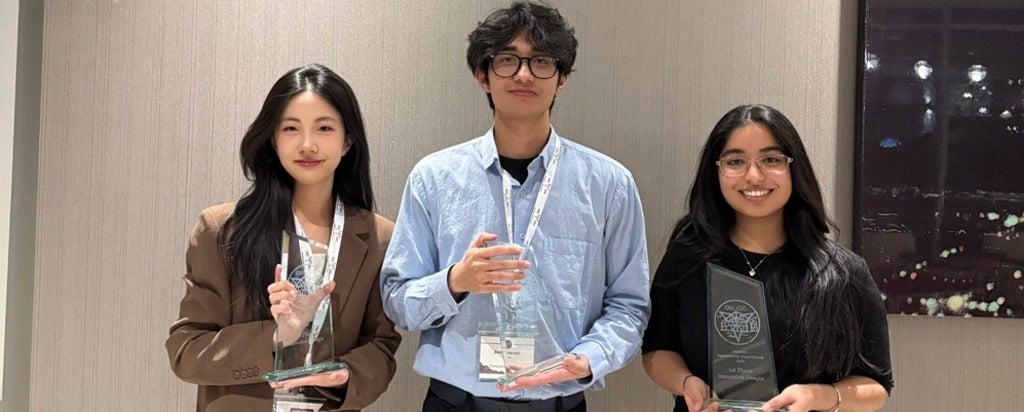
Student innovation sparks advancement in soft robotics
Nanotechnology engineering students Edward Hong and Micahel Ali were part of an interdisciplinary research group that has created a new tissue‑like hydrogel that can act as "muscles" for soft robotics.
The project was led by PhD candidate Negin Bouzari. Her supervisor, Hamed Shahsavan, a chemical engineering professor hired four undergraduate co-op students to assist Bouzari in her research. The team included Melanie Bouzanne, Nrushanth Suthaharan, Ali and Hong. Their collaboration embodies Waterloo’s mission to involve undergraduates directly in high‑impact, interdisciplinary research.
Shahsavan calls the work a powerful example of what students can accomplish when they’re trusted with ambitious challenges.
“Complex problems rarely fit inside one discipline. Interdisciplinary research brings complementary tools and viewpoints together, leading to creative, high-impact solutions,” says Hong. “Beyond innovation, working across disciplines improves communication skills and adaptability; abilities that are invaluable in both industry and academia.”