
From left to right: Flora Wu, San Basnet and Divhleen Ruprai
A nanotechnology engineering team won first place at the Ontario Engineering Competition (OEC) in Ottawa for their Capstone Project called IISense. The team designed a prototype to monitor chronic kidney disease (CKD).
The competition was fierce at the OEC which was held in Ottawa this year. Teammates Flora Wu, San Basnet, and Divhleen Ruprai entered the innovative design category at the event.
“The best part of OEC was that for the innovative design competition, we had to do a public opening. We displayed our poster and prototype, and people approached us and asked questions about our project. It was really cool to hear people’s perspectives on our product.” says Ruprai. “They provided feedback on things that we had not considered, which could improve our project to make it easier to use and accessible to different groups of people that we weren't aware of before.”
CKD is a silent disease that can have no obvious symptoms until a late stage and lead to the need for dialysis or, in some cases a kidney transplant. It can be more prevalent in people who have pre-existing health issues like diabetes or hypertension.
Current testing methods for CKD are a blood test known as the estimated glomerular filtration rate (eGFR) and a urine test for albumin which must be done in a hospital setting.
“Our project is called IISense because we are using dual biomarker and biofluid sensing. We are looking at two specific biomarkers, urea and glucose related to chronic kidney disease and how to monitor them for better day-to-day management for patients,” says Wu.” Our prototype is minimally invasive as it only takes the interstitial fluid, which is right under your skin but above your blood layer and sweat”
The team created a wearable device, like a wristband, which uses both microneedles and microfluidics and has an enzymatic sensor to test for the biomarkers of the disease.
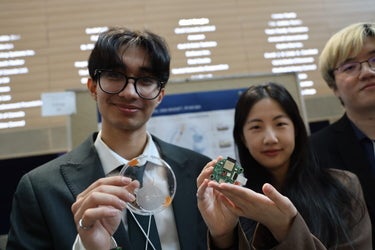
Basnet holding the microfluidics layer for fluid uptake, Wu holding electronics that measures biomarker concentrations in the fluids. Ma is on the right.
The interstitial fluid and sweat are collected in microfluidic channels to electrodes which produce byproducts that can be measured by a potentiostat and converted into a concentration. It’s akin to a glucose sensor for diabetes but for kidney health management.
The team brought skills acquired in their undergraduate co-op experiences to the project. Ruprai has a biology background and had co-ops in companies that produced vaccines. Basnet had co-ops that were related to data science management and Wu worked at a biomedical start-up and had experience with flexible electronics. The synergy of these skills was instrumental in creating this award‑winning project.
“We were shocked when they announced IISense won first place! I think we stood out because we did a lot of research, and we had a lot of faith in our product. And I think that's what you need for innovation. You need to have that mindset; you need to have the goal and the intention and to create a project that helps people. And I think that was very evident and that's where we stood out,” says Basnet.
The other team member, Ryan Ma could not attend the event. In an exciting update, the team placed third in the Canadian Engineering Competition.
Congratulations to this award-winning team!