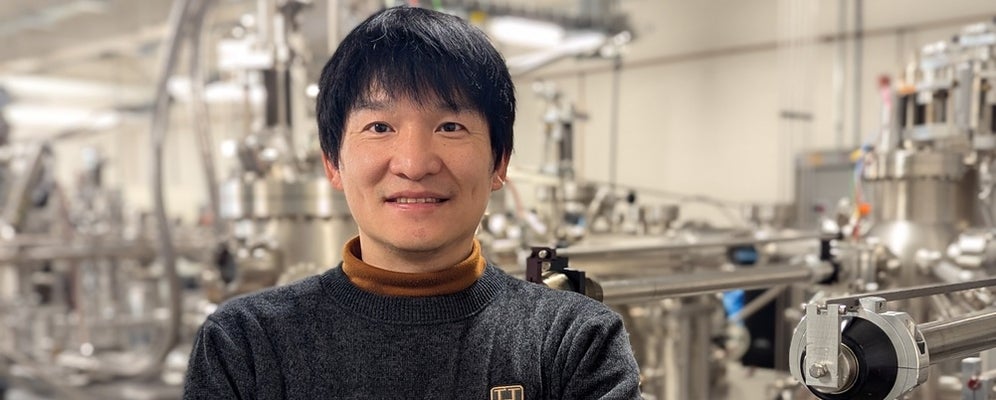
Professor Guo-Xing Miao, Director of the Nanotechnology Engineering Program has won the En-Hui Yang Research and Innovation Award. The En-Hui Yang Award is bestowed to an outstanding researcher in the University of Waterloo’s Faculty of Engineering annually.
Miao’s research focuses on the specific spin quantum properties in condensed matter platforms. The precise confinement, transport and manipulation of electrons and ions across nano materials and devices, enriched by their accompanied spin degrees of freedom, allows for advanced information processing in both the quantum and classic realms.
His team synthesizes industrial level quantum materials such as complex spin systems, ion platforms, topological phases, and superconductors—to mass fabricate scalable, wafer-level devices.
His innovation extends to a new company called SpinQ. Miao is one of the founders and science advisors of SpinQ. This company was founded in Waterloo, with all founding members deeply connected with the Institute for Quantum Computing.
SpinQ aims to bring compact, desktop quantum computers to high schools and elementary classrooms across the world. The desktop units are already available and can produce two or three qubits with full programming package extending beyond. The company is currently a quantum unicorn, valued at over 1B US dollars.
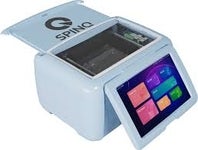
“The idea is that we are creating something tangible for students,” says Miao Director of the Applied Quantum Materials and Devices Lab. “They’ll be able to write their own programs, watch the computer run and observe the output.”
Quantum computing is a special kind of computing that uses highly coherent systems to do calculations. Its programming logic is fundamentally different from the classical sequential programming. Students can benefit from working with this type of computing from a young age.
“The aim is to get one in every classroom. Imagine what students could potentially do with it! What a difference would that make to their education,” says Miao. “Previously, quantum computing was probably only something you read about in sci-fi. Now students could access them in the classroom."
Classic or regular computers use bits which can be either 0 or 1,while a quantum computer uses qubits which can be 0 and 1 at the same time which is called superposition. This difference allows quantum computers to explore many possibilities in vast parallelism much faster than a normal computer.
In other words, a normal computer is set up to work step by step with a limited number of parallel tasks, like connecting multiple CPU cores or adopting GPUs and TPUs. Whereas a quantum computer can represent and process super positioned information all at once, allowing them to explore many solutions in parallel as a whole “concept” rather than checking each one individually.
Quantum computers typically need to be stored at very cold temperatures as they are highly sensitive to their environments. Thermal vibrations or electromagnetic interference can cause quantum states to collapse causing “decoherence.”
SpinQ uses the largely isolated therefore extremely stable nuclear spins for their quantum computing to get around the decoherence issues and allow the computers to be at room temperature so students can interact with this emerging technology. These desktop units are designed to have open and transparent enclosures so students can observe the inside of the computers.
“While it's true these minicomputers are limited in power due to the compact and room-temperature constraints, but they are true quantum computers,” says Miao.
Miao’s work at Waterloo is driving innovation to create new materials and devices aimed at enabling high-performance, energy-efficient information processing systems. Maio’s next journey in innovation is looking into the iontronic ways of creating artificial hardware brains another powerful non von Neumann architecture beyond our familiar digital implementations.