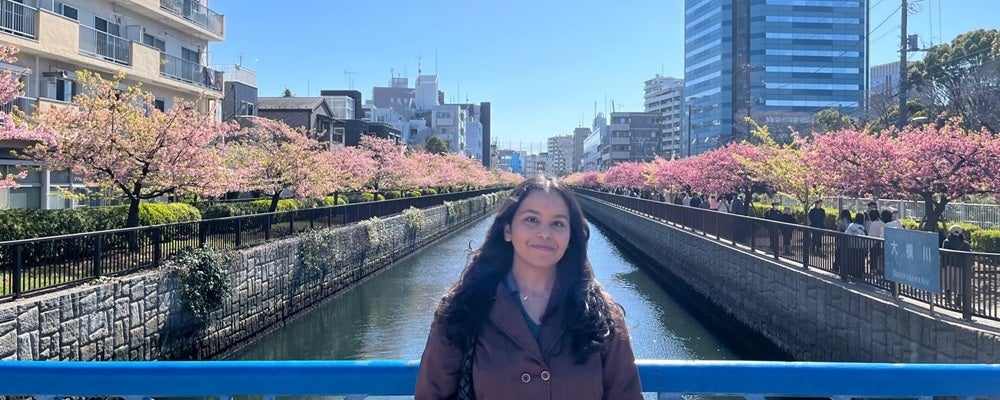
Aishia Siddiqui is a third-year Nanotechnology Engineering (NE) student. She was drawn to the program because it is interdisciplinary, meshing concepts from electrical and computer engineering, chemical engineering, chemistry and fundamental sciences that tie in with nanofabrication.
“The most exciting part of the program is the labs that bring our learning to life. You can learn the theory behind a subject at any point in your life, but what makes the NE Program special is how its hands-on labs help translate that knowledge into practical skills and co-op-ready experience,” says Siddiqui.
Siddiqui has had a varied and fascinating co-op experience. She did a co-op term at the Technology Innovation Institute in the United Arab Emirates in 2024, where she worked on developing proof-of-concept quantum climate sensing technologies and explored applications for small-scale sensing devices.
In 2025, Siddiqui worked at Kinectrics in Toronto in material testing with the nuclear division team.
“It was a great experience because I was learning about power plants across North America and Europe while analyzing data,” says Siddiqui. “My team was generating reports that directly informed the work being done at these facilities, so it felt rewarding to know our work was making a tangible impact. It was also meaningful to see how research translates into industry decision-making from a corporate perspective.”
Siddiqui’s most recent co-op was at Japan’s National Institute for Materials Science (NIMS) in Tsukuba. She took the initiative to reach out to the institute directly to secure the co-op placement.
At NIMS, Siddiqui joined the Super Molecules Research Group, which develops advanced sensing technologies. Her project focused on organic electrochemical transistors for bioelectronic sensing, with the goal of creating self-contained, durable sensors capable of long-term monitoring.
This was an eight-month co-op which allowed Siddiqui to see the development of the sensor from its inception.
Sensors currently used degrade over time, Siddiqui’s team aimed to engineer a simple sensor that could last for months or years. This was achieved by creating a self-contained ion gel-based organic electrochemical transistor.
“The experience provided valuable insight into how classroom theory and hands-on lab experience in the NE Program translates into device development and scientific innovation,” says Siddiqui. “My co-op work experience in semiconductor fabrication, sensor development, and materials science directly connected to coursework in nanofabrication, semiconductors, and materials engineering.”
For Siddiqui, working in Japan exposed her to a different research culture and work environment. At NIMS they often invited international speakers to run seminars for the researchers at the institution and Siddiqui was able to attend. A highlight of that co-op was attending a conference called Nanotech Japan where nanotechnology specific companies presented their work.
Siddiqui is looking forward to her third and fourth year in the NE program. She will start doing lab work in the clean room, exclusively dedicated to NE undergraduate students.
Her co-op journey has inspired Siddiqui to envision a future in research and development after graduation.