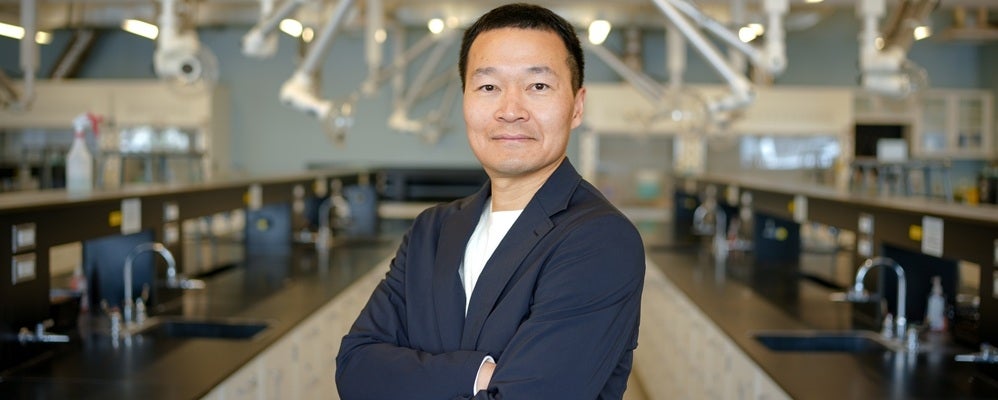
Nanotechnology Engineering professor, Juewen Liu has been awarded an $872,000 grant from the Canadian Institutes of Health Research (CIHR) to develop a more effective treatment for dry eye disease (DED).
Dry eye disease (DED) affects over a billion people each year and an estimated 30 percent of Canadians. The chronic condition occurs when people’s eyes do not produce enough tears to keep their eyes properly lubricated, leading to discomfort, irritation and potential vision problems.
Current treatments rely on eye drops that must be used multiple times a day at high doses. Much of the medication is quickly washed away, reducing its effectiveness and irritating healthy eye tissue. Liu’s research group aims to develop a longer lasting drug delivery system that could improve how DED is treated.
The research group developed aptamers which are DNA sequences that bind specifically to the cornea tissue. Under the new project, the team will identify aptamers that preferentially recognize corneal cells associated with dry eye disease while minimizing binding to healthy cells. Then attached them to liposomes, tiny nanoscale drug delivery carriers that deliver and protect medication. The system is designed to deliver lifitegrast,a drug commonly used to treat dry eye disease, directly to damaged areas of the cornea.
“Our preliminary studies in cells and animal models showed that these aptamer-targeted liposomes achieved the same therapeutic effect as the currently used system, but with longer eye retention and at about one-tenth of the dose,” says Liu a Canada Research Chair in Biosensors and Bionanotechnology. “Using a lower dose could improve the drug's safety by reducing the amount of medication required while maintaining its effectiveness.”
For patients, the treatment would be administered in the same way as conventional eye drops. The innovation lies in the drug delivery system, which is designed to keep the medication at the target site longer.
Previously, the study titled “Aptamer-functionalized liposomes for targeted delivery of drugs to treat dry eye disease" demonstrated proof of concept in animal corneas. The next phase of this research will focus on ensuring the aptamers target damaged human corneal cells while avoiding healthy cells.
The research group includes Dr. Heather Sheardown from the School of Biomedical Engineering at McMaster University and Dr. Lyndon Jones from the School of Optometry and Vision Science at the University of Waterloo.
The CIHR grant will enable the team to develop the first aptamer-conjugated liposome therapy for DED and generate preclinical evidence to support its progression to clinical trials.