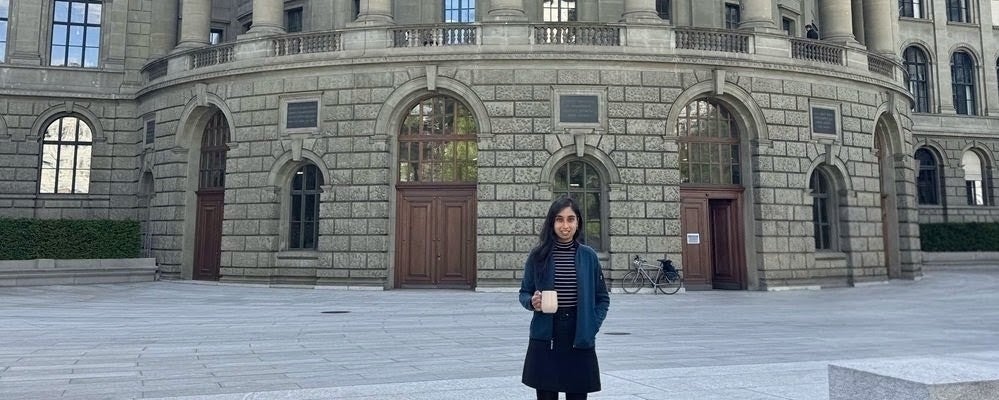
Manasa Kaniselvan (BASc ’19) is embarking on a journey as an incoming Assistant Professor at the Massachusetts Institute of Technology (MIT) with a shared appointment through the Schwarzman College of Computing in the departments of Materials Science and Engineering (DMSE) and Electrical Engineering and Computer Science (EECS).
At MIT, Kaniselvan will establish a research group focused on computational materials simulation and semiconductor device modelling. Her work uses machine learning to bridge length and time scales between materials behaviour and device performance.
Kaniselvan began her academic career in the Nanotechnology Engineering (NE) Program at the University of Waterloo and remained at Waterloo for a master’s in electrical and computer engineering. She is currently a PhD candidate at ETH Zurich, in the Computational Nanoelectronics group.
When considering her options for an undergraduate degree, Kaniselvan sought an interdisciplinary education at the intersection of science and engineering. She found the NE program to be a strong fit because of its broad curriculum spanning multiple scientific disciplines. She notes that the knowledge gained still informs her current research working with semiconductor devices, which are built at near-atomic dimensions. NE courses in semiconductor physics, microfabrication and nanoelectronics provided early exposure to the field.
“There is a rich set of phenomena occurring directly because of atomic-level differences in materials and interfaces, and as we miniaturize technology, understanding them becomes increasingly important. Emerging research uses quantum-level computational models to study how atomic structure influences material behaviour,” says Kaniselvan. “The Nano program primed me to be able to think about materials in this way.”
During her undergraduate studies, Kaniselvan completed several research-based co-op work terms. She began at Canadian Nuclear Laboratories, where she optimized sputtering parameters for metal thin-film deposition. She then completed a placement in Japan at the National Institute for Materials Science (NIMS), working on nanosensor development.
Kaniselvan also completed an eight-month co-op work term in Boston at SLIPS Technologies (now Adaptive Surface Technologies), where she worked with a team of formulations engineers to optimize coatings for industrial food containers.
She completed her final co-op at Waterloo, developing modelling code for quantum cascade lasers (QCLs) and comparing simulation results with experimental data.
“These initial experiences involved a lot of routine lab work, but it taught me how research really happens, all the trial-and-error that goes into it. That hands-on experience still grounds me today, because my current work requires bridging the gap between our understanding of physics, which we distill into clean simulations, and the messy experimental reality,” says Kaniselvan.
For Kaniselvan, the best part of the program was the people she met in her cohort.
“I made a lot of friends in Nano, and the co-ops and student design teams made our experience very rich both within and outside of class. I am still in touch with almost all of them,” says Kaniselvan. “We are now scattered around the world, but still meet up regularly, and sometimes cross paths in our professional lives.”
She credits co-op with helping her develop strong interpersonal skills and confidence.
“I went into the program as a shy first-year, but through co-op I learned how to make friends in multiple new cities, and how to maintain those friendships. The time I spent with friends and the confidence I gained as a result directly translated into my ability to build relationships in my professional life.”
Kaniselvan’s journey from Waterloo to MIT reflects the impact of an interdisciplinary education paired with hands-on experience.