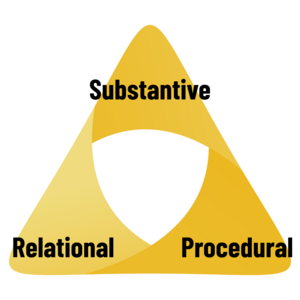
Fairness does not require an outcome you agree with. It refers to what transpires when a decision is made and is comprised of three main categories: Substantive fairness, Relational fairness, and Procedural fairness.
Substantive Fairness: what decision was made? what were the factual concerns?
Relational Fairness: how were you treated? were you provided an opportunity to participate? did you feel heard?
Procedural Fairness: how was a decision made? were you afforded opportunities that adhered to policy?
The Fairness Triangle framework was developed by Ombudsman Saskatchewan (see What is Fairness?, January 2019) and is based on the concept of the Satisfaction Triangle in Moore, Christopher (2003). The Mediation Process: Practical Strategies for Resolving Conflict (3rd ed.). San Francisco: Jossey-Bass Publishers.
How the Fairness Triangle is used
The Fairness Triangle is used widely by Ombudsperson Offices across Canada to help provide an understanding of what fairness is so individuals experiencing challenging situations can identify what type of unfairness they may be experiencing. By knowing the kind of unfairness experienced, pathways and options can be identified as ways to address, challenge, and resolve the unfairness.
However, there are limitations to the use of the Fairness Triangle. The Triangle cannot be used as evidence to support challenging a decision or action. The triangle simply gives a framework for you to understand what constitutes fairness.
You may find, when considering this framework and decisions or challenges you've faced, that while you disagree with the outcome of a situation, it becomes apparent it was fairly decided or that you were treated fairly throughout the process. This doesn't mean that your feelings are invalid or that you have to agree with the decision. It also doesn't mean that you cannot challenge a decision or outcome that you disagree with - it just means your options are different.
Equality, Equity, and Fairness
Equality, equity and fairness are interconnected concepts; however, they are not the same. While equality focuses on providing the same resources to everyone, equity focuses on distributing resources based on individual needs to achieve fairness. Fairness is the goal that both equality and equity strive to achieve.
Equality refers to providing everyone with the exact same services and resources. In many cases, providing the same services and resources proves to be the right solution. However, a student who has different needs may be disadvantaged when provided the same resources and services as their peers. In all classrooms across campus, all students are provided with the same desk and chair. This is an example of equality.
Equity involves recognizing that each individual has different circumstances and providing unique services, resources, and opportunities needed to reach an equal outcome as their peers. Some students may require more resources than others for their learning environment to be considered equitable. A student with a physical disability requires an alternative seating arrangement in classroom settings. Providing an alternative desk arrangement for this student is an example of equity.
Fairness ensures that all students get a desk and chair to participate in class, and those who have unique needs are provided with an appropriate desk, chair, or seating arrangement for their particular context.