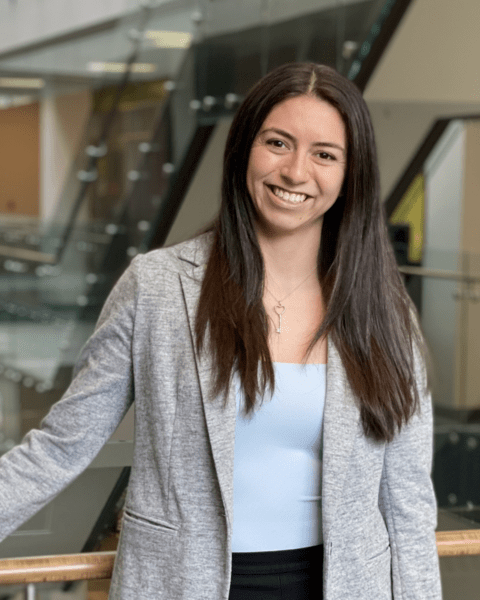
Mayank Garg develops minimally invasive wearable biosensing technologies that enable continuous, real-time monitoring of critical protein biomarkers such as insulin and cardiac troponin. By integrating microneedles, electrochemistry, and biomolecular engineering, his work advances personalized healthcare beyond single-point diagnostic testing.
Blog
Filter by:
Senanu Kwasi Kutor
Senanu Kwasi Kutor studies how climate adaptation strategies like Managed Retreat impact wellbeing, mobility, and community resilience in coastal Ghana. His work explores the psycho-social effects of climate change while centering equity, justice, and community-led perspectives.
Naila Ayala
Naila Ayala uses wearable sensors, machine learning, and neuroscience to study how pilots and other professionals acquire complex skills in high-stakes environments. Her work develops predictive tools that improve training, enhance safety, and address workforce challenges in aviation and beyond.
Lea Gassab
Lea Gassab bridges quantum physics, biology, and chemistry to explore how quantum effects in the brain contribute to protein damage linked to neurodegenerative diseases. Her work combines computer modeling with experimental biochemistry to uncover new insights into brain health and inspire future quantum technologies.
Irenius Konkor
Irenius Konkor’s research explores how social inequities and marginalization shape poor health outcomes, with the goal of informing more inclusive health service delivery. At Waterloo, his postdoctoral work examines the impacts of extreme heat on vulnerable populations, including immigrants and older adults in Canadian cities.
Kai Sands
Kai's work focuses on the synthesis and development of new hypervalent iodine (HVI) reagents and reaction conditions for the fluorination of electron-neutral and -rich (hetero)aromatic ring systems. By developing HVI reagents containing drug-like motifs, Kai explores the possibility of this methodology’s application in radiolabeling studies for the development of new PET tracers.