The morphology of river bedforms offers critical ecosystem services. Despite decades of thorough research, there remains significant disagreement and ambiguity around the conditions of morphology formation, such as the case of the pool-riffle. River scientists and engineers have generally described the pool-riffle as a reach-scale morphology, comprised of two unit-scale features; the pool and the riffle. Pools are energy-dissipating depressions in the bedform that often (but do not exclusively) occur in succession with riffles (Itsukushima, 2022). Riffle features are shallower, faster flow regions of higher sediment transport rates that are commonly identifiable by their exposed or near-surface coarse sediment (Thompson & MacVicar, 2022).
While these sequences are generally found in all types of channel patterns (e.g., straight, braided, and meandering rivers), their occurrence in meandering channels is considered more ubiquitous, with pools developing along bends in the channel, and riffles forming in channel straights (Rodríguez et al., 2013; Thompson & MacVicar, 2022).
Pool-riffle sequences have been classically defined as either ‘forced’ or ‘free-formed’ (Montgomery et al., 1995). A forced sequence is the induced formation of the bedform as a result of channel obstructions or bends that cause converging flow patterns and scour (Montgomery et al., 1995). In contrast, a free-formed pool-riffle is associated with naturally occurring cross-stream flow and sediment transport (Montgomery & Buffington, 1997). These features are regularly spaced, but are noted to rarely form when the gradient of the channel exceeds 0.02 (at which point, step-pool sequences become more frequently observed) (Florsheim, 1985). The ‘forced’ flow scenario for pool-riffle formation, as described by Montgomery and Buffington, has persisted in illustrative renderings of pool-riffles that are still commonly used in the literature. An interpretation of this conventional reach-scale description of pool-riffles is provided in the figure below.
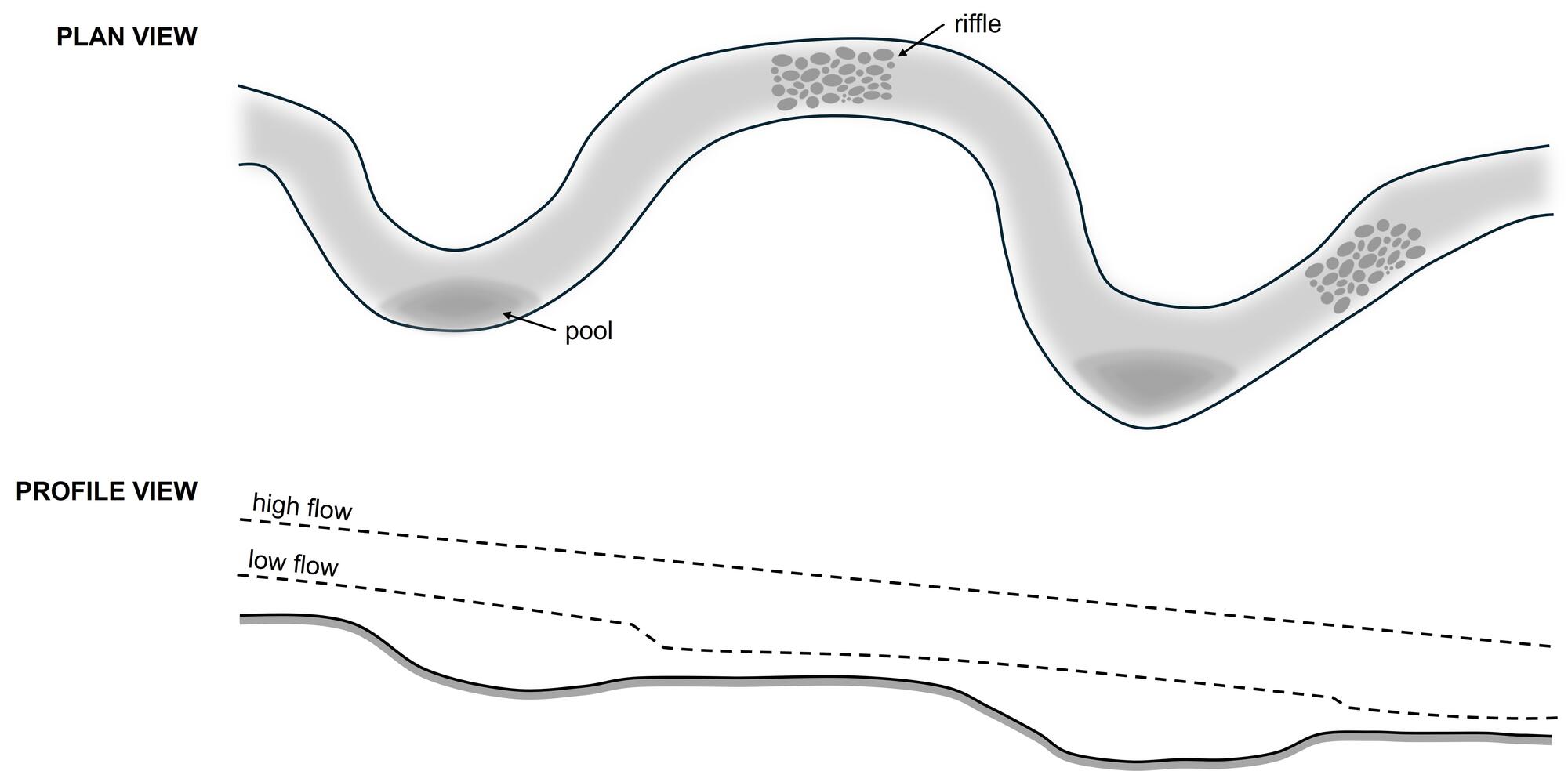
Figure 1: A plan view of a simple reach in a meandering river with pools forming along channel bends and riffles accumulating in the straights between bends. The corresponding profile view illustrates how low flows result in riffles appearing near the water surface, thereby more likely exhibiting fast and shallow (supercritical) flow conditions compared to the slow and deeper (subcritical) pools. Adapted from the definitions of Montgomery and Buffington (1997) and schematic from Dunne and Leopold (1998). Illustration by M.G. Chislett.
The common understanding of pool-riffles defers to their physical and observational description. However, the process-based explanations under which pools and riffles form, and more curiously, their requirement (or lack thereof) for collocation, remain contested in the literature. Further, the physical characterization of pool-riffles is a longstanding, one-dimensional description that neglects the stage-dependent patterns and self-maintenance that is more akin to a three-dimensional definition (Rodríguez et al., 2013). An increasingly common argument within this field of research is that the development of pool-riffle sequences, among other bedform morphologies, may be a case of equifinality; more than one pathway could achieve the same result (Buffington & Montgomery, 2013).
My research on this topic justifies the concept of a pool-riffle formation gradient. The possibility of equifinality has generated several new research questions. What mechanisms dictate that no two riffles are the same? How can the uniqueness of one riffle influence the attributes observed in downstream pools? Do step-pools exist in the theoretical pool-riffle formation gradient? What three-dimensional feedback mechanisms can possibly explain pool-riffle maintenance?
The hypothesis of a pool-riffle formation gradient poses significant value for river applications. Namely, process-based restoration can benefit from being able to predictably induce the formation of riffles for spawning habitat. The regional variability from a formation gradient can also inform restoration strategies to best align with the locally relevant flow and geographical conditions. Greater research effort to answer these many “unknown unknowns” is the next step in redefining the complex pool-riffle syndrome.
REFERENCES
Buffington, J. M., & Montgomery, D. R. (2013). 9.36 Geomorphic Classification of Rivers. In J. F. Shroder (Ed.), Treatise on Geomorphology (pp. 730–767). Academic Press. https://doi.org/10.1016/B978-0-12-374739-6.00263-3
Dunne, T., & Leopold, L. B. (1998). Water in environmental planning (15. print). Freeman.
Florsheim, J. L. (1985). Fluvial requirements for gravel bar formation in Northwestern California [Master’s thesis, Humboldt State University]. https://www.trrp.net/library/document?id=448
Itsukushima, R. (2022). Characteristics of streambed morphology at reach and unit scales in a sandstone-dominated headstream area of the Kantō Range. Limnology, 23(2), 309–325. https://doi.org/10.1007/s10201-021-00690-y
Montgomery, D. R., & Buffington, J. M. (1997). Channel-reach morphology in mountain drainage basins. Geological Society of America Bulletin, 109(5), 596–611. https://doi.org/10.1130/0016-7606(1997)109%3C0596:CRMIMD%3E2.3.CO;2
Montgomery, D. R., Buffington, J. M., Smith, R. D., Schmidt, K. M., & Pess, G. (1995). Pool Spacing in Forest Channels. Water Resources Research, 31(4), 1097–1105. https://doi.org/10.1029/94WR03285
Rodríguez, J. F., García, C. M., & García, M. H. (2013). Three‐dimensional flow in centered pool‐riffle sequences. Water Resources Research, 49(1), 202–215. https://doi.org/10.1029/2011WR011789
Thompson, D. M., & MacVicar, B. J. (2022). 6.30—Pool-Riffle. In J. (Jack) F. Shroder (Ed.), Treatise on Geomorphology (2nd ed., pp. 587–608). Academic Press. https://doi.org/10.1016/B978-0-12-409548-9.12087-1
