Balancing the scales: Sustainable groundwater use for a secure agricultural future

A WaterLeadership Snapshot
WaterLeadership Snapshots feature articles written by graduate students participating in the Water Institute’s WaterLeadership training program, which focuses on skills development in knowledge mobilization, leadership, and research communication. Here, students describe the value of their research and its potential for ‘real world’ impact.
By Boyao Tian
Groundwater plays an important role in global agriculture, sustaining crops that feed billions. But with rising populations and increasing food demands, this vital resource is under unprecedented pressure. By 2050, feeding the world’s projected population of 9.1 billion people will require a 70 per cent increase in food production compared to levels from 2005-2007. Without effective management, the future of farming—and food security—is at risk.
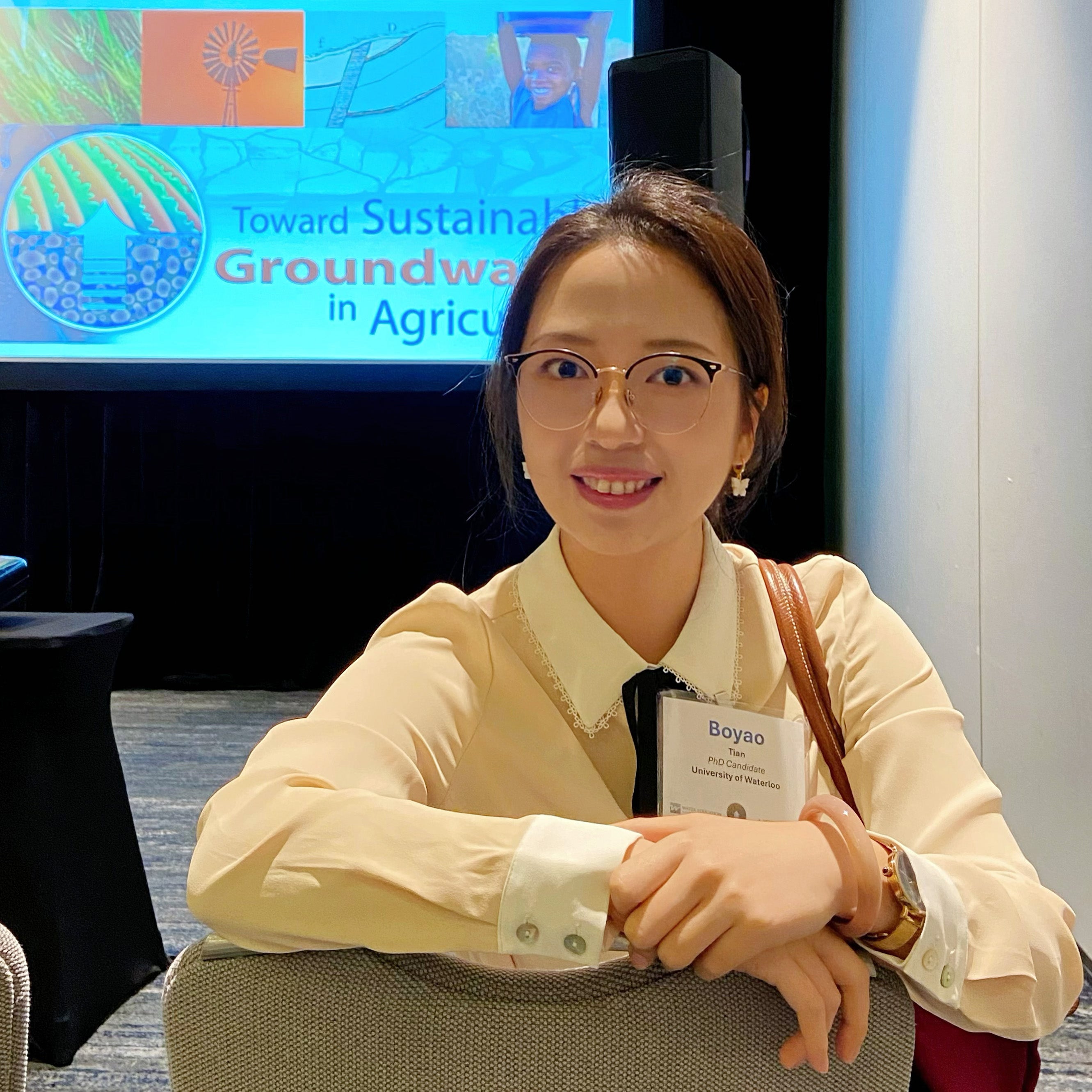
Working under the guidance of Dr. Andrea Brookfield, Boyao Tian is a PhD student investigating how farmers can use groundwater sustainably while maintaining economic viability. Her research focuses on creating a hydrologic-economic model tailored for critical agricultural regions, specifically the High Plains Aquifer in the U.S. and Canada’s Saskatchewan River Basin. These areas represent contrasting climates and groundwater conditions, making them ideal for studying diverse management strategies.
Boyao Tian, PhD student in Earth and Environmental Sciences
Farmers rely on water to grow crops, and using an irrigation system can often increase yields and income, though this isn’t always the case. However, irrigation can lead to the over-pumping of aquifers, depleting groundwater faster than it can recharge. This leaves less water available for future use. Adding to this challenge, climate change is altering precipitation patterns and temperatures, making water availability increasingly unpredictable. This work addresses these challenges by integrating environmental science and economics to guide farmers toward smarter irrigation practices.
Between 1990 and 2008, the High Plains Aquifer was responsible for 36 per cent of the total decline groundwater storage across the United States. Using Tian’s hydrologic-economic model, we can determine that a sustainable rate for groundwater taking from the High Plains Aquifer is 3,400 cubic meters per day. Maintaining these levels would allow for optimal benefits without exhausting the aquifer. Meanwhile in the Saskatchewan River Basin, using a daily combination of 400 cubic meters of groundwater and 200 cubic meters of surface water helps balance resource sustainability with economic benefits.
What sets this research apart is its focus on real-world uncertainties. By incorporating unpredictable factors like rainfall variability and fluctuating crop prices, the model provides farm-level recommendations that are not only sustainable but also economically resilient. It also includes Conditional Value-at-Risk, a method that helps farmers assess and understand economic risks, leading to more cautious and adaptable water use strategies.
The work is timely as climate change intensifies the pressure on farmers to adapt. By combining environmental and economic insights, this research offers a roadmap for sustainable groundwater management. It empowers farmers to safeguard their livelihoods while preserving this critical resource for future generations. This research aims to be a small but significant step aims to guide farmers, policymakers, and communities in securing water and food for years to come.
This work was supported by a University of Waterloo Water Institute Seed Grant and University of Waterloo Trailblazer Award.