Breaking down barriers to better water data
As pressures on water systems continue to grow, accessible and interoperable data will be increasingly important for turning observations into knowledge, supporting informed decisions and developing solutions that can be used across regions and scales.
More than 120 members of the global water community came together on October 1 for an international webinar exploring how organizations can make hydrological data easier to discover, access, share and reuse across different systems and jurisdictions.
The webinar, “Unlocking the Power of Hydrological Data: Empowering People, Enabling Applications, Informing Policy, and Protecting the Environment,” was organized by the World Meteorological Organization (WMO) in collaboration with the University of Waterloo’s Water Institute, Global Water Futures Observatory, DataStream, the Consortium of Universities for the Advancement of Hydrologic Science (CUAHSI) and government partners.
The event was moderated by Philippe Van Cappellen, Professor and Canada Excellence Research Chair Laureate in Ecohydrology and lead of the Waterloo Global Water Futures Observatory team.
The WMO is the United Nations system’s authoritative voice on weather, climate and water. It supports countries in sharing observations, knowledge and technical expertise to strengthen weather, climate and hydrological services and help communities better manage environmental risks.
A key focus of the webinar was the WMO Hydrological Observing System (WHOS) and its approach to data interoperability. Participants heard how a brokering approach can help connect data systems that use different formats, standards and technologies. Rather than requiring every data provider to completely change its existing system, a middle-layer broker can translate between different systems, enabling data to be discovered, accessed and used through a common framework.
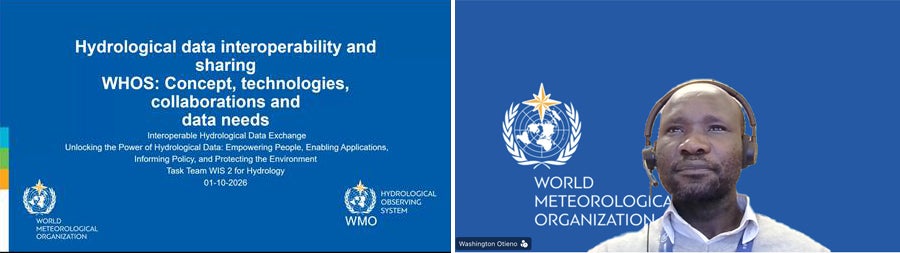
Photo: Washington Otieno, Scientific Officer│Hydrological Monitoring and Data Management Section│Hydrology and Cryosphere Division │Earth System Data and Prediction (ESDP) Department, World Meteorological Organization, Geneva, Switzerland.
Participants were given demonstrations of how this approach can work in practice, including examples of data discovery and access through WHOS, as well as applications involving DataStream and HydroShare. The demonstrations illustrated how interoperability can reduce some of the technical barriers that can make it difficult to share and reuse hydrological information.
The webinar also brought an operational perspective to the discussion. Environment and Climate Change Canada (ECCC) shared reflections on the role that data brokering could play within Canada’s hydrological data framework, helping to connect national systems and approaches with broader international efforts.
Across the presentations and discussion, participants recognized the value of improving interoperability and strengthening connections between research, operational and government communities. The conversation highlighted that better data exchange is not only a technical challenge, but also one that benefits from shared standards, collaboration and practical approaches that can work across organizations.
The webinar provided an opportunity to build connections across the global water community and advance practical approaches to more open and interoperable hydrological data.
Missed the webinar? A recording is available here.
