Changing water levels can accelerate the cleanup of petroleum-contaminated soils
New research shows fluctuating water tables can accelerate contaminant breakdown
Old petroleum spills can continue to contaminate soil and groundwater for decades, making remediation slow, costly and difficult to predict. New research from the Ecohydrology Research Group shows that a natural process, the rise and fall of the water table, can significantly influence how quickly petroleum contaminants breakdown.
The study, “Effects of water table fluctuations on naphthalene degradation: Soil column experiment and modeling,” was recently highlighted in a CSA News Science Brief. Published in the Vadose Zone Journal, the research examines how fluctuating water tables affect the breakdown of petroleum contaminants.
Putting fluctuating water tables to the test
To investigate how changing water levels affect petroleum hydrocarbon degradation, researchers conducted a 300-day laboratory experiment using eight columns filled with petroleum contaminated soil. Four columns underwent repeated cycles of drainage and rewetting to simulate a fluctuating water table, while four remained saturated to represent stable conditions.
The difference was significant. Soils exposed to fluctuating water levels removed more than 91 per cent of the contamination, compared with approximately 60 per cent under stable conditions.
The researchers found that oxygen was a key driver. As the water table dropped, air entered the soil, increasing oxygen availability and supporting aerobic microbial activity. When the water table rose again, conditions became more oxygen limited, promoting anaerobic processes. These repeated shifts accelerated the breakdown of naphthalene and other organic compounds.
Faster degradation, but an environmental trade-off
The study also highlights an important trade-off. While fluctuating water tables accelerated contaminant degradation, they also increased greenhouse gas emissions. Cumulative carbon dioxide and methane emissions were approximately twice as high under fluctuating conditions.
A reactive transport model developed alongside the experiment successfully reproduced the main patterns observed in the laboratory, providing a framework for investigating how these processes may behave at contaminated sites under changing hydrological conditions.
The findings suggest that water table fluctuations should be considered an active factor in contaminated site management, rather than simply background variability. Understanding the connections between hydrology, microbial activity, contaminant degradation and greenhouse gas production could help improve environmental risk assessments and inform more effective remediation strategies.
The study was coauthored by Mehdi Ramezanzadeh, Stephanie Slowinski, Jane Ye, Marianne Vandergriendt and Water Institute researchers Fereidoun Rezanezhad, Philippe Van Cappellen, David Rudolph and Neil Thomson.
Read the CSA News Science Brief.
Read the full research article.
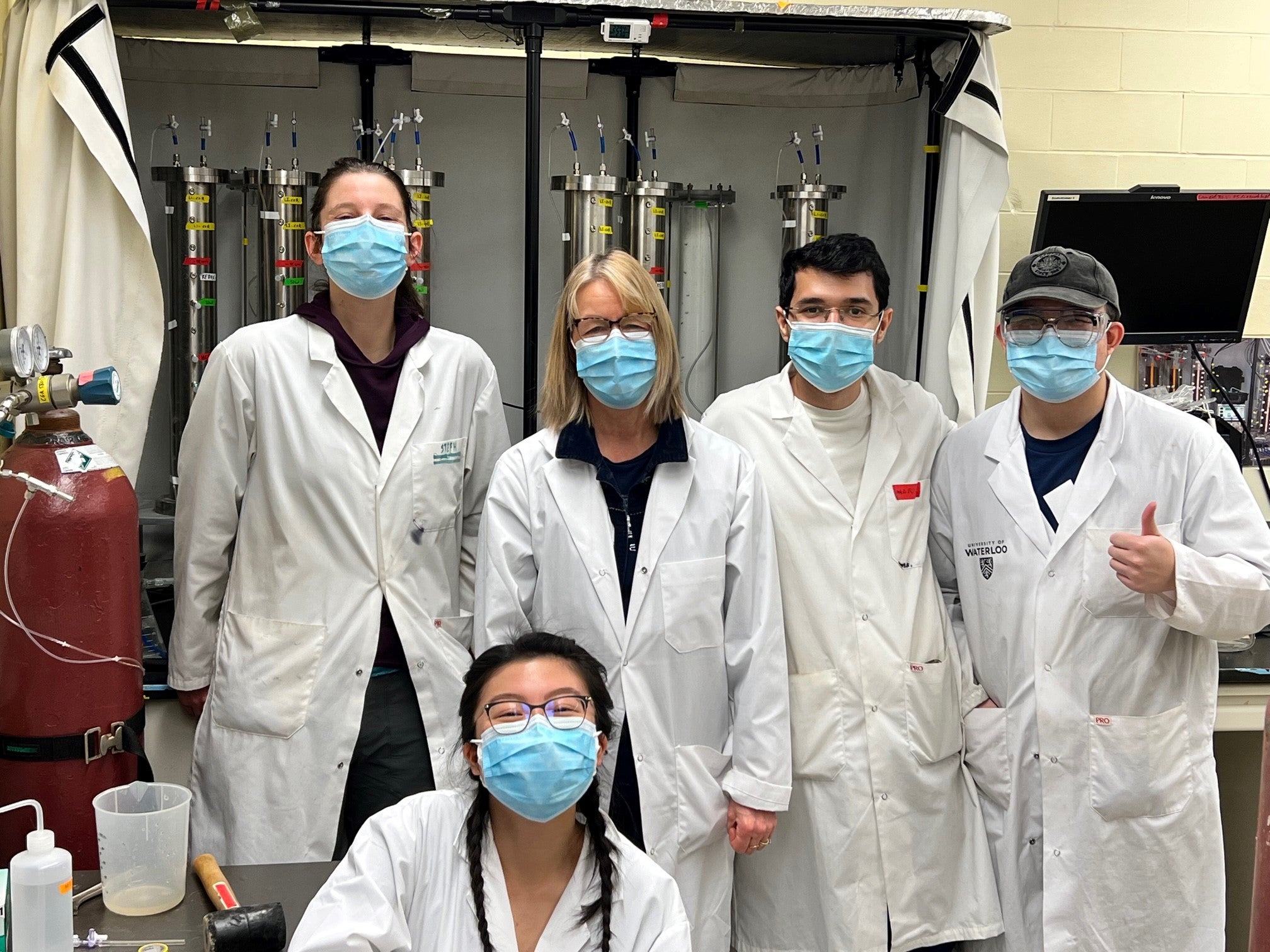
Photo: LtoR Stephanie Slowinski, Marianne Vandergriendt, Mehdi Ramezanzadeh, Richard Dinh Pham. Front: Jane Ye.
Banner Photo: Stainless steel soil column setup equipped with moisture, temperature and redox sensors, along with water and gas samplers. Photo courtesy of Fereidoun Rezanezhad.