Freshwater virus challenges biology’s rules
A virus that infects harmful freshwater cyanobacteria is challenging one of biology’s most fundamental assumptions about the difference between viruses and living cells.
Published in The ISME Journal, new research reveals that the jumbo cyanophage PhiMa05 carries the largest set of ribosomal protein genes ever found in a virus. The discovery is prompting scientists to rethink how viruses evolve and where the line between viral and cellular life truly lies.
For decades, scientists believed viruses and cells were completely different, with ribosomal genes serving as one of the clearest dividing lines. Ribosomes are the cell’s protein-making machinery, responsible for translating genetic instructions into the proteins needed for life.
Until recently, no viruses were known to carry genes for ribosomal proteins. That assumption began to erode as a small number of viruses were found with one to three such genes. PhiMa05 now pushes that boundary even further.

The study, co-authored by Isaac Meza-Padilla and Water Institute members Dr. Jozef Nissimov and Dr. Kirsten Müller, shows that PhiMa05 carries six ribosomal protein genes and two additional genes involved in ribosome formation. It is the first cyanophage known to encode ribosomal proteins and the most complete set identified in any virus to date.
"Our study re-emphasizes the fact that viruses are so much more than just mediators of disease," says Nissimov.
"In our field of research, for years the giant viruses that infect eukaryotes like amoeba and algae were the ones catching most of the spotlight. Today we see that viruses of bacteria, and specifically those that infect toxic species, are as fascinating. Given that cyanobacteria were crucial for oxygenising Earth, viruses, such as the ones we report here, and we study in our lab, likely played very important roles in shaping life, the result of which is what we see today."
Photo: Authors (Top) Isaac Meza-Padilla, PhD candidate, Department of Biology, (Bottom left) Dr. Jozef Nissimov, Professor, Department of Biology and (Bottom right) Dr. Kirsten Müller, Biology Professor and Associate Vice-President, Research Grants and Infrastructure.
While analysing genomes of viruses that infect cyanobacteria, also known as cyanophages, the researchers also found evidence that PhiMa05 may have transferred some of its ribosomal genes into a group of non-photosynthetic cyanobacteria.
In some cases, these viral-origin genes appear to be the only remaining copies in host genomes, suggesting that certain organisms may now rely on genetic material first acquired from a virus to produce proteins and sustain essential biological functions.
These findings indicate that viruses may play a far greater role in shaping cellular evolution than previously understood, not only carrying genes once thought exclusive to cells, but potentially embedding them into the long-term biology of their hosts.
“During biological research, we often find clues that remind us that life is a continuum,” says Meza-Padilla. “PhiMa05 blurs the divide between viruses and cells as never before, supporting the continuous nature of virus-host systems. It would be fantastic to study more PhiMa05-like viruses in nature—there is still so much fascinating biology to discover!”
Beyond evolutionary biology, the discovery has potential implications for freshwater management.
PhiMa05 infects and kills Microcystis, a group of cyanobacteria responsible for toxic harmful algal blooms in lakes and reservoirs. These blooms can threaten drinking water supplies, disrupt aquatic ecosystems, limit recreation and create significant costs for water treatment and management.
Because PhiMa05 naturally targets these bloom-forming organisms, it could serve as both a model system for studying viral ribosomal genes and a potential tool for understanding or eventually managing harmful algal blooms. However, researchers caution that more work is needed to understand how the virus behaves in natural freshwater environments.
The findings, published in The ISME Journal under the title “A jumbo cyanophage encodes the most comprehensive ribosomal protein set in the known virosphere,” highlight the complex relationships between viruses and their hosts while raising a fundamental question that remains unresolved: what exactly is a virus?
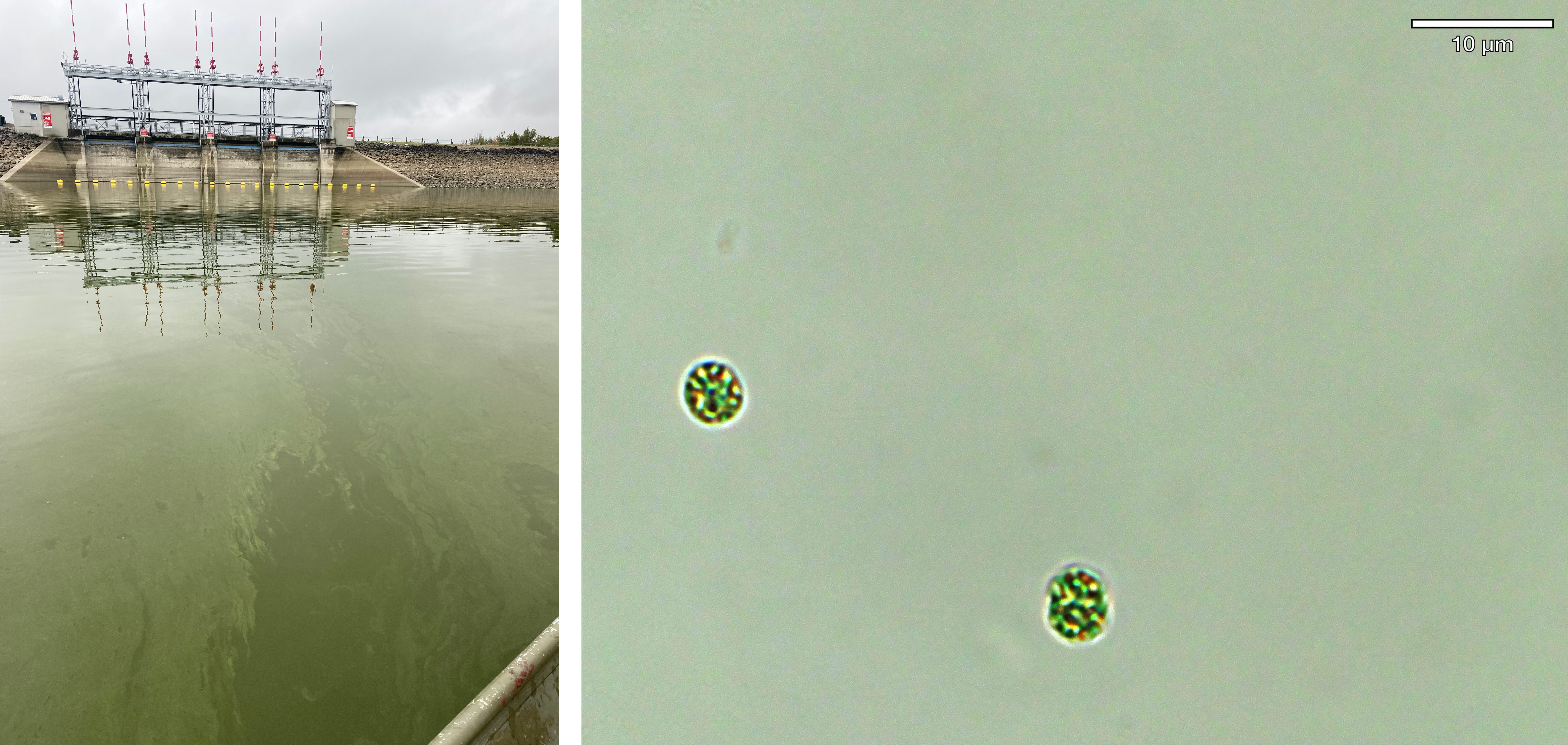
Banner photo: Microcystis bloom by PhD student Cody Collis. Bottom (R): Toxic Microcystis cells infected by a cyanophage courtesy of Isaac Meza-Padilla.