Meet Nibi: Waterloo’s newest supercomputer supporting next-gen research
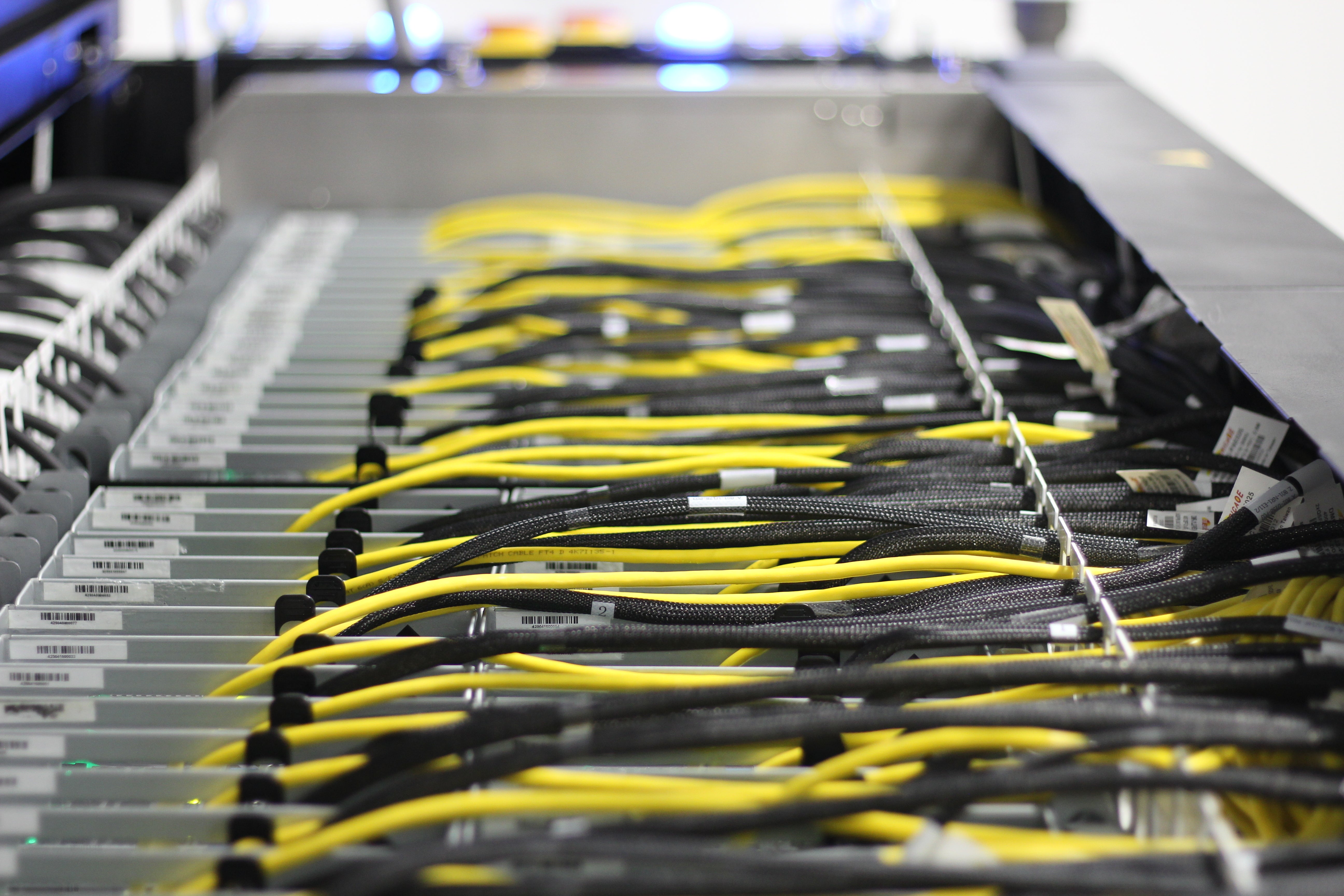
Banner photo by Sam Charles
From modelling floods and droughts to managing watersheds and tracking climate change, today’s environmental challenges require faster, more powerful computing. Now, researchers at the University of Waterloo and across Canada have a new tool to help solve them: Nibi, Waterloo’s newest high-performance supercomputer.
Located in the basement of the Mathematics and Computer (MC) building, Nibi marks a transformative step forward in research computing at Waterloo. Powered by $50 million in funding supported by Innovation, Science and Economic Development Canada through the Digital Research Alliance of Canada, and the Ministry of Colleges, Universities, Research Excellence and Security through Compute Ontario, Nibi delivers four times the performance of its predecessor, Graham.
Researchers now have access to a dramatically improved user experience, with all-flash storage, expanded compute and service resources, and tightly coupled GPUs designed to accelerate advanced modelling and simulation. With this cutting-edge infrastructure, Waterloo researchers can tackle larger, more complex challenges, driving innovation at a speed and scale that smaller systems simply can’t match.
The name Nibi, meaning water in Anishinaabemowin (Ojibwe), reflects both the system’s advanced liquid-cooling design and the deep significance of water in our lives. Nibi is also Canada’s first immersion-cooled supercomputer, where CPUs are housed in immersion tanks and GPUs are cooled with direct liquid cooling. This dramatically improves energy efficiency by capturing nearly all the system’s heat and recycling it to warm the Mike and Ophelia Lazaridis Quantum-Nano Centre (QNC) building. A closed-loop water system further reduces environmental impact, making Nibi a leader in sustainable high-performance computing.
Nibi is part of SHARCNET Canada’s largest high-performance computing (HPC) consortium by number of participating institutions. SHARCNET connects 19 academic institutions across Ontario to advance cutting-edge computational research, foster academic-industry partnerships, and attract top talent.
“By deploying Canada’s first Granite Rapids HPC cluster in immersion and integrating heat reuse, we’re not just pushing the boundaries of high-performance computing, we are setting a new benchmark for sustainable research infrastructure,” said John Morton, Director of Technology at SHARCNET. “This proves that cutting-edge performance and environmental responsibility can go hand in hand.”
Researchers can now begin using Nibi by creating a free account through the Alliance network. All services, including up to 40 terabytes of storage, are free to academic users. For convenience, users can debug and test small nodes independently, without having to wait in a queue. This accessibility, combined with Nibi’s world-class computing power and energy-efficient design, makes it a significant resource for advancing water, climate, and environmental research and much more.
Learn more and create an account today: https://ccdb.alliancecan.ca/