New parliamentary report highlights Water Institute expertise in shaping Canada's freshwater future
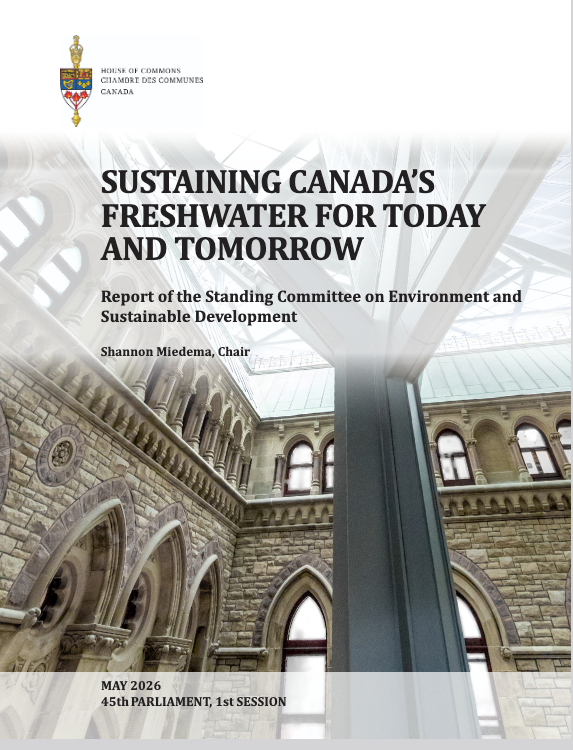
The House of Commons Standing Committee on Environment and Sustainable Development's newly released report, Sustaining Canada's Freshwater for Today and Tomorrow, outlines recommendations to strengthen Canada's freshwater future, informed by testimony from leading researchers and experts across the country.
Among those invited to testify and cited in the report was Dr. Roy Brouwer, Professor in the School of Economics and former Executive Director of the Water Institute at the University of Waterloo, who testified on the socioeconomic values of freshwater use in Canada.
Brouwer shared evidence on water use, exploitation and waste of our valuable freshwater resources, highlighting the need for improved data collection on water use, awareness-raising and financial incentives to promote more sustainable water use and management.
He also addressed one of Canada's most prominent water challenges: aging infrastructure and the lack of a sustainable business model to finance the necessary infrastructure investments. He noted that “In 2021, losses from the water distribution systems due to leaking accounted for 17 per cent of all water produced in Canada. This is 828 million cubic metres of potable water, enough to meet the needs of 10 million Canadians for a whole year.” Some cities experienced even higher rates of loss, including Montreal at 24 per cent.
This testimony demonstrates knowledge mobilization in action, with Water Institute expertise informing discussions at the highest levels of federal decision-making. By bringing research evidence on water use, infrastructure challenges and socioeconomic impacts directly to policymakers, Dr. Brouwer helped ensure that academic knowledge could contribute to practical solutions.
In response to issues raised during Dr. Brouwer's testimony, the Committee recommended that the Government of Canada establish a fund through the Federation of Canadian Municipalities for water system diagnostics to assist municipalities in better detecting system leaks and other weaknesses before failures occur, demonstrating the potential policy impact of evidence-informed research.
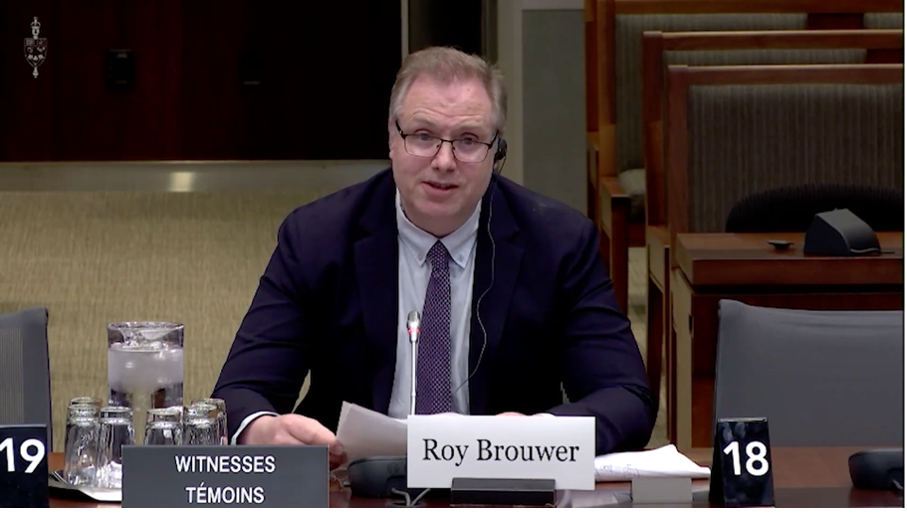
Dr. Roy Brouwer, Professor of Economics and former Water Institute Executive Director, testifying before the House of Commons’ Standing Committee on Environment and Sustainable Development.
Many of the report's recommendations, including greater investment in freshwater research, recognizing the importance of wetlands and the value of groundwater, improved monitoring and data, watershed-based management, and technology innovation, reflect the collaborative, evidence-based approach of the Water Institute. They also reinforce the important role Canadian universities and research institutes play in generating the knowledge and expertise needed to inform policy, support communities and protect freshwater resources.
The report further recognizes the importance of strengthening Canada's research capacity, recommending: “That the Government of Canada actively support Canadian academic institutions that wish to consolidate and increase Canada's scientific knowledge and professional expertise in water management.”
By bringing together experts from across disciplines and working with governments, communities and industry, the Water Institute helps ensure research doesn't stay in the lab but translates into practical solutions with real-world impact. As Canada moves to implement the report's recommendations, the Water Institute will continue connecting research, expertise and people to help protect freshwater resources and build a more resilient future.
Read the report: Sustaining Canada's Freshwater for Today and Tomorrow
Photo:House of Commons Sustaining Canada's Freshwater for Today and Tomorrow Report Cover