Peatlands & wetlands knowledge exchange: Connecting Canada and Ireland on wetland climate solutions
Researchers from Ireland, Canada, and the United States gathered in Waterloo on November 27–28 for a two-day workshop focused on nature-based climate solutions: peatlands and wetlands. Hosted by the SOLUTIONSCAPES project, led by Nandita Basu, Professor at the University of Waterloo and Canada Research Chair in Global Water Sustainability and EcoHydrology, the event invited scientists, engineers, and emerging researchers to exchange ideas on hydrology, greenhouse gas dynamics, wetland and peatland restoration practices, and geospatial techniques that can guide climate-smart land management across continents.
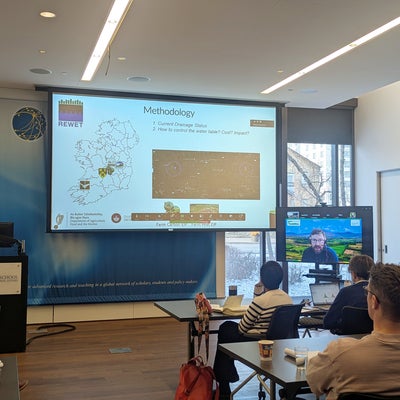
The workshop opened with an Irish-led deep dive into the challenges and opportunities of rewetting agricultural peat soils, shared by Owen Fenton, Principal Research Officer for Teagasc. Ireland has set an ambitious national goal to rewet 80,000 hectares of drained peat grasslands, a task that requires better data, stronger engagement with farmers, and cross-sector collaboration. Presenters from Teagasc, the University of Galway, Munster Technological University, and Trinity College Dublin shared the complexity of this work through several initiatives, including the ReWet, Farm Carbon / FarmPEAT EIP, D-TECT, and ASPEN projects. Together, these efforts explore how to identify where rewetting is most feasible, how to understand water table dynamics, how microbial processes respond when drained soils are rewetted, and how restoration affects greenhouse gas emissions.
Dave O’Leary and Hilary Pierce, researchers from the University of Galway, described their efforts to create “living labs” on working farms, combining peat depth measurements, soil chemistry, radiometric mapping, and farmer input to understand how rewetting can work at field, farm, and national scales. The discussions highlighted a core challenge: small changes in water table depth, in the range of just 20–30 centimeters, can fundamentally shift carbon cycling, methane emissions, and microbial activity. This sensitivity underscores the need for site-specific data and careful hydrologic mapping and management when designing restoration programs.
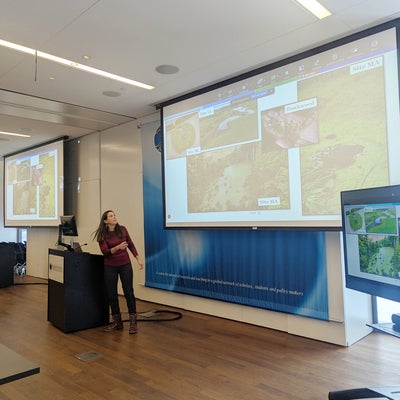
Geospatial innovation was also featured strongly at the workshop, with presentations from Dave O’Leary, Charmain Cruz, Eoin Reddin, Inam Bari, and Eoin McCarthy on radiometric mapping and drone-based drainage surveys that are helping Ireland refine its national peatland inventory. These tools are now being tested in Canada, opening new possibilities for international methodological alignment.
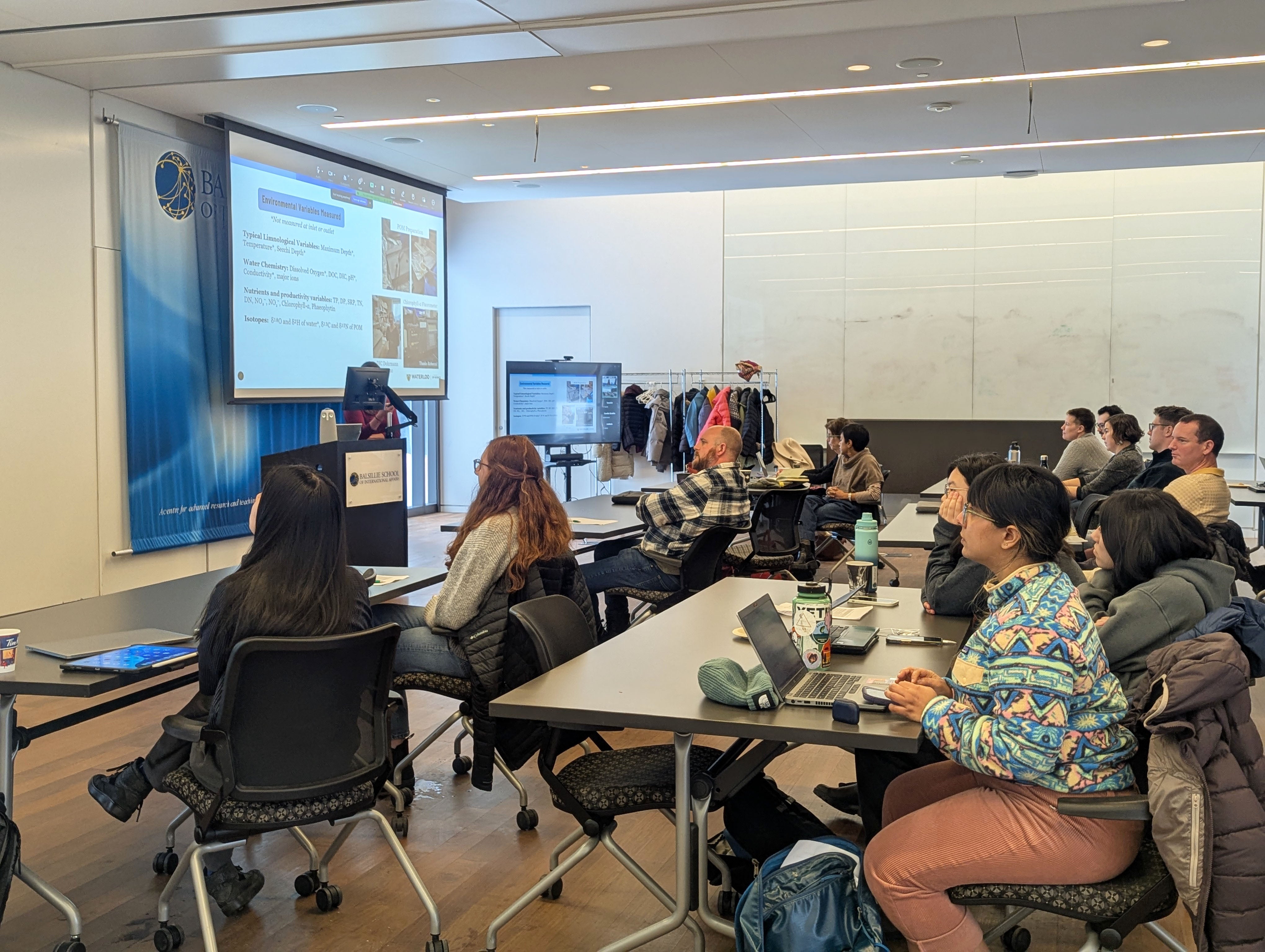
Day two shifted to North American presentations from the University of Waterloo and Penn State University, drawing on research using field studies and data modelling approaches to examine wetland and peatland systems, greenhouse gas dynamics, and carbon sequestration. Nandita Basu, Maria Strack, Tonya DelSontro, and Kim Van Meter, highlighted Can-Peat and SOLUTIONSCAPES projects, as well as other initiatives from Canada and the United States.
Principal Investigator of the Can-Peat project, Maria Strack outlined Canada’s peatland landscape and climate responsibilities. With approximately 120 million hectares of peatlands, home to an estimated 150–160 billion tonnes of carbon, Canada plays a globally significant stewardship role. Strack discussed national coordination efforts toward peatland research networks and improved carbon stock maps, emphasizing that avoiding new peatland disturbance remains one of the country’s largest climate opportunities.
The discussion shifted from peatlands to mineral wetlands, with SOLUTIONSCAPES GHG Lead Tonya DelSontro presenting insights on GHG emissions and carbon balance based on fieldwork from eight agricultural wetlands across Southern Ontario. Empirical insights were complemented by process modelling, with Gordon McNicol, Postdoctoral Fellow from Applied Math and co-supervised by Anita Layton and Nandita Basu presenting results from a process-based model linking hydrology to methane dynamics, illustrating how modelling approaches can complement field-based studies and inform adaptive wetland management.
Finally, SOLITIONSCAPES collaborator Kim Van Meter, from Penn State University (US), shared findings on using satellite data to identify opportunity spots for wetland restoration to improve water quality without compromising productivity, using examples from wetlands in Iowa’s Prairie Pothole Region.
Drawing on data from the same region, lightning talks from University of Waterloo PhD and Master’s researchers added energy to the workshop, highlighting new work on swamp carbon budgets, agricultural peat emissions, seismic line restoration co-developed with Indigenous communities, and trade-offs between carbon sequestration and greenhouse gas emissions in restored wetlands.
Across all sessions, a common message emerged: Peatland and wetland restoration is both scientifically intricate and deeply social. It requires hydrologic expertise, microbial insight, geospatial innovation, policy alignment, and above all—collaboration between researchers, communities, farmers, and policymakers.
By the end of the SOLUTIONSCAPES workshop, new connections had formed, shared challenges had been articulated, and participants left with a clearer sense of how cross-Atlantic collaboration can accelerate progress in scientific research and restoration efforts. As climate pressures intensify, the knowledge exchanged in Waterloo will help guide more effective, equitable, and evidence-based peatland and wetland stewardship across Canada, Ireland, and beyond.
This workshop was supported by the SOLUTIONSCAPES project, a multidimensional climate solutions project at the nexus of nature, food, and water. The project works to support Canada’s ability to transition to a net-zero future, while improving water quality, ecosystem integrity and human well-being.