The secret life of stormwater ponds
Understanding groundwater exchange to support resilient urban climate design

A WaterLeadership Snapshot
WaterLeadership Snapshots feature articles written by graduate students participating in the Water Institute’s WaterLeadership training series. Students describe the value of their research and its potential for real world impact.
Urban water stress is no longer a future concern. Water scarcity is already shaping how cities grow and develop. This challenge is not only about how much water is available, but also about where water flows and how long it stays within urban systems. One key player in this urban water cycle is the stormwater pond. Commonly found across cities, these ponds are often seen as simple drainage facilities. In reality, they play a much larger role. Stormwater ponds store water, redirect flow pathways, and control how long water remains in the system, making them important nodes in urban hydrology.
Despite this, most studies still treat stormwater ponds as surface-water systems only. A critical piece is often missing: groundwater interactions. Because groundwater is difficult to observe and the subsurface environment is complex, its role is frequently simplified or left out of stormwater studies.
Why does groundwater matter?
Stormwater pond behavior can change through exchanges with groundwater. Groundwater inflow and outflow can affect pond water levels, storage, and residence time. These hydrologic changes also influence carbon cycling and greenhouse gas (GHG) emissions. In other words, invisible subsurface flows can shape how cities respond to climate change.
This research brings groundwater explicitly back into the picture. By applying an integrated hydrologic model, the study examines how groundwater–surface water interactions influence stormwater pond hydrologic systems at the watershed scale.

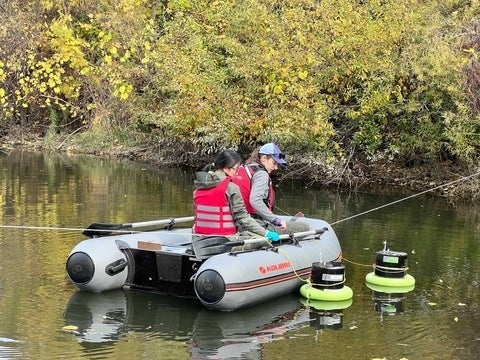
Westforest Pond. Image source: Xinchang Wang
The analysis follows a step-by-step approach. It begins at the site scale, focusing on individual ponds, then expands to the stormwater pond network, and finally to the entire urban watershed. Through this upscaling process, the study explores how local groundwater processes combine to reshape overall urban water balances.
The results show that including groundwater leads to a more realistic representation of urban hydrology. Compared to surface-only models, the integrated approach reduces overestimated infiltration and improves how evaporation and runoff are represented. Water that infiltrates at the surface does not simply disappear. Instead, it becomes part of a connected system, contributing to groundwater storage, subsurface evaporation, deep percolation, and in some cases, returning to surface waters. These patterns are consistently observed from single ponds, to a five-pond network, and across the entire urban watershed.
Looking ahead, this work supports municipalities in developing more sustainable urban water management and more effective GHG reduction strategies. By providing indicators that help assess how groundwater influences stormwater pond GHG emissions, the research offers a scientific basis for integrating groundwater considerations into climate planning.
Understanding the role of groundwater allows cities to operate smarter and more effective green stormwater infrastructure, bringing urban areas one step closer to achieving their climate goals.
This research was conducted with the support and collaboration of the Ecohydrology Research Group at the University of Waterloo.