News

Filter by:

Limit to news where the title matches:
Limit to items where the date of the news item:
Date range
Limit to news items tagged with one or more of:
Limit to news items where the audience is one or more of:

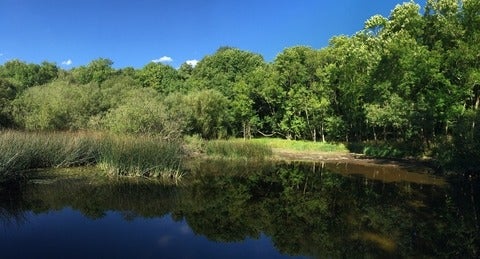
Wetlands provide valuable ecosystem services, such as reducing flood peaks during wet periods, augmenting baseflows during dry periods and water purification, and they enhance biodiversity. There is increasing interest in using wetlands as ‘nature‐based solutions’ for flood mitigation and soil and water conservation. However, over time, there can be water-quality tradeoffs and wetlands can become sources of nutrients to downstream water bodies.

Water Institute member and professor in Waterloo's School of Architecture, Elizabeth English, discusses her research into the development of amphibious foundation systems to adapt coastal communities to rising water levels and avoid habitual relocation.

Indigenous and Black Engineering and Technology (IBET) Momentum Fellowships address an urgent need to encourage and support the pursuit of graduate studies by under-represented groups.

Six universities in Ontario have partnered to create a new fellowship to expand the pathways for Indigenous and Black students pursuing doctoral degrees in engineering and mathematics to prepare for careers as professors and industry researchers.

Water Institute member Anita Layton, Canada 150 Research Chair in Mathematical Biology and Medicine, Professor of Applied Mathematics, Computer Science, Pharmacy, and Biology, has been named the recipient of the 2021 Krieger-Nelson Prize for her exceptional contributions to mathematical research with applications ranging from fluid dynamics to biology and medicine. Dr. Layton will receive her award and present a prize lecture during the CMS Summer Meeting in June 2021.

Cyanobacteria blooms are a major environmental issue worldwide. They can have direct impacts on the safety of drinking water supplies by producing a variety of toxins which also impose health risks for swimmers and boaters. Although many may associate cyanobacteria with bright green algae seen on the surface of lakes, Ellen Cameron, PhD Candidate in Waterloo’s Biology Department, is using DNA sequencing to study cyanobacteria communities in low-nutrient, clear lakes in Northern Ontario.