Collaborative Water student pays it forward by sponsoring essay competition in Philippines
The following story was written by Sylvie Spraakman, an EIT working on researching and implementing low-impact development for stormwater management systems.
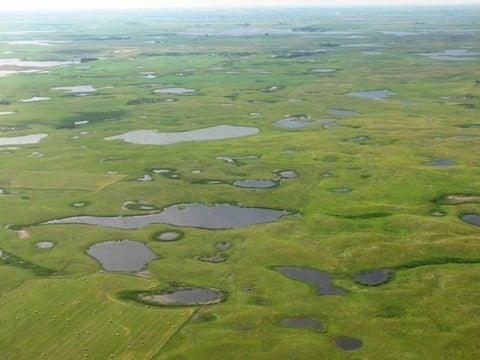
Leaving wetlands in their natural state could reduce the financial costs of flooding by nearly 40 per cent, according to a report from the University of Waterloo.
Researchers at Waterloo’s Intact Centre on Climate Adaptation found that avoiding wetland loss could lead to substantial savings for Canadian communities that experience flooding.


Water Institute member, Peter Huck, comments.
The AquaHacking 2017 semi-final competition unfolded last week at CIGI. By the end of the evening, five teams were chosen to move on to the final competition at Waterloo on September 13. It was a difficult decision for the five judges, as all 17 teams that competed offered innovative ideas that tackled the challenges and opportunities facing Lake Erie.

The second International Conference on Amphibious Architecture, Design and Engineering – hosted by Water Institute member and associate professor Elizabeth English – took place June 25-28, and brought together academics, practitioners, professionals and policymakers to discuss amphibious architecture.

Climate change is significantly impacting Canada’s water resources. From melting permafrost, to more pervasive algal blooms, to increased flooding, these impacts are only expected to increase in the future. Three professors from the University of Waterloo’s Water Institute have been awarded significant grants to develop new, innovative technologies and to deliver new management approaches to enhance the resilience and adaptive capacity of Canada’s water resources in the face of climate change.
Today, University of Waterloo Earth scientists received a $1.9M grant from Agriculture and Agri-Food Canada to examine greenhouse gas emissions from agricultural systems, and the impacts of alternative land-use practices and beneficial management practices (BMPs) on greenhouse gases.


Water reservoirs created by damming rivers could have significant impacts on the world’s carbon cycle and climate system that aren’t being accounted for, a new study concludes.