For 50 years, the Writing and Communication Centre (WCC) has supported students in developing the communication and academic skills they need to succeed academically, professionally, and personally. Since its founding, the WCC has evolved alongside the University of Waterloo community, expanding its programs and services while remaining committed to helping students become confident and effective communicators. As we celebrate this milestone, we honour the students, staff, faculty, and campus partners who have been part of our story.
50 Years of Transformation:
A Showcase of Poetry, Spoken Word, and Storytelling
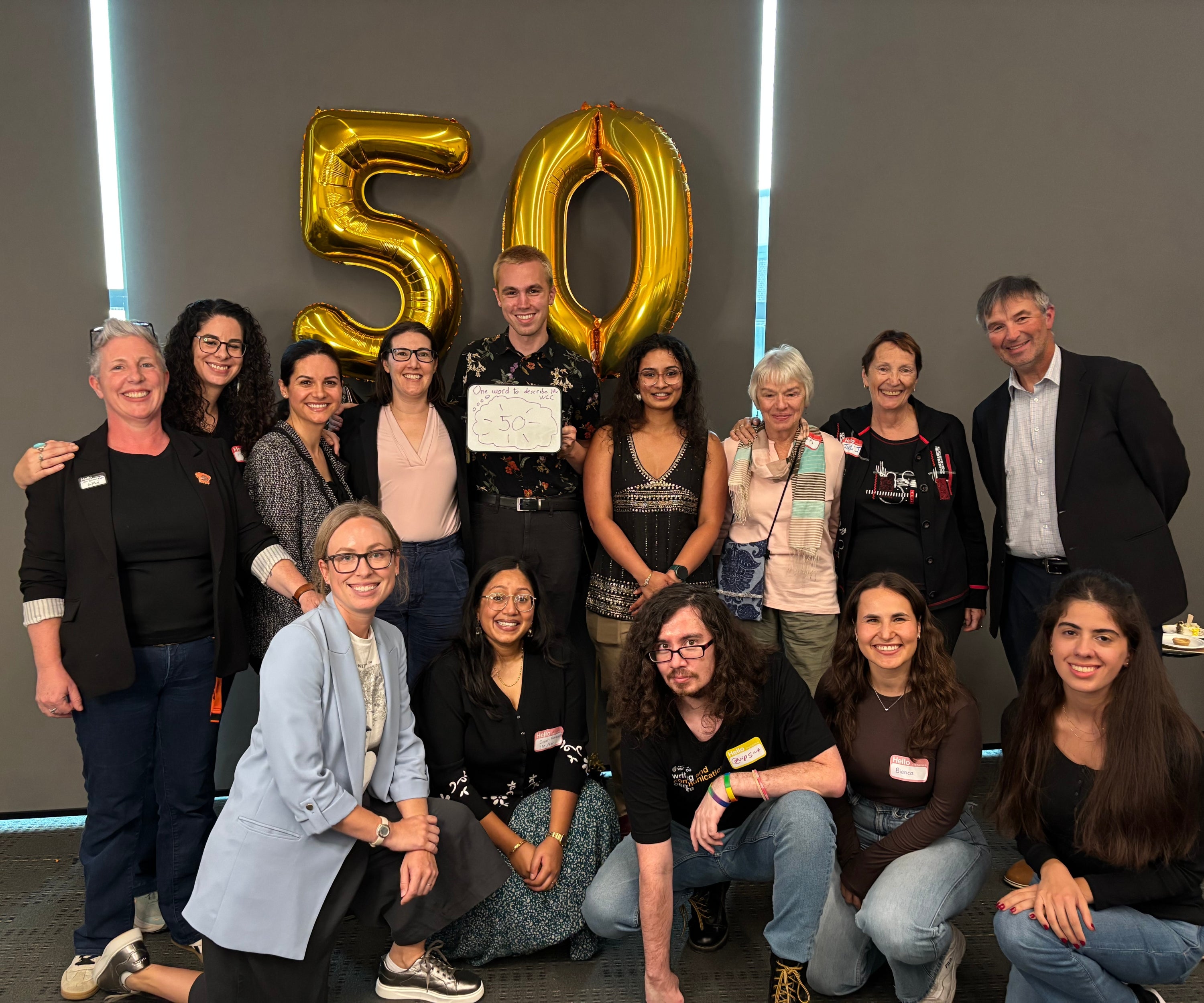
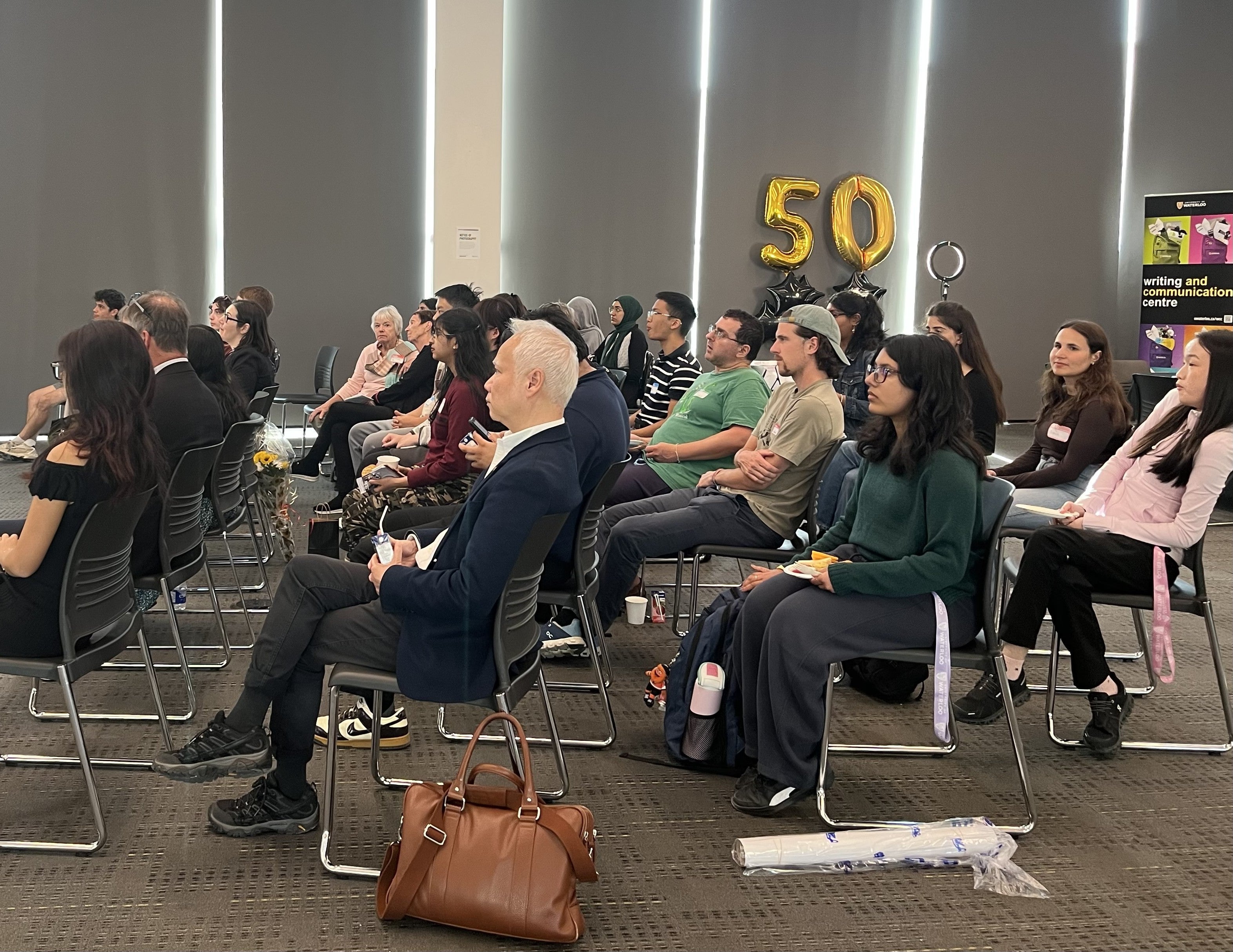
To commemorate the Writing and Communication Centre's 50th anniversary, we hosted 50 Years of Transformation: A Showcase of Poetry, Spoken Word, and Storytelling in the Student Life Centre's Black & Gold Room. The celebration brought together students, alumni, faculty, staff, university leaders, and friends from the broader community to reflect on five decades of supporting students at the University of Waterloo.
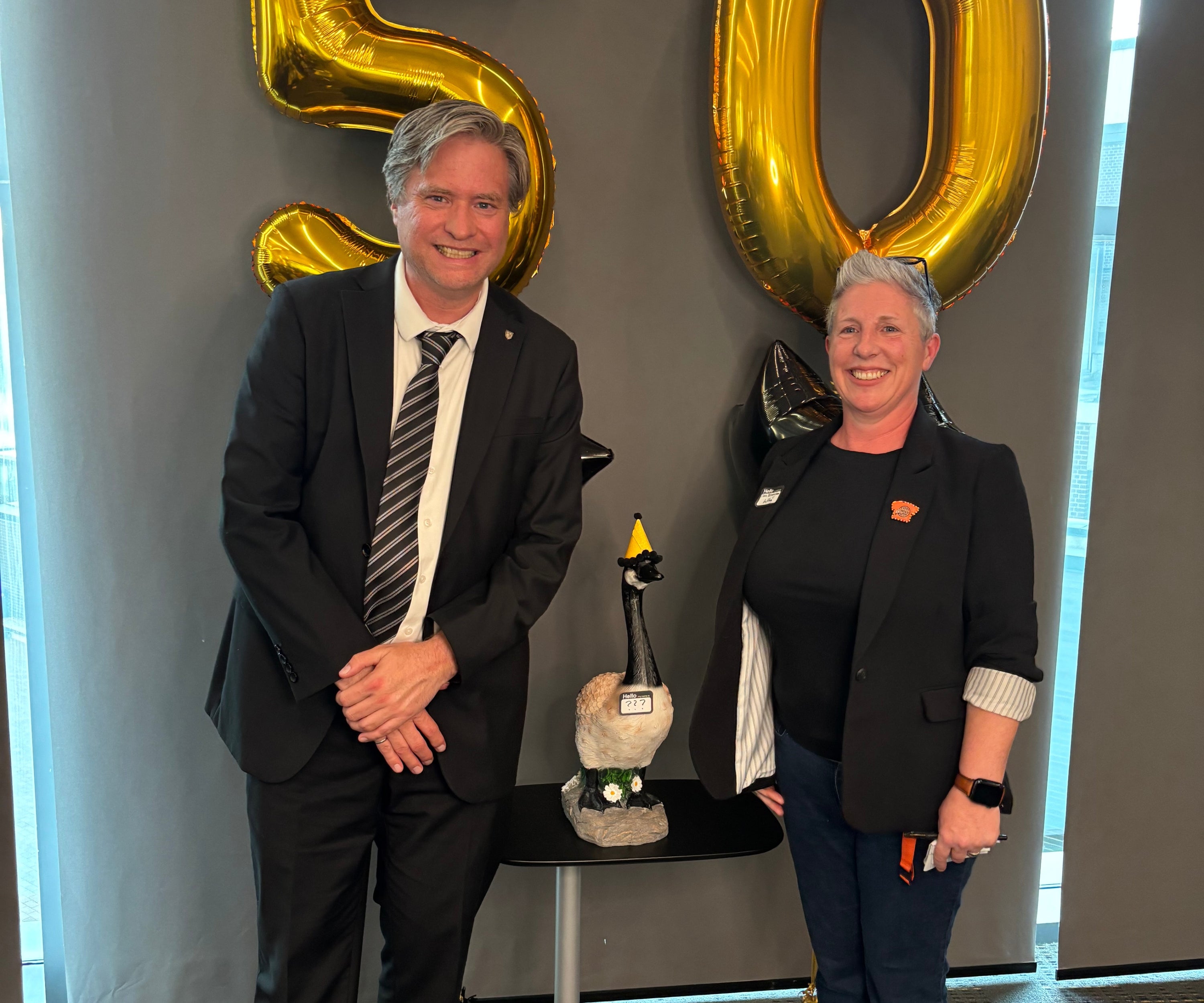
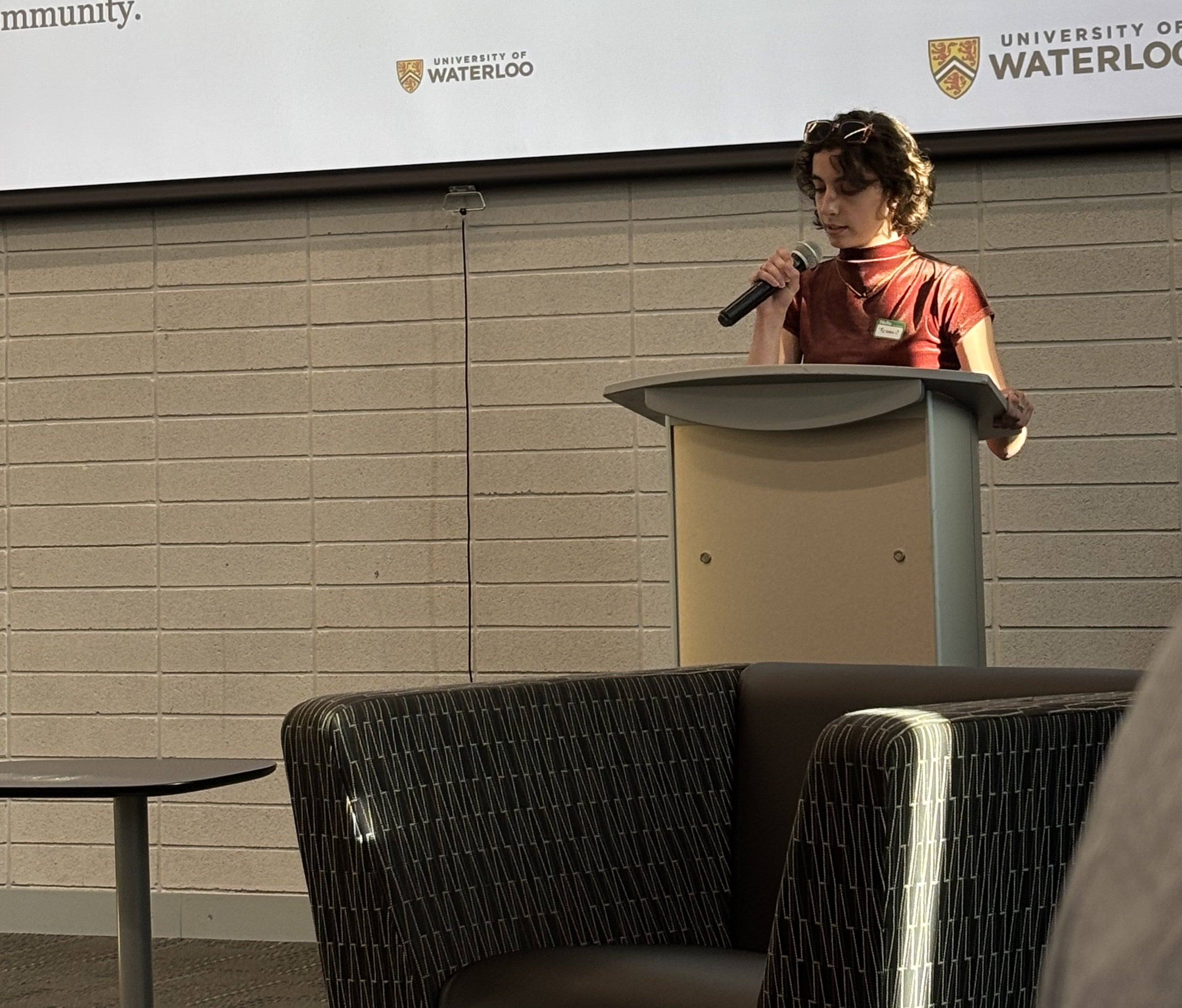
The event featured performances by five poets representing different corners of the Waterloo community, highlighting the power of storytelling, creativity, and personal expression. Guests also heard remarks reflecting on the WCC's history, impact, and future from WCC founder, Judi Jewinski; Associate Vice-President, Students, Chris Reid; and the Director of the WCC, Clare Bermingham.
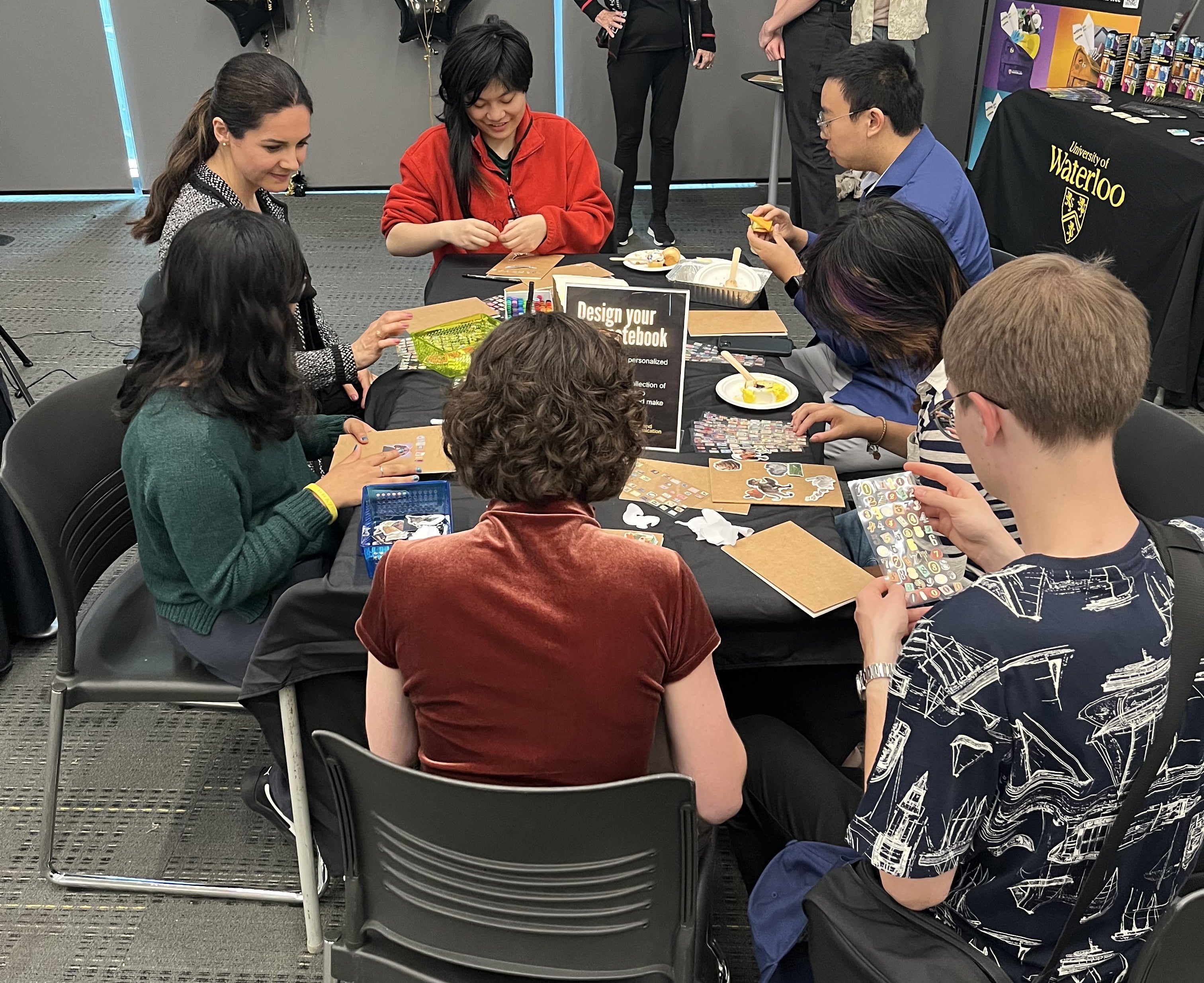
Attendees were invited to participate in interactive activities throughout the evening, including a speed poetry station featuring a typewriter and a notebook-making activity. Alongside food, refreshments, and conversation, these opportunities encouraged guests to create, connect, and celebrate the transformative role that writing and communication have played in the lives of Waterloo students for the past 50 years.


In Another Life
By Abby Zhang
Abby Zhang (she/her) is a first-year Mathematics student at the University of Waterloo originally from Montreal. She writes across forms, from postcards and poetry to creative nonfiction. In Another Life is a piece about an important friendship, growing up, and the imagined lives we might have shared with the people we love.
In another life, you live down the street. Your mother is friends with mine and you are loved and you grow up that way. You knock on my door as often as I can bear to think of you now. You stand under the porchlight in dirty flip-flops, tanned skin flushed with late August heat. You have come to save me again. Beloved things gather their wear from being held, passed from hand to hand and carried through the years. You are full of dents that way. That summer we spend our nights playing heroes, tucked into bruised elbows and knees, giggling under covers where we are safe at the end of the world. Before you fall asleep, tell me again, the story of your life. The story I lived next to you. Tell it one more time, just so I can know you once more.
In another life I am brave. You know just as well as I do—that there isn’t a thing tying me to you that the world would recognize. We are best friends. The terrible thing about those words is how easily the world expects you to let it go. We are not lovers, not blood. There is nothing that keeps you here except your own choosing. When the world finally ends, we have nowhere else to be but apart.
In another life we are sisters and I have a reason to keep you. You can hold the sky in your palms, still sticky with soda. Our waking moments will all go to waste. But school has ended and we don’t have to be anywhere else. We can ruin our chances at being great. We can become nothing—and everything to each other. Your window is open sometimes and I wish I could live in the low hum of your cello strings. The world always feels bigger this way. The ground beneath our feet tilts, spins, and brings morning after morning. Daylight drags on in this life.
In this life I am just as tall as you. We grow older and collect things we don’t know how to put down. A bottle passing through hands, a scar of my own choosing, a shadow, a dream, another hunger. In this life you cannot save me from it all. We soon learn the names of things that make the night disappear faster. The terrible little freedoms of being young enough to believe consequences happen only to other people. The world never ends in this life. We live too hard and learn too little.
In this life, we leave but never escape. Our mothers’ fears follow us out—across borders and into new apartments. You make yourself dinner from leftovers and study the history of music by the porchlight. I wish for easier sleep and for the courage of starting over. You talk about a stage, about a room filled with people who might finally listen to girls who look like us. Hours behind you, I am frivolous with want. It is always easier to get to the center of things when you’ve got something to prove. I spend white nights leaning over numbers and figures like I always belonged there. Morning arrives without us ever noticing.
In this life there are years between us that I cannot account for. We live on opposite ends of the phone and listen to each other breathe at two in the morning. Our elbows and knees are now bruised by the sharp corners of becoming and we sleep half-tucked into the empty side of the bed. Time has sanded down the jigsaw parts of us that used to fit and we are no longer alike in all the ways we are incomplete. Your kind heart falls in love with a frantic boy, then a soft-spoken man. I tell you the story of my life as you fall asleep on the other end of the phone. In this life we will be musicians. We will be mathematicians. We will be heroes. We will become the kind of people who get to sleep through the night.
Jeff Casello, Professor / Former AVP-GSPA, Civil and Environmental Engineering
Kim Nguyen, Associate Professor, Communication Arts
Marlee Spafford, Professor Emerita, Optometry and Vision Science
Jacqui McIsaac, Former Advisor, Writing and Communication Centre
Barbara Moffatt, Distinguished Professor Emerita / Former Associate Dean, Biology, Faculty of Science
Rodrigo Curry Pereira, Postdoctoral Fellow, Faculty of Health and Social Development, UBC Okanagan (Alumnus)
Jennifer O'Brien, :earning Strategist, AccessAbility Services
Stephanie Steh, Former Peer Tutor / Current Staff, Human Rights Equity & Inclusion
Angela Rooke, Manager Academic Success and Retention, Student Success Office
Justine Salam, Associate Dean of Career Readiness, Franklin University Switzerland (Alumna)
Jackie Stapleton, Liaison Librarian, Faculty of Health
Nada Alshehabi, Academic Development & Retentions Specialist/Manager, Student Success Office
Angela Carter, Professor, Political Science, Memorial University of Newfoundland (Former Faculty)
Sharon Kirkpatrick, Professor, School of Public Health
Nancy Worth, Associate Professor, Geography and Environment Management
Fatima Suleiman, Alumna, Engineering
One by One
By T. P. D.
One by one, snowflakes like static breathe through the open window, alight on my cheek and, crackling, wake me once again. To look outside is to see Galanthus blooming by the drifts and know that spring is here.
Then it too has passed as the baby birds, one by one, burst from their nests and beat their wings against the wide, wild world. And one by one, the cones upon the ground, freshly sprinkled with the morning's dew, grow into trees while I look away, spread their seeds and drop their needles and twigs so the birds may begin to build their nests again.
One by one, the songs all fade, telling me that time moves slowly though life goes by so fast. What other reason could a day feel like a year, while last year feels like yesterday?
And as they pass, one by one, each change, I know I'll never see what they amount to just as I never saw how they came. And of course I'll smile, since I also know how well I've seen the pale-swept snow, the scenting flower, the kingfisher’s breast, the staggering trees and all their evanescent pines and leaves.
One by one, the memories flee and, unfolding, shut my mind with sleep
In X and the Graph of y=1/x
By Tessa Sultan
Tessa Sultan (she/her) is a first-year student from Cape Breton, Nova Scotia. Tessa is a first-year student studying Civil Engineering, and performed three fantastic poems at our 50th Anniversary showcase. Below is one of her poems, inspired by "A Search for Meaning," her Grade 12 calculus textbook.
While in x, I am approaching the finale and its elaborations, the comma between the 24th and 25th I am in flux, a being of multitudes of gaps, of one-way ledges and conflicting infinities.
But what do I become so that all is satisfied? What conditions, what dilemmas or impossible indeterminations will you dress me up in now? I cannot be this imagined thing you see me as in your confusion, nor can I shift what I was before.
Nature changes moods and why depends on my judgement, my independence. So she flips the rationale- my wherefore, our journey was fraught with rifts after this. Our continuity may part but our bond is fast and true and we will always find a balance that makes us both right.
But now, alas, I shoulder freedoms of the shimmering scale on the platform and I will always be beneath something. Was I lying to myself? I tend to know my limits; watch me sink and barely miss the asymptote — how do you think it feels to never know the depths of rock bottom?
Raised on the messy half, one learns how to cut through the thickets of raw, unpruned numbers to find the pathways and answers underneath — I know you just want me to be the easy solution, and I promise I’m still being rational, but there are lines I simply cannot cross when it comes to my values.
While in x, taking flight in the graph I split below, I want to be left to my own genius to soar into the stratosphere and discover the truth of the left-hand limit I only assumed to be infinity. I do not want a tired mathematician to pigeonhole me for ease of access and make me into an example for twelfth graders.
I think you should try to imagine what it’s like to be x in a world so bent to the whining of the thousand-faced why my sun, my stars, my partner searching for meaning in her tidy, lonesome side of the world. She’s all I live for, but whose fault is that?
I want you to know that I exist to satisfy whatever conditions this life leads me to; Someday I’ll have the value you want.
the problem with calling myself a writer is
By Prerna Somani
Prerna Somani (she/her) is a Writing and Communication Advisor for Graduate Students and Postdoctoral Fellows here at the Writing and Communication Centre. She holds a Master of Fine Arts in Creative Writing, as well as a Bachelor's in English language and Literature, with a focus on translingualism and composition studies. Outside academia, her professional experience spans the publishing industry, where she worked as an editor on fiction, nonfiction, and academic projects.
The problem with calling myself a writer is the frivolous self-importance, like I must show my literacy off by rubbing it in the face of dead trees. Writing is fundamentally unnatural or else, the giant tortoise would have engraved his shell, the salmon would have drawn maps, the swans would have filed for divorce, and the apes would have stalled evolution. No manifestation of nature fights erasure like us, no aspect of sapience mythologizes its existence like us.
The problem with calling myself a writer is, I thought you become a writer the way you become a mother: by prying yourself open with both hands till something tears or comes alive. But then a dog came prancing into my life and looked at me with searching eyes. I could not have birthed her even if I tried. She is a bubble of forgiveness, I am a memory palace. My body does not have the recipe for her kind of happy, but she has made a mother of me.
The problem with calling myself a writer is, I would have to first demolish the walls and then do math to install a door frame when people come knocking. I would have to train my dog to not scare them away, I would have to explain the smell and apologize for the mess, mundane and sordid. Then I would have to stand patiently and let them pinch peg and lick all that I have hoarded.
The problem with calling myself a writer is the devoir packed in the job description, of looking out with one eye and inside with the other, of seeking beauty in that which makes me suffer, of making myself so tender that even absence leaves an impression, of taking a hammer to my rib cage to experience salvation.
The problem with calling myself a writer is all of the above but also none of the above. In truth, if I called myself a doctor, I would be expected to save lives mid-flight.
I don’t call myself a writer because if I did, I would be expected to sit down and write.