Our Research
How Artificial Intelligence Systems should be trained? How should users interact with it? Do users need to understand how it makes decisions? When does AI augment human work and when does it make human work more challenging? These are the questions we are asking.
In the News

Inter-University Workshop (IUW) 2025
Our Director, Dr. Catherine Burns, joined a group of graduate students to attend the 2025 Inter-University Workshop (IUW), hosted by the Human Factors Interest Group (HFIG) at the University of Toronto. The students had the opportunity to showcase their work, connect with peers, and gain new insights from inspiring presentations.
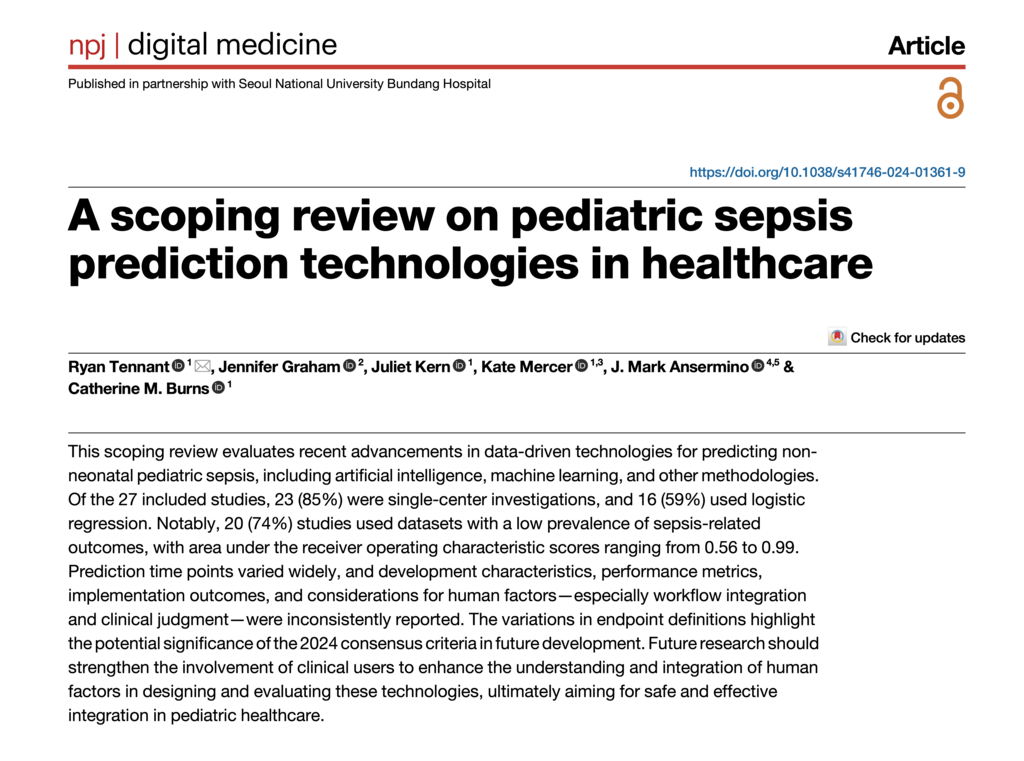
This scoping review evaluates recent advancements in data-driven technologies for predicting non-neonatal pediatric sepsis, including artificial intelligence, machine learning, and other methodologies. Of the 27 included studies, 23 (85%) were single-center investigations, and 16 (59%) used logistic regression. Notably, 20 (74%) studies used datasets with a low prevalence of sepsis-related outcomes, with area under the receiver operating characteristic scores ranging from 0.56 to 0.99. Prediction time points varied widely, and development characteristics, performance metrics, implementation outcomes, and considerations for human factors—especially workflow integration and clinical judgment—were inconsistently reported. The variations in endpoint definitions highlight the potential significance of the 2024 consensus criteria in future development. Future research should strengthen the involvement of clinical users to enhance the understanding and integration of human factors in designing and evaluating these technologies, ultimately aiming for safe and effective integration in pediatric healthcare.
Current Projects
Our research team is developing an AI-based clinical decision support system (AI-CDSS) for hypertension management.
Researchers are conducting a study to see if experts in important jobs, like doctors and military personnel, can make better decisions alongside data-driven predictions from artificial intelligence (AI).
In the context of high-risk, nonspecific conditions like pediatric sepsis, using AI as a clinical decision-support tool may be challenging due to high variability and uncertainty in clinical sings and symptoms. Globally, healthcare systems lack consistent standardized rules and procedures for pediatric sepsis, hindering AI performance and introducing ethical issues if relied on uncritically. An ecological approach to system design that guides both clinicians and AI in decision-making is crucial.
Projects
Cognitive Work Analysis based Explainable AI
Duration: Jan 2019 - Aug 2021
I am currently exploring how Cognitive Work Analysis (CWA) can be used to improve AI systems with a focus on explainability and interpretability in the context of loan assessment and lending. I use CWA to model expert decision-making and design explanation interfaces to support human decision-making and improve user experience with AI systems.
Sponsors and Partners:
- NSERC
Development of an Artificial Intelligence intervention system for prevention, diagnosis and treatment of stress injury, utilizing psychophysiological measures, biofeedback and resilience training
Duration: 2018 - 2020
Currently working on a multi-phase, multifaceted project that combines the development of an Artificial Intelligence predictive and proactive intervention system for prevention, diagnosis and treatment of stress injury; Understanding and influencing individual reactions to injurious stress utilizing Machine Learning, psychophysiological measures and biofeedback systems; and resilience training and enhancement of human performance under conditions of acute injurious stress.
Theses
Publications
- Dikmen*, M., Burns, C.M. (2017). Trust in autonomous vehicles: The case of Tesla Autopilot and Summon. 2017 IEEE International Conference on Systems, Man and Cybernetics. 1093-1098. 10.1109/SMC.2017.8122757
- Li*, Y., Wang, X., and Burns, C.M. (2017). Ecological Interface Design for financial trading: Trading performance and risk preference effects. 2017 IEEE International Conference on Systems, Man and Cybernetics. 600-605. 10.1109/SMC.2017.8122672
- Dikmen*, M., and Burns, C.M. (2016). Autonomous driving in the real world: Experiences with Tesla Autopilot and Summon. 8th International Conference on Automotive User Interfaces and Interactive Vehicular Applications, 225-228.
- Li*, Y., Hu, R., Burns, C.M. (2016). Representing stages and levels of automation on the decision ladder: The case of automated financial trading. Proceedings the 2016 Annual meeting of the Human Factors and Ergonomics Society. 328-333.
- Chin*, J., Li*, Y., Burns, C. (2018). User perspectives of conversational agents across lifespan: Being assistive, but not too smart. Poster presented at the Cognitive Aging Conference 2018, Atlanta, GA.