


Since 2018, Waterloo.AI has served as the University of Waterloo’s hub for cutting-edge research and collaboration in artificial intelligence and data science. We bring together faculty, researchers, students, and industry partners to tackle real-world challenges in areas such as disease detection, language understanding, emotional intelligence, and autonomous navigation.
At Waterloo.AI, we are dedicated to advancing responsible innovation that fosters economic prosperity and improves quality of life globally. Together, we’re building the intelligent systems of tomorrow—and we’re just getting started
What is Artificial Intelligence?
Artificial Intelligence (AI) is the study of machines and software that exhibit intelligence, such as learning, reasoning, planning, problem-solving, predicting, and the use of language and vision. With the advent of big data, and driven by the explosion of computing capacity and speed, AI tools are being increasingly integrated into technological solutions that are central to our everyday life, business, society, and the environment.

Why Should You Care About Data?
Professor Jimmy Lin, explains the importance of data in this episode of the "Back to the Classroom" video series.

News
NTNU Researchers Visit Waterloo as Part of IWIL AI Program to Advance Global AI Collaboration
Through a shared commitment to artificial intelligence research and co-operative education, the University of Waterloo and the Norwegian University of Science and Technology (NTNU) are working together to turn global collaboration into real-world impact.
Co-operative and Experiential Education (CEE) and the Waterloo Data & Artificial Intelligence Institute (Waterloo.AI) recently welcomed a delegation of eight NTNU researchers to campus for a four-day visit. The program brought together faculty and students to explore shared research interests, strengthen ties between both institutions, and spark new opportunities for collaboration in the field of AI.
About the Visit
This visit was part of the International Work-Integrated Learning in Artificial Intelligence (IWIL AI) project, a four-year initiative between NTNU and the University of Waterloo that connects student learning with real-world application and research. Supported by the Norwegian Directorate for Higher Education and Skills (HK-dir), the program promotes international research mobility and hands-on learning to strengthen education for a sustainable future.
A Growing Partnership
Since its launch, IWIL AI has supported twenty-four Waterloo co-op students completing AI-centred research work terms in Norway, along with five NTNU master's students undertaking research visits in Waterloo. The recent delegation of NTNU researchers builds on this project by offering new opportunities to connect the research ecosystems of both institutions.
Program Highlights
Throughout the visit, the NTNU delegation visited a wide range of Waterloo labs and innovation spaces, including:
- A campus tour and an overview of the Waterloo Data & Artificial Intelligence Institute, led by faculty members
- Meetings with student-led AI groups
- A tour of RoboHub
- A visit to the Bio-robotics, Artificial Intelligence and Neuroscience (BRAIN Lab)
- Sessions on Waterloo's approach to industry collaboration, including visits to the Perimeter Institute and the Velocity Innovation Arena, to explore the intersection of research and entrepreneurship
- A networking session bringing Waterloo co-op students, researchers, and faculty supervisors together with the NTNU delegation to share research ideas and explore future collaboration
Voices from the Delegation
Several NTNU PhD students reflected on what the visit meant for their own research. “The trip was beneficial for me, as I gained a fresh perspective on research and innovation beyond Europe and Africa. I will definitely reach out to some of the contacts I got and explore possible future collaborations,” said one delegate. Another added, “Learning about the Waterloo co-op program, industry collaborations, campus infrastructure, student clubs, and administrative support: these were very interesting and inspiring practices that gave me a new perspective.”
Looking Ahead
As the program wraps up this year, visits like this reinforce the value of international collaboration in strengthening Waterloo's position as a global leader in AI innovation, helping expand its research networks, and creating new opportunities for students and researchers to collaborate on impactful, real-world projects.
Learn More
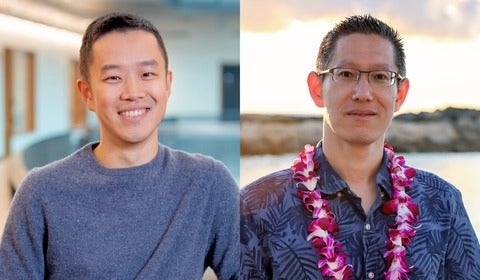
Victor Zhong, Jimmy Lin awarded $1.64M NSERC Alliance grant to develop deep research agents for natural science R&D
Professor Victor Zhong (principal investigator) and Professor Jimmy Lin (co-investigator) of the Cheriton School of Computer Science have been awarded $1,641,776 through the NSERC Alliance Grant program. Combined with more than $1.8 million in cash and in-kind contributions from industry partner BASF Canada, the total project value reaches roughly $3.5 million.
The three-year project, titled “Deep Research Agents for Natural Science R&D,” will co-develop and deploy an end-to-end intelligent research assistant capable of retrieving, reasoning over, and acting on diverse experimental data sources. Developed with BASF Canada, it aims to transform chemical informatics from static information retrieval into dynamic, action-oriented knowledge systems that accelerate scientific discovery.
The project will also help train the next generation of researchers, supporting two postdoctoral researchers, six PhD students and two master’s students over its three years.
More about this research
Innovation in the chemical sciences requires integrating diverse data sources — from reaction protocols and compound properties to safety data sheets and spectral data — that are often stored across separate, incompatible systems. As a result, researchers can spend a significant share of their time retrieving, cleaning and integrating data manually rather than focusing on discovery.
Overcoming these barriers requires AI systems that can reason across diverse information sources and interact seamlessly with laboratory data. Current methods fall short: retrieval-augmented generation systems struggle with complex hybrid scientific queries, while text-to-SQL systems require rigid schemas poorly suited to unstructured lab notes. This project aims to develop a multimodal, general-purpose agent equipped with computer vision and logical reasoning to support experimental planning — a step toward autonomous scientific execution.
Professor Zhong contributes expertise in frontier agentic behaviours and reasoning, while Professor Lin brings expertise in scalable retrieval infrastructure to enable efficient processing of the large, complex datasets involved in industrial R&D.
p>
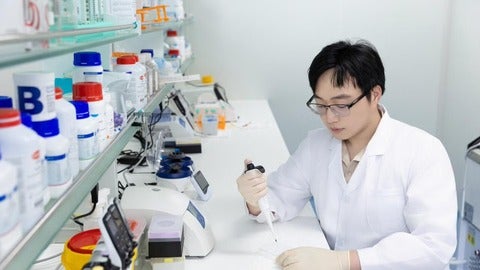
Unlocking disease-linked protein changes using AI
A new algorithm could drive breakthroughs in understanding cancer, Alzheimer's disease, and other potentially fatal conditions. Researchers from the University of Waterloo developed the machine learning algorithm, called RNovA, to detect changes in the proteins in human cells.