Events

Filter by:

Limit to events where the title matches:
Limit to events where the first date of the event:
Date range
Limit to events where the type is one or more of:
Limit to events tagged with one or more of:
Limit to events where the audience is one or more of:
Wednesday, October 1, 2025 11:30 am - 12:30 pm EDT (GMT -04:00)

Astroseminar - Woorak Choi

Woorak Choi is a postdoctoral fellow at McMaster University. He completed his PhD in 2024 at Yonsei University, South Korea. Woorak's research focuses on understanding the evolution of the ISM and star formation in extreme environments, ranging from galactic centers to galaxy clusters. As a radio astronomer, he primarily uses radio telescopes such as ALMA and VLA, but has recently begun working with JWST data. Woorak is also interested in incorporating numerical simulations to complement observational studies.
Wednesday, October 22, 2025 11:30 am - 12:30 pm EDT (GMT -04:00)

Astroseminar - Adrian Bayer

Dr Adrian Bayer (Princeton) works on the intersection of astrophysics and machine learning. Recent interests include: creating multi-probe cosmological simulations for galaxy, lensing, and CMB surveys; performing optimal and interpretable cosmological inference by sampling high-dimensional parameter spaces to reconstruct the Universe's initial conditions and using simulation-based inference; and developing statistical techniques to find astronomical signals in large and noisy spaces, such as for super massive black hole binaries and exoplanets. 

Wednesday, October 29, 2025 11:30 am - 12:30 pm EDT (GMT -04:00)

Astroseminar - Camille Avestruz

"Modeling Galaxy Clusters for Cosmology"

Prof. Camille Avestruz is an assistant professor in the department of physics at the University of Michigan with research interests that span astrophysics, cosmology, and computation. Her primary focus is to understand the evolution of clusters of galaxies. Other aspects of her work prepare for the next decade of observations, which will produce unprecedented volumes of data. 

Wednesday, October 29, 2025 7:00 pm - 8:00 pm EDT (GMT -04:00)

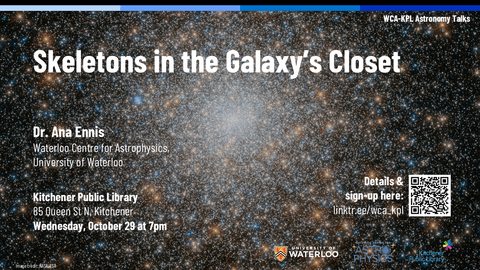
WCA-KPL Public Talk -Skeletons in the Galaxy's Closet (Ana Ennis)

Globular clusters are ancient groups of stars found in every single galaxy, and they are key tools for studying the evolution of the Universe. These dense cosmic cities contain some of the oldest stars in existence, offering us a glimpse back in time. In this month’s KPL astronomy talk, Ana Ennis will teach us what globular clusters are, how we think they are made, and all the things we can learn from them, from black hole formation to galaxy evolution.

Wednesday, November 5, 2025 11:30 am - 12:30 pm EST (GMT -05:00)

Astroseminar - Arnaud de Mattia

"DESI DR2: Survey Overview, Cosmological Constraints from BAO, and Preparation for Full-Shape Analyses"

Ardaud de Mattia (CEA Saclay) is a member of the Dark Energy Spectroscopic Instrument (DESI) collaboration, where he has worked successively on photometric systematics (through image simulations), clustering catalogs and two-point statistics, and cosmological parameter inference. Arnaud is deeply involved in pipeline development for DESI — from catalog creation to cosmological constraints — leveraging GPU computing and automatic differentiation whenever relevant. He is also interested in galaxy field-level inference as a more comprehensive approach to cosmological analysis.

Wednesday, November 12, 2025 11:30 am - 12:30 pm EST (GMT -05:00)

Astroseminar - Elena Massara (Zoom)

"From Science to Data Science: How to Land a Job in Industry."

Elena Massara is a Machine Learning Scientist at TD Bank and holds a Ph.D. in Astrophysics from SISSA (Italy, 2016). She previously held postdoctoral research positions at the University of California, Berkeley; the Flatiron Institute in New York; and the Waterloo Centre for Astrophysics in Canada.

Wednesday, November 19, 2025 11:30 am - 12:30 pm EST (GMT -05:00)

Astroseminar - Andrew Zentner

"Halo Clustering, Galaxy Clustering, and the Theory and Detection of Assembly Bias"

Andrew Zentner is Professor and Chair of the Department of Physics and Astronomy at the University of Pittsburgh, where he has been a member of the faculty since 2007. Originally, from Queens, in New York City, Andrew earned a B. S. in Electrical Engineering from The Cooper Union for the Advancement of Science and Art, a unique, tuition-free school in New York’s East Village, in 1998. He earned his Ph. D. in Physics from The Ohio State University in 2003. Subsequently, Andrew conducted postdoctoral research at the University of Chicago where he was a Kavli Fellow and a National Science Foundation Fellow before joining the faculty at Pittsburgh. 

Wednesday, November 26, 2025 11:30 am - 12:30 pm EST (GMT -05:00)

Astroseminar - Sven Heydenreich

"Probing the Dark Sector: Implications of DESI's Dynamic Dark Energy Results"

Sven’s (UCSC) scientific journey has been shaped by trying to ensure accurate and precise results from weak lensing surveys. His contributions to this field are both direct investigations of potential systematic biases (such as variable survey depth) as well as the establishment of higher-order lensing statistics (persistent homology and third-order shear statistics, in collaboration with Pierre) for a robust cosmological inference. As a member of DESI, he performed the validation of Galaxy Lensing measurements for subsequent cosmological analyses.

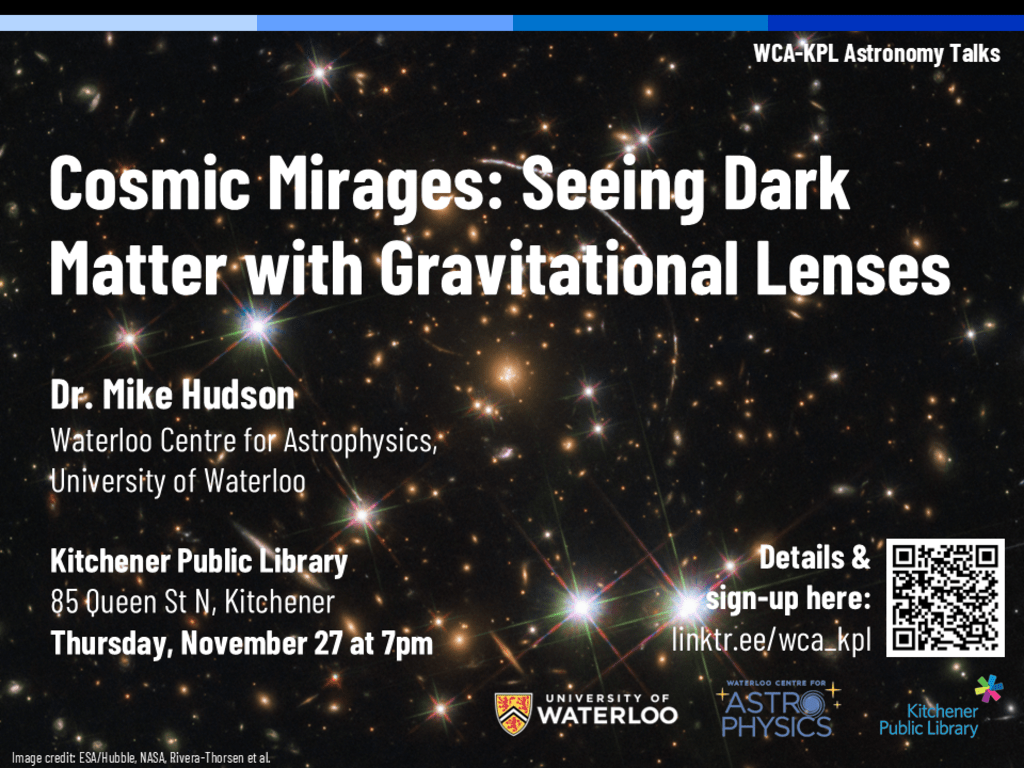
Most of the matter in the Universe is dark matter: an elusive particle that is completely invisible. But we can “see” this matter by studying how it distorts the light from galaxies in the distant Universe, a phenomenon called gravitational lensing. In this month's KPL astronomy talk, Mike Hudson will give a whirlwind tour of gravitational lensing’s “greatest hits” showing how it can be used as a tool to understand some of the most mysterious things in the Universe: from black holes to the “cosmic web” of dark matter that links galaxies together.