WCA-KPL Astronomy Talk series
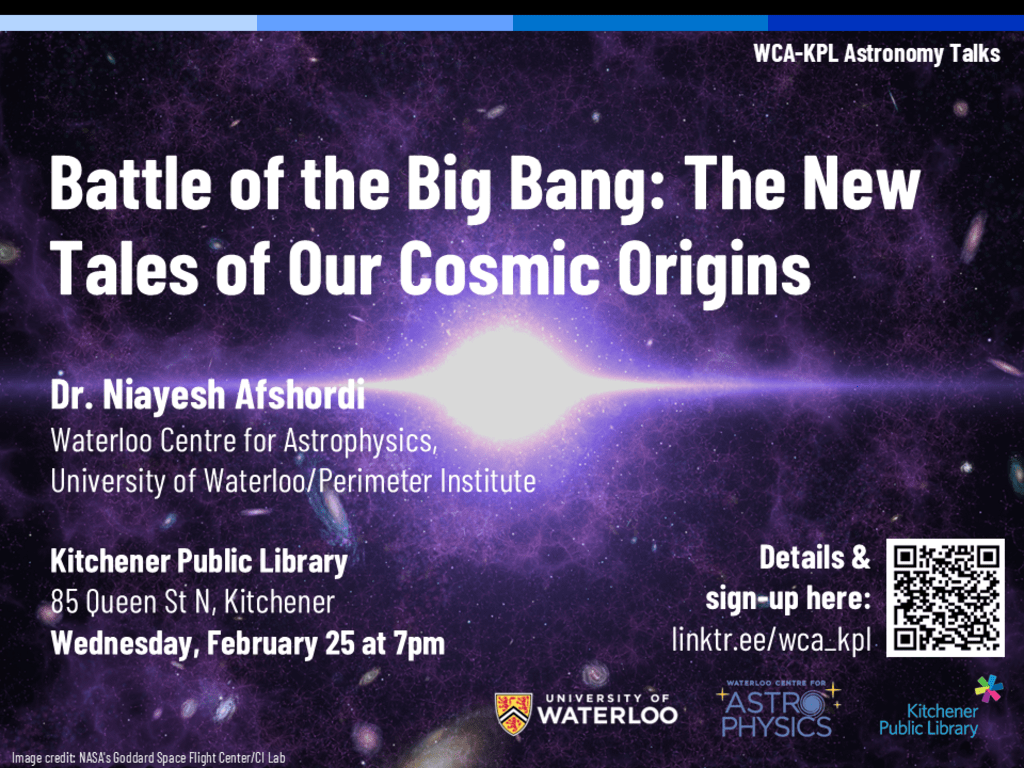
Most of us are taught that the universe began with a giant explosion called the Big Bang. But what if that picture is incomplete—or even wrong? In this month's KPL astronomy talk, Niayesh Afshordi will explore the growing cracks in our standard cosmic origin story and introduce rival ideas that challenge the very notion of a beginning of time.
Most of the matter in the Universe is dark matter: an elusive particle that is completely invisible. But we can “see” this matter by studying how it distorts the light from galaxies in the distant Universe, a phenomenon called gravitational lensing. In this month's KPL astronomy talk, Mike Hudson will give a whirlwind tour of gravitational lensing’s “greatest hits” showing how it can be used as a tool to understand some of the most mysterious things in the Universe: from black holes to the “cosmic web” of dark matter that links galaxies together.
Globular clusters are ancient groups of stars found in every single galaxy, and they are key tools for studying the evolution of the Universe. These dense cosmic cities contain some of the oldest stars in existence, offering us a glimpse back in time. In this month’s KPL astronomy talk, Ana Ennis will teach us what globular clusters are, how we think they are made, and all the things we can learn from them, from black hole formation to galaxy evolution.
The first three minutes after the Big Bang shaped the entire history of our Universe. In this month’s KPL astronomy talk, Encieh Erfani (Perimeter Institute) will take us on a journey back to these formative moments, exploring how matter, light, and the building blocks of today’s cosmos first emerged, all in just 180 seconds of cosmic history.
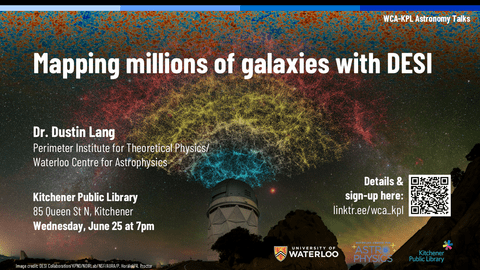
The Dark Energy Spectroscopic Instrument (DESI) is helping scientists to produce the largest and most comprehensive map of galaxies ever seen. This map is then being used by cosmologists to understand the growth of the Universe over cosmic time. In this month’s KPL astronomy talk, Dustin Lang will discuss the technology behind this innovative experiment, and how these advances have allowed cosmologists to make insights that change our view of the Universe.
Our knowledge and understanding about the Universe at present day brings together various famous discoveries made by astronomers. Many of these discoveries were made by women who never became household names. In this month’s KPL astronomy talk, Lammim Ahad will discuss some of the important work done by women who contributed significantly to astronomy and astrophysics, but whose contributions were often underappreciated or unrecognized at the time.
Astrophysics deals with structures of incredible sizes and scales. But what are the biggest things out there, and how big can something actually get? In this month’s KPL astronomy talk, Roan Haggar will speak about galaxy clusters, the largest objects in our Universe that are held together by gravity, discussing what clusters are made from and what we can learn by studying them.
Supermassive black holes, though tiny compared to their host galaxies, play a crucial role in shaping galaxy evolution. In this month’s KPL astronomy talk, Marie-Joëlle Gingras will explore how these cosmic beasts influence their surroundings through a process known as Active Galactic Nucleus feedback, regulating star formation and transforming galaxies over billions of years.
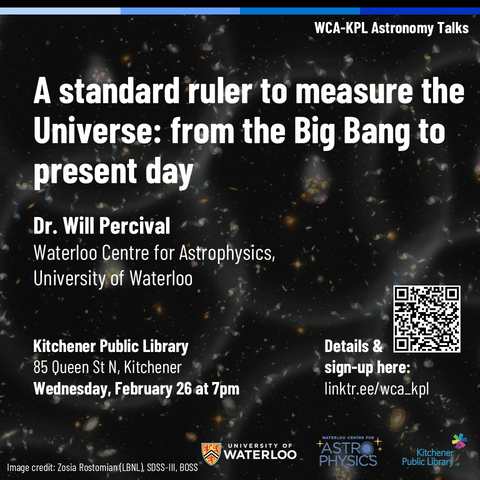
The Universe is big – so big that measuring its size is incredibly difficult. By mapping out the positions of galaxies, cosmologists can trace the structure of the Universe, observing patterns in this structure that can be used as a ruler. In this month’s KPL astronomy talk, Dr. Will Percival will talk about this technique, called Baryon Acoustic Oscillations, highlighting how we came to learn that the Universe is expanding at an accelerating rate.
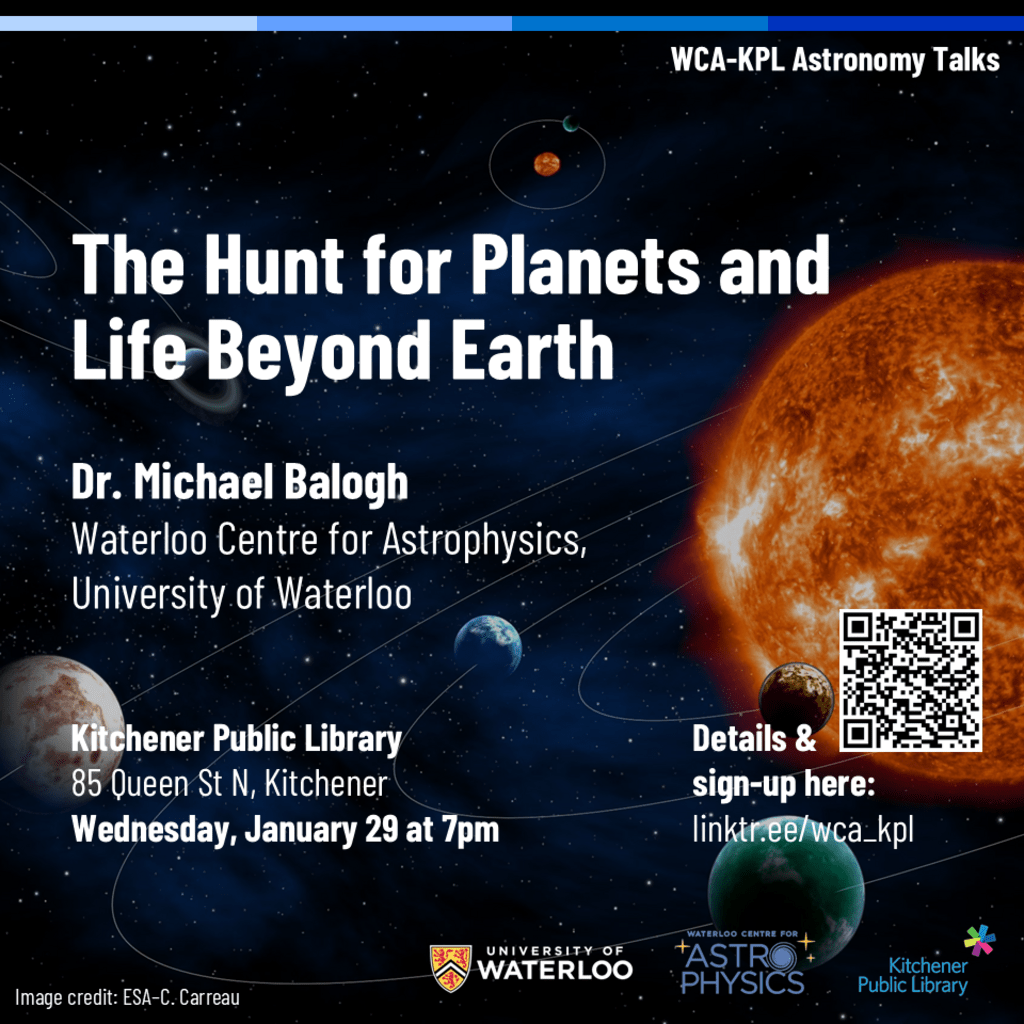
Astronomers have discovered thousands of planets orbiting other stars, opening a new chapter in our understanding of the Universe and our place in it. In this month’s KPL astronomy talk, Dr. Michael Balogh will discuss how scientists find and study these distant worlds, and how upcoming technology will help us search for life beyond our solar system.