WCA-KPL Astronomy Talk series
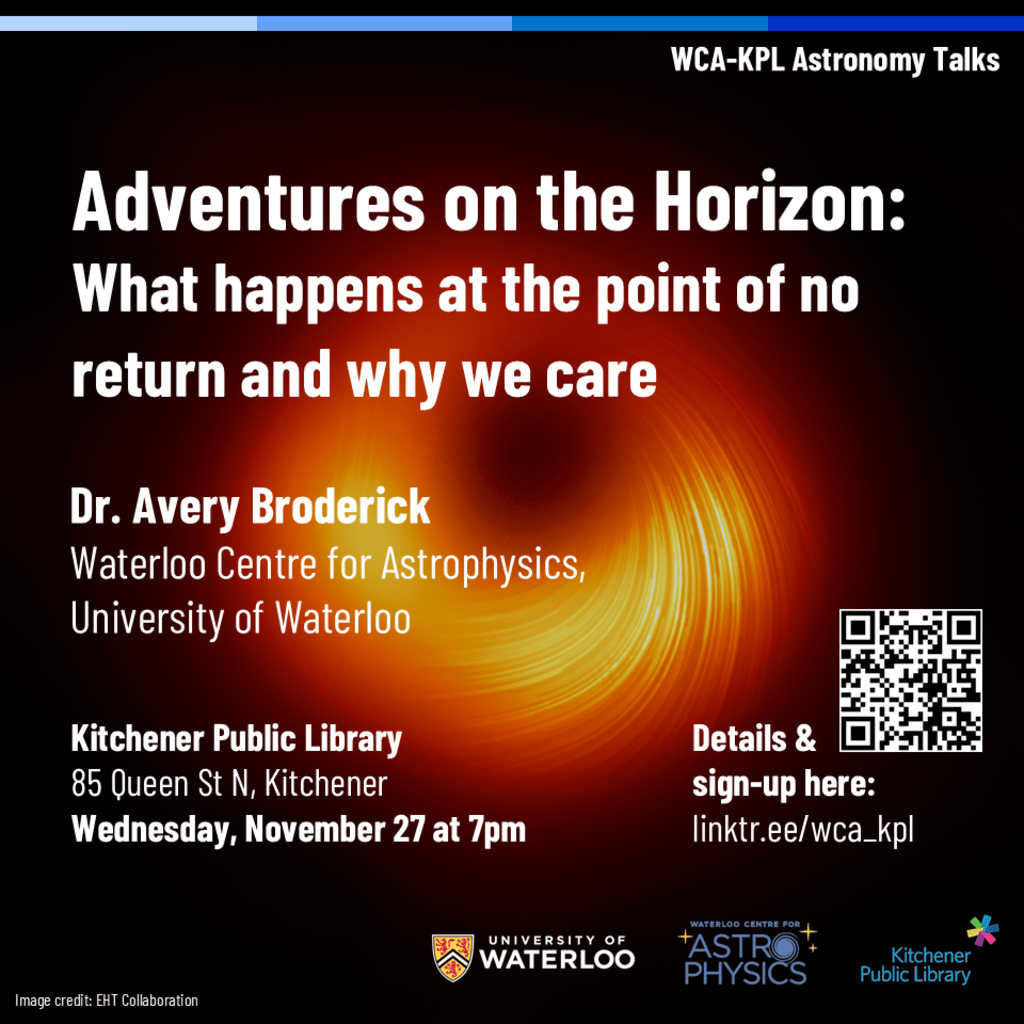
In the past few years, we have seen for the first time an image of the “event horizon” around a supermassive black hole – the mysterious and powerful object lying at the heart of a nearby galaxy. In this month’s KPL astronomy talk, Dr. Avery Broderick will talk about what we can learn about fundamental physics from these images, and how we go from a fuzzy image to sharp conclusions about the nature of gravity.
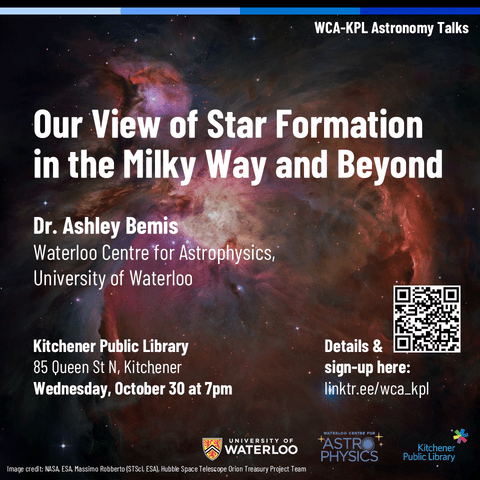
Understanding how stars form is a vital aspect of many areas of astronomy. From one perspective, star formation is a crucial part of understanding how galaxies evolve – from another, star formation can help us determine where planets exist that have the potential to host life. In this month’s KPL astronomy talk, Dr. Ashley Bemis will discuss what we learn about star formation by looking at where stars are being born in nearby galaxies – and within our own Milky Way.
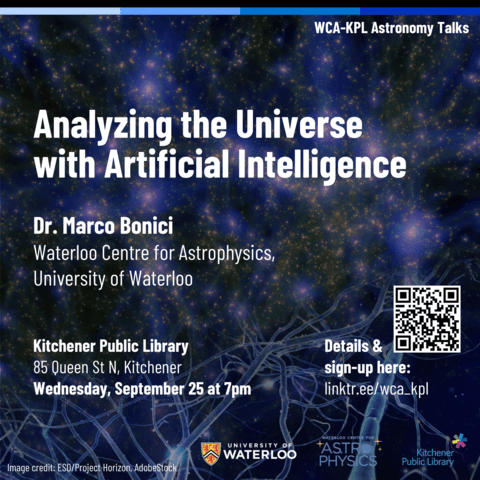
Cosmology is the study of the Universe as a whole, and asks questions like "How did the Universe begin?" and "What is our Universe made of?". However, answering these questions comes at a cost: huge questions require huge quantities of data, and huge amounts of analysis. At September's WCA-KPL astronomy talk, Dr. Marco Bonici will discuss how a new tool -- Artificial Intelligence -- is helping cosmologists to understand the data collected from telescopes, and answer the fundamental questions about the cosmos.
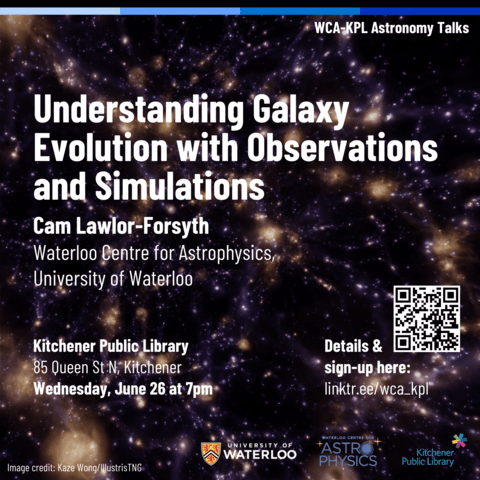
Galaxies change and evolve over hundreds of millions of years, and while we can gain clues about their evolution by looking at galaxies, this evolution is too slow to watch in real time. However, by running simulations of galaxies, astronomers can unlock this additional dimension, tracking how galaxies form and evolve through time. At this month's KPL astronomy talk, Cam Lawlor-Forsyth will discuss the combination of observations and simulations as a powerful tool in understanding galaxy evolution.
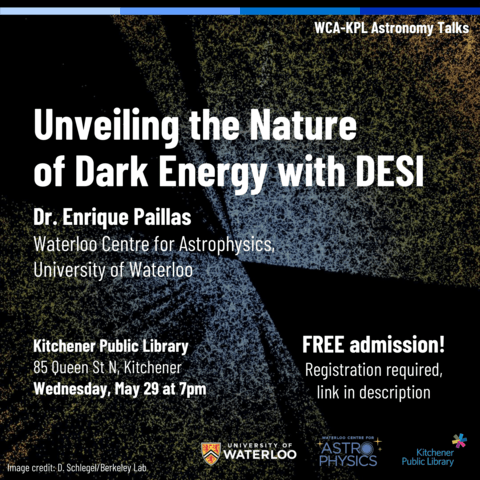
Dark energy is a strange and enigmatic form of energy, causing our Universe to grow and expand at an increasingly fast rate. While the exact nature of this energy remains a total mystery, new astronomical instruments are shedding light on dark energy like never before. Join us at this month's KPL astronomy talk, when Dr. Enrique Paillas will speak about the Dark Energy Spectroscopic Instrument (DESI), and what its newest results tell us about the dark Universe.
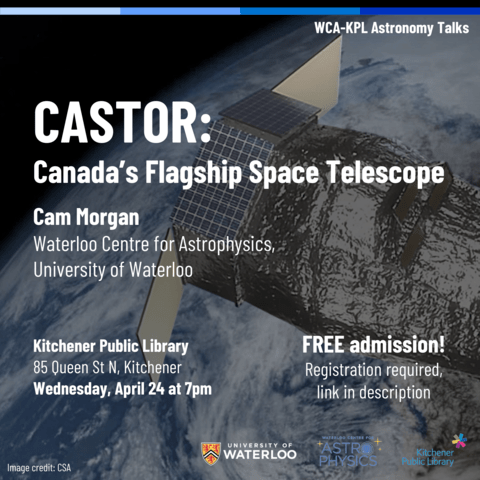
Canada has made significant contributions ever since the early days of space-based astronomy, and now the prospect of a flagship Canadian-led space telescope as a successor to the Hubble Space Telescope is alive and well. At this month's KPL astronomy talk, Cam Morgan will speak about the CASTOR mission, an ultra-violet telescope that promises to compliment other cutting-edge missions, such as Euclid and the Roman Space Telescope, throughout the 2030s.
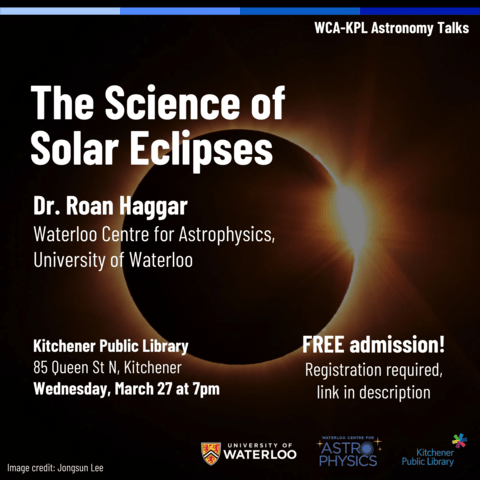
On April 8, Southern Ontario will witness a total solar eclipse for the first time in nearly 100 years, as the Moon blocks out the light of the Sun for several minutes. Total eclipses are an amazing spectacle, but have also played a key role throughout history in our understanding of science. At this month's KPL astronomy talk, Dr. Roan Haggar will speak about the upcoming solar eclipse, and what eclipses have taught us about the Sun, our Solar System, and the Universe.
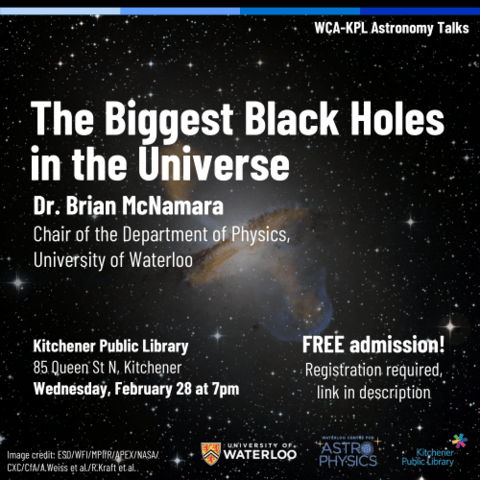
Most galaxies harbour monster black holes, millions to billions of times the Sun's mass, at their centres. These black holes are central to how galaxies formed, and how they have evolved, over nearly 14 billion years of existence. At this month's KPL astronomy talk, Dr. Brian McNamara will speak about these supermassive black holes, explaining how they work and how astronomers learn about them.
The WCA-KPL Astronomy Talk series takes place on the last Wednesday of each month, and is jointly organized by the Waterloo Centre for Astrophysics and Kitchener Public Library.
WCA-KPL public talk - Gravitational Lensing: A tool to study the Universe by Jordan Ducatel