


It is well known that Canada is an urban nation. Most people now live in cities. But most growth is occurring in the suburbs of large metropolitan areas and in nearby towns and cities. Yet academic research has often focused on our central cities. Better understanding of suburbs as places, and suburbanization as a process, have less frequently been explicit aims of research.
The research of the suburbs that is conducted is all too commonly broad-brush, looking from the seemingly dense and diverse inner city outward to supposedly low-density, uniform suburbs.
But what if we mapped characteristics commonly believed to be telling of suburbs just to see where they actually occur? What if we went to the suburbs, figuratively and literately, and conducted research as if looking from one suburb to the other, or as if looking from a suburb toward the central city? The likely result is an understanding of suburbanism, and our cities more generally, that is richer and more diverse; an understanding that does not take for granted the political or historic development of cities as drawing concrete lines between what we believe is the suburban and the urban.
The Atlas of Suburbanisms aims to provide information that can help us move toward such an understanding.
News
A sprawled Waterloo Region? Considering an alternate view
Atlas lead Markus Moos comments on the arguments against suburban sprawl in light of regional planning decisions.
Housing Affordability and the Canadian Suburb
Tristan Wilkin presents “Housing Affordability and the Canadian Suburb”, the first in a series of working papers from the PLAN 675 Canadian Suburbanisms reading course.
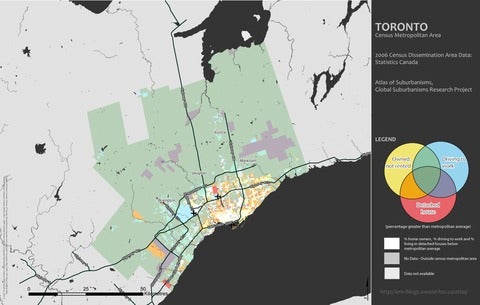
Mapping the dimensions of suburbanisms
Pablo Mendez (University of British Columbia) offers an analytical writeup to accompany the most recent contribution to the Atlas data: a series of 69 maps covering 23 cities visualizing 3 sets of socioeconomic data themes. The result: a compelling set of data-rich maps showing interesting and surprising patterns of suburbanism across Canada.


Markus Moos
Markus Moos is an Assistant Professor in the School of Planning, Faculty of Environment, University of Waterloo. His research is on the implications of the changing economy and social structure of Canadian cities, labour restructuring, housing markets, commuting patterns, and the relations between sustainability planning and social justice in cities. He has published on these issues in book chapters and articles in Urban Studies, Journal of Planning Education and Research, Environment and Planning A, Journal of Urban Affairs, International Journal of Urban and Regional Research and Urban Geography.
Markus can be found on Twitter: @Markus_Moos