
Earlier this year, 73 student teams from the University of Waterloo (UWaterloo) entered the eighth annual Map the System competition hosted by the Kindred Credit Union Centre for Peace Advancement. Five of these teams advanced to UWaterloo’s campus finals, but only one project could be nominated to proceed in the competition.
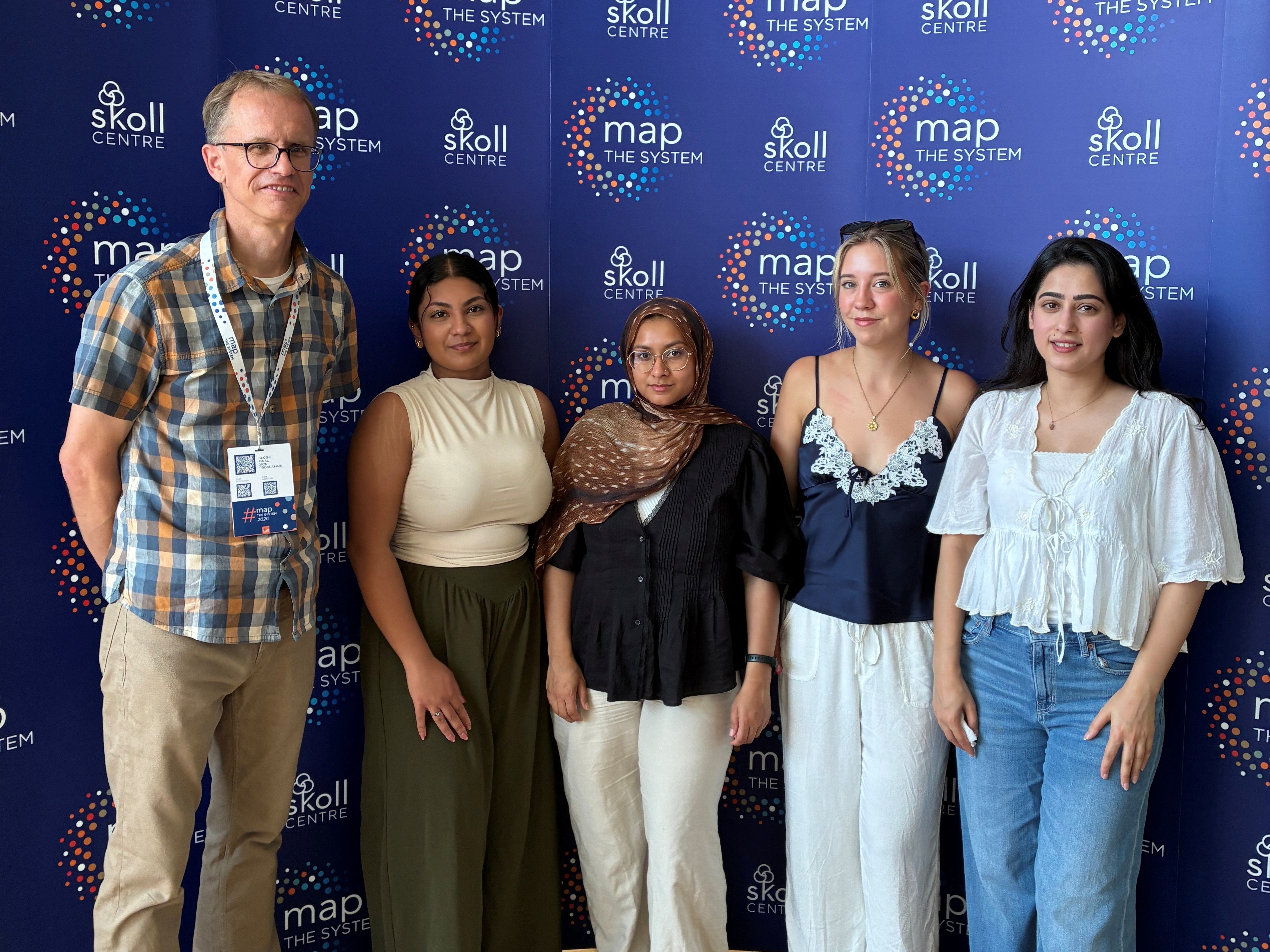
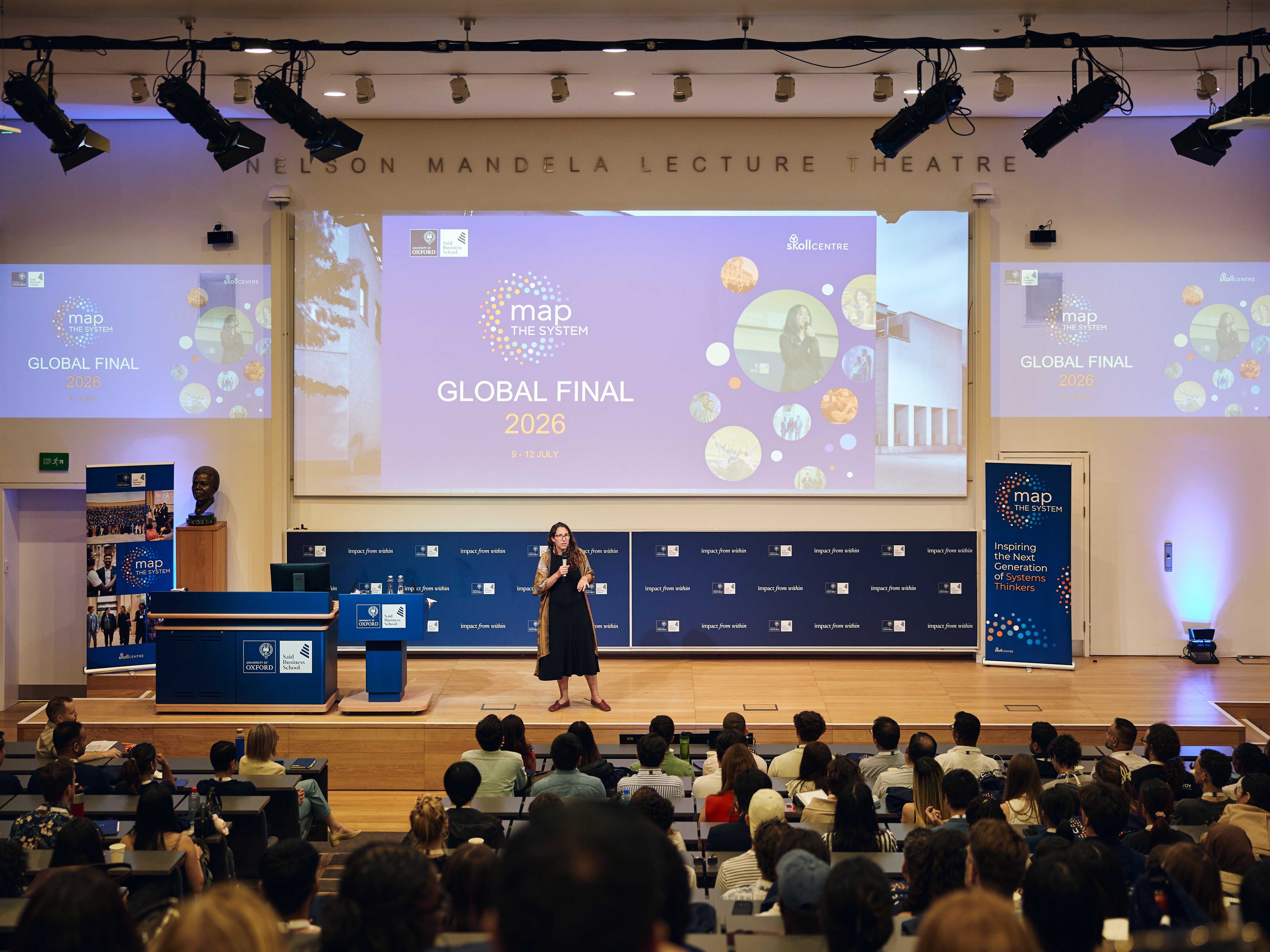
Photo by Fisher Studios, UK
As detailed in Mapping what matters in April, the systems thinking project chosen to represent UWaterloo and Map the System Canada abroad in 2026 was Unravelling the Feminomenon by Master of Development Practice students Sadia Mohammad, Zoraiz Sheikh, Chloe Stroh, Prishaa Rajalathan, and Bria Wong-Armstrong.
This month, four members of UWaterloo’s winning team joined their counterparts from 48 educational institutions in 19 countries at the University of Oxford, hosted by the Skoll Centre for Social Entrepreneurship at the Saïd Business School. From July 9 to 12, they practiced pitches, shared their research, and used systems-thinking to explore diverse challenges from around the world.
During their time at Oxford, they heard from inspiring speakers like Daniela Papi-Thornton, the visionary behind Map the System, and Martin Kaungu-Banda, a visiting fellow at the Saïd Business School. Various activities helped participants refine their presentations and expand their systems-thinking strategies. Outside of conference programming, attendees get to connect with other students and educators at receptions in historic settings like Oxford’s Bodleian Library and Natural History Museum.
Sadia, Zoraiz, Chloe and Prishaa chose their topic because it reflected some of their shared experiences as women at different stages in their professional journeys. In Unravelling the feminomenon: how occupational gender-shifts trigger industry devaluation, they explored five dimensions that together systematically constrain women’s advancement in the workplace in countries like Canada. Using systems-mapping to examine how dimensions such as occupational segregation, feminization, and devaluation interact, their research revealed that “even when jobs demand equal education, experience, and complexity, work coded as ‘women’s work’ is systematically valued less.”
For these students, both their project and participating in Map the System conveyed the necessity for systemic transformation. “Solutions must change structures, not just mindsets,” they reflected.
In the end, just six teams out of 48 in attendance at Oxford were invited to present again on the final day for a chance to take home one of three cash prizes. For their project entitled Borrowing from tomorrow: the high price of Kenya’s sovereign debt-climate trap, Aarushi Panday and Satya Chaudhary from John Hopkins University in the U.S. took home £5000. Utah Valley University’s team claimed second place and £4000 for Data surveillance of Latin American immigrants to the United States. Finally, students from Ashesi University in Ghana won £3500 for Nourished or merely fed? A Systems map of child food poverty in Ghana.
Although UWaterloo’s team was not among the top six for 2026, their learning went beyond the competition itself. For Prishaa, the highlight was hearing how people from different schools all around the world “use systems thinking and share their perspectives to be able to analyze problems.” Sadia shared that she “can’t wait to go back to Canada and share all of the wonderful insights that I’ve received, to really spread awareness about issues from around the world.”
The team was accompanied to Oxford by Centre for Peace Advancement Director Paul Heidebrecht. “Map the System really is a unique kind of competition,” he reflected. “In a short time, and despite the wide variety of contexts and disciplines we are all coming from, it creates a community of students and educators united by a passion for learning and a commitment to helping create the conditions for positive change.”
Want to join the competition next year? Learn more about Map the System on the Kindred Credit Union Centre for Peace Advancement website or by following the Centre’s Instagram or LinkedIn.