
From workplace gender inequities to refugee family separation, this year’s Map the System finalists showed how personal connections can spark powerful insights into systems-level change. For the eighth year in a row, the Kindred Credit Union Centre for Peace Advancement hosted the systems thinking research competition for students at the University of Waterloo. Out of 73 registered teams, five advanced to the finals on April 7.
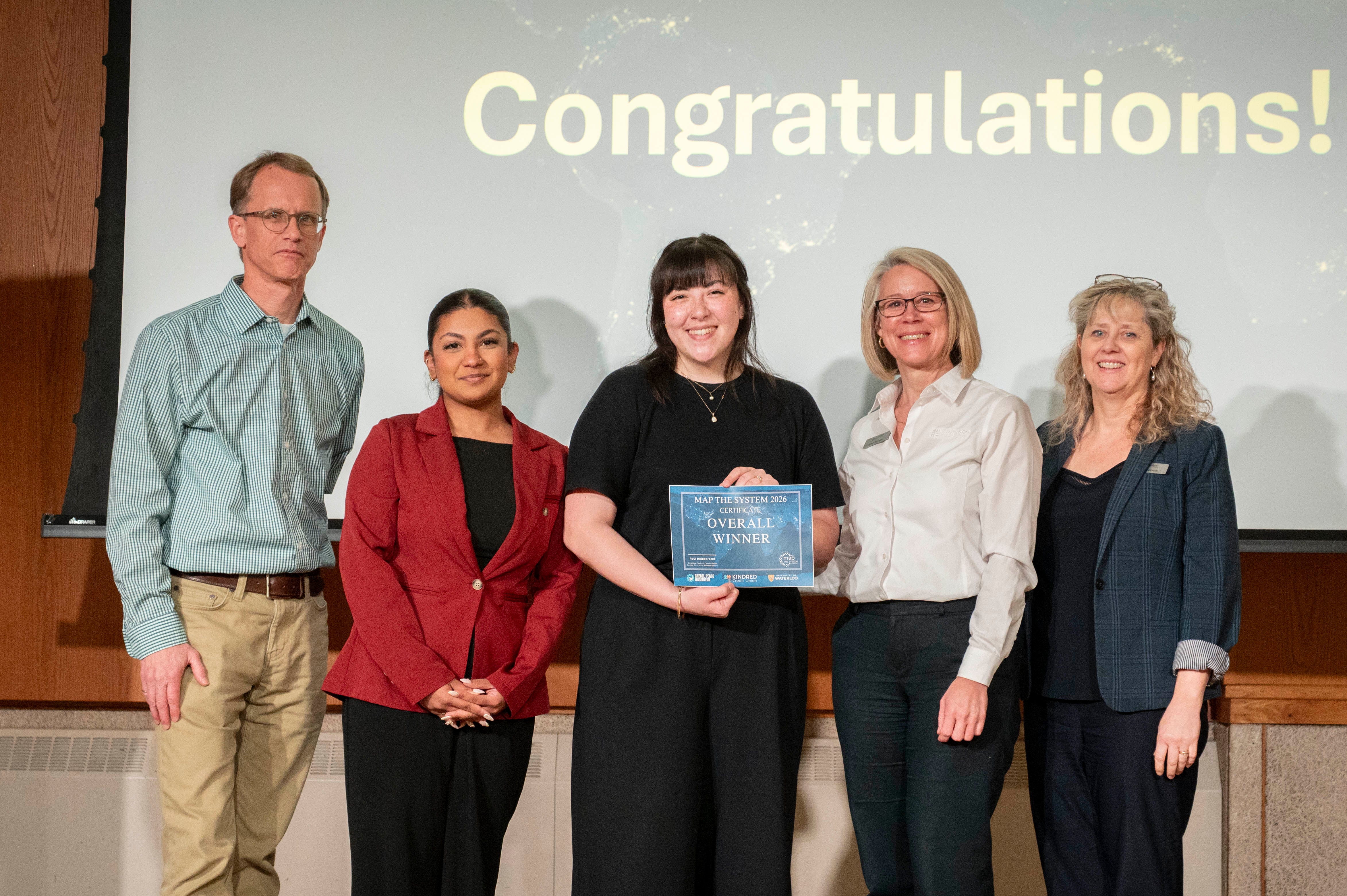
The overall winners and recipients of the People’s Choice Award for Best Systems Map was Unravelling the Femininomenon by Sadia Mohammad, Zoraiz Sheikh, and Chloe Stroh. Their teammates, Bria Wong-Armstrong and Prishaa Rajalathan, represented their team in person and presented on how occupational gender-shifts trigger industry devaluation. The team, all Master of Development Practice students enrolled in DEVP 607: Methods of Sustainable Development Practice: A Systems Approach, chose this topic because they wanted to explore an experience they all shared—being a woman in the workplace.
Prishaa and Bria were presented the Overall Winner Award by Kindred Credit Union, represented by Sheryl Ramseyer, the Waterloo Branch Manager and Vicky Matthews, the Financial Services Advisor. Their award for the Best Systems Map was presented by Kirsten Wright from the Waterloo Institute for Complexity & Innovation (WICI). In early July, the team will be going to the University of Oxford to represent Waterloo at the Map the System Global Finals.
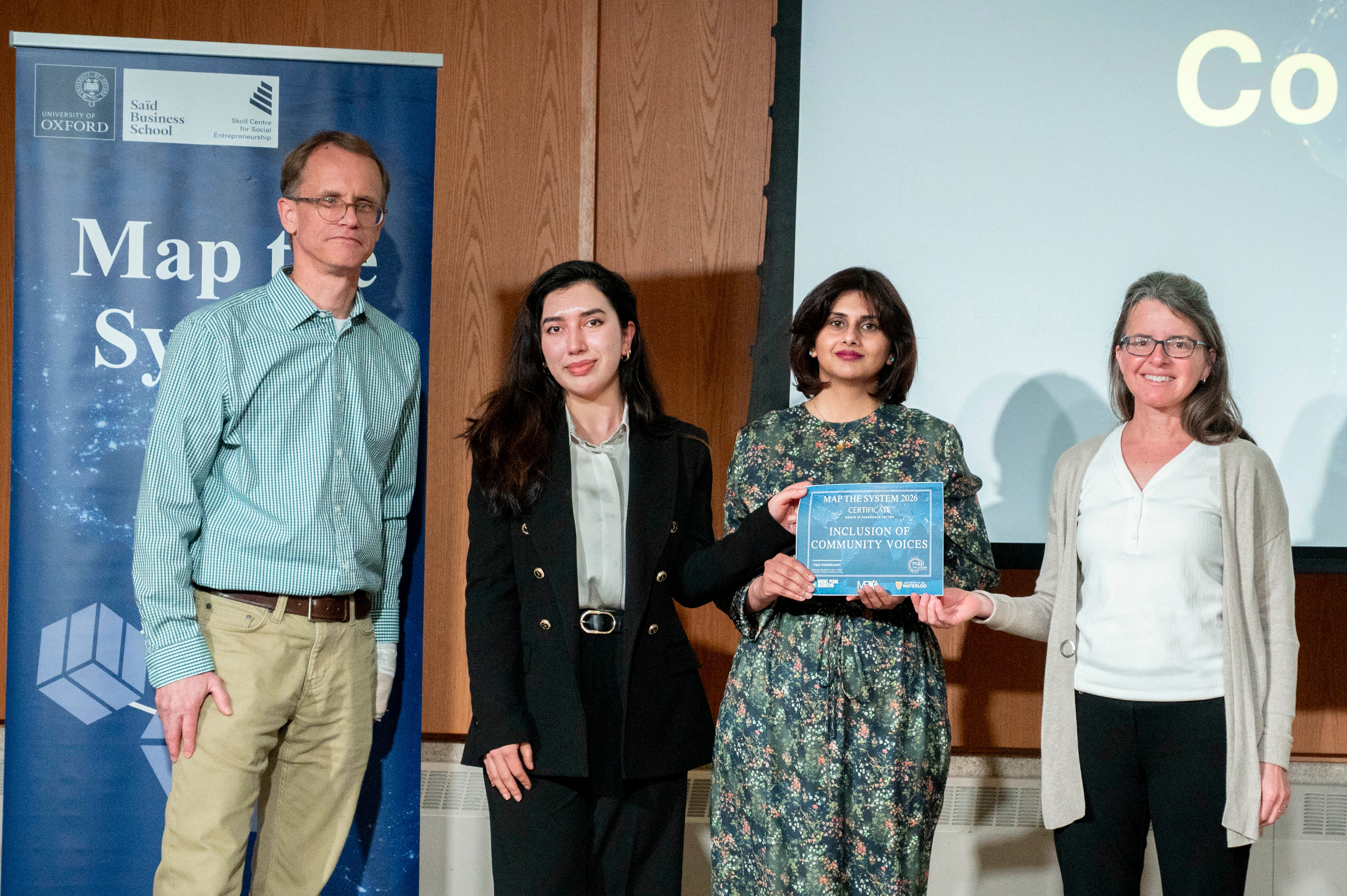
The recipients for the Award of Excellence for the Inclusion of Community Voices were Candice Xiu Cong Li, Sameera Murtaza, Kawsar Rahimi, and Rashedul Stalin, who researched Syrian refugee families in Ontario who are missing loved ones. The team consisted of Master of Digital Experience and Innovation students enrolled in DEVP 607: Business Innovation and Impact. They chose their topic because many of them came from immigrant backgrounds and empathized with the struggle of being far from loved ones. Their team worked in collaboration with Dima Aldera, the founder of FindSuri in the Grebel Peace Incubator. Their award was presented by Sarah Fretz from Mennonite Economic Development Associates (MEDA) Waterloo Network Hub.
Thanks to the support of WICI, MEDA, and Sarona Asset Management, all the finalist teams not progressing to Global Finals will receive $500 in “Apprenticing with the Problem” funding to further their research.
One of the finalist teams, focused on affordable housing, plans to use the funding “to ensure the transition from systemic mapping to actionable change, our further research should prioritize actionable change. This would be done by investigating the legislative feasibility of dismantling vacancy decontrol to eliminate financial incentives for ‘renovictions.’”
The team that focused on the ecological impacts of road salt hopes “to deepen our investigation into long-term environmental impacts and explore more sustainable alternatives for winter road maintenance, which can be translated into insights for decision-makers and key stakeholders.”
Finally, the team that focused on the youth mental health crises aims “to expand our work by incorporating lived-experience insights from youth who have faced mental health crises, enabling a deeper understanding of the gaps and challenges within existing support systems. Support from the Apprenticing with a Problem Grant will enable us to translate this lived-experience data into a targeted app prototype that demonstrates how a specific identified issue can be effectively addressed, and presented as a feasible, scalable solution to policymakers.”
A special thanks to the judges for the thoughtful questions and comments they gave the finalists. This year’s judges included Rich Janzen, the Executive Director for the Centre for Community Based Research; Fiona Li from the Mennonite Central Committee Indigenous Neighbours Program and a past Map the System winner; Elham Mohammadi, a Postdoctoral Fellow at UWaterloo and a past finalist and Campus Lead; and Jennifer Yessis an Assistant Professor in Waterloo’s School of Public Health Sciences.
Congratulations to all the finalists for their exceptional achievements!
Interested in joining this global systems competition next year? Learn more about Map the System on the website and follow the Centre for Peace Advancement on LinkedIn to stay updated.