Editor:
Brandon Sweet
University Communications
bulletin@uwaterloo.ca
Waterloo marks Sexual Violence Awareness Month

A message from Sexual Violence Prevention Office.
May marks Sexual Violence Awareness Month (SVAM). SVAM is an opportunity for campus community members to spark important conversations about sexual and gender-based violence (SGBV) and foster a community of support.
Let's spark important conversations, raise awareness, and foster a community of support. Together, we can create a campus culture of respect, safety, empowerment, and consent - mark your calendars this May!
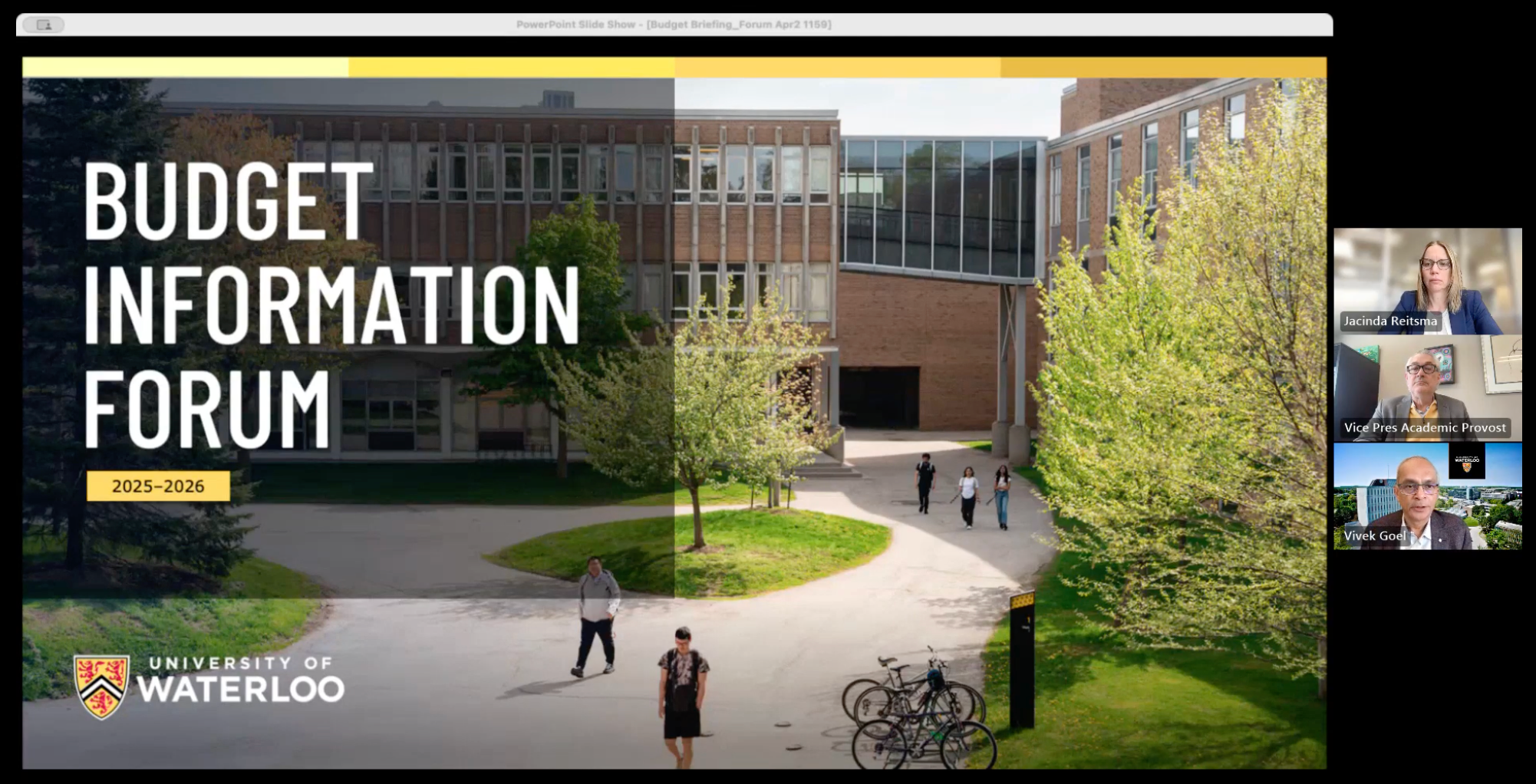
Nearly 2,000 members of the University community tuned in to the Budget Information Forum livestream event on Wednesday, April 2 that featured University leaders providing an update on the University’s financial challenges and the strategies to return to a balanced budget.
President Vivek Goel opened the meeting by discussing the economic and political environment in which the post-secondary sector finds itself.
“We understand the uncertainty related to the current financial challenges, in addition to challenges across the sector and our wider global context,” said President Vivek Goel. “We know this can be stressful for everyone. We hope this forum can help address some of the uncertainty as we continue to work on ways to support our employees through this period.”
Goel highlighted the Waterloo at 100 goals as institutional guideposts, referring to them as the “north star.” He also spoke about the values – thinking differently, acting with purpose, and working together—that would help Waterloo come together to address the challenges the institution faces.
Vice-President, Academic and Provost Jim Rush then gave an overview of recent operating budget trends and highlighted the revenue and expenses. Dr. Rush explained that salaries and benefits currently make up over three quarters of the operating budget. He noted that the University was projected to end the year 2024-2025 with a $32M structural deficit that would carry over to the 2025-2026 year.
The proposed 2025-2026 operating budget, Rush said, includes significant expense constraint activities to remove $50M from the total projected deficit via ongoing measures to leave a $44M structural operating deficit for the end of the first year of the three-year plan. There will be significant expense reductions expected each year throughout the 3-year planning period ending in 2027-2028 as part of the plan to return to a balanced budget.
“The majority of those savings are going to come from finding efficiencies and reductions in the salary budget,” Provost Rush said. “And there are a variety of processes already underway that are assisting in that, including the carryover from the previous year’s efforts, and also closing long-term open positions and normal attrition through retirements and resignations occurring in conjunction with the hiring freeze that will remain in place.”
“But inevitably, there also will need to be some targeted redundancies that will be required to meet the budgetary goals,” Rush said.
Vice-President, Administration and Finance Jacinda Reitsma then gave an update on capital projects both recently completed and currently underway, and provided an explanation on how these projects were funded and why the University was continuing with them during a time of budgetary deficits and fiscal restraint.
Reitsma explained how funding sources for capital projects came from a variety of sources, specific to each project, including grants, donations, student and residence fees, and capital funds accumulated over a number of years. The build-up of these capital reserves allowed the University to move forward with large capital projects, Reitsma said, highlighting the Waterloo Eye Institute as an example. The new residence building across University Avenue, as another example, did not impact the operating budget because it is being funded by student residence fees.
Reitsma then spoke about the issue of deferred maintenance. “I know that we've shared openly around some of the needs of the University, and we're not unlike other universities that are also at an age where the maintenance of buildings need to be addressed,” Reitsma said. She highlighted safety upgrades in the Humanities Theatre and the Physical Activities Complex roof replacement project as examples.
Reitsma said that there were no new major capital projects currently in the pipeline. “We want to finish the projects we have,” she said. “We want to look carefully at sources of funding before we move forward.” In addition, the Campus Plan currently in development will guide future decisions on capital projects.
Next up was an update on the state of the functional reviews. Reitsma said that the reviews of the University’s communications and marketing, IT, and finance functions were in the process of being wrapped up and that work was underway to reduce duplication and improve efficiency. “As we move forward with the three-year plan, I also want to highlight that we will be looking at various ways to conduct reviews of other processes and other areas as well,” Reitsma said.
The bulk of the forum was given over to a question-and-answer period. Unlike previous forums, where questions were asked live from the floor, or in the online chat, forum organizers took questions in advance—nearly 200 of them—and grouped them into thematic areas. Associate Vice-President, Communications Nick Manning moderated the Q&A period.
The first thematic area was around layoffs and job security.
“First of all, we recognize this is a source of deep anxiety and concern in the community and we see almost every day other post-secondary institutions announcing program closures or large-scale layoffs,” said President Goel. “Being in the situation of having to have mass layoffs is something we are working hard to avoid.”
Reitsma acknowledged that there have been some layoffs already occurring in some units but stressed that the University’s leaders were working to avoid the situation of mass layoffs. “Beyond numbers and graphs, we know these are positions, jobs, and most importantly, people,” she said.
The theme of shared sacrifice was also discussed, with some questions from the community asking about any potentially inequitable distribution of cuts among frontline workers versus senior leaders. Executive salaries were also highlighted.
“Everything is on the table, everything is being considered as we look at our current situation,” President Goel said. “We are reviewing the executive compensation frameworks we have…the hiring freeze is applying across all ranks, including most senior executive ranks where vacancies haven’t been filled. We will see changes in the composition of executive ranks as we go through this period.”
Provost Rush also stated that the University remains committed to the work that it started as a result of the PART report recommendations and the institution’s commitment to Indigenous reconciliation. “That remains top of mind in trying to prioritize ways to best position and support that activity in the context of the challenges we’re facing,” Rush said.
Other question areas included upcoming salary negotiations and settlements, the feasibility of the institution borrowing money to cover expenses, and the possibility of another voluntary retirement initiative. Workplace culture, morale and burnout was another area of discussion, including the approach to hybrid work.
Manning informed the virtual audience that updates would be continually added to the Waterloo Budget Plan website, including answers to the questions posed during the information forum, and invited members of the community to continue to send questions and suggestions to budget@uwaterloo.ca.
President Goel then made closing remarks. “We need to take care of ourselves and take care of each other as we work through this difficult time,” he said in conclusion.
At its meeting on Monday, April 7, the University's Senate recommended that the Board of Governors approve the 2025-2026 operating budget. The Board of Governors met on Tuesday, April 15 and approved the budget.
Last week, the Ontario government announced a $750M investment to support Science, Technology, Engineering, and Math (STEM) programs at post-secondary institutions across the province. Speaking to the Waterloo Region Record on April 26, Jacinda Reitsma said, “There are certainly concerns about funding, and we’re very grateful for any funding that we do receive.”
New partnership empowers AI innovation and operational excellence
This article was originally published on Waterloo News.
Chemical company BASF and the University of Waterloo’s Data and Artificial Intelligence Institute (Waterloo.AI) are joining forces to advance AI applications through a collaborative research agreement that will run from 2025 to 2028. This partnership is designed to facilitate knowledge sharing and develop advanced AI systems to drive operational excellence, enhance customer value, and streamline processes.
As part of BASF’s commitment to harnessing value and unlocking new potential through AI innovation, the partnership will leverage novel root cause analysis, forecasting, and optimization methodologies and integrate advanced graph structures and language and data models to deliver granular, real-time insights in complex situations. Through these innovative solutions, BASF and the University of Waterloo will aim to empower business users with tools for analyzing and optimizing intricate structures and combine ease of use with transparency to maximize adoption and business impact.
“At BASF, we’ve been on a decade-long journey of AI innovation, and this collaboration with the University of Waterloo is our next step forward. By applying advanced methodologies, we can better equip our teams with the tools needed to optimize complex global value networks,” said Jürgen Müller, global head of AI Innovation Center at BASF. “However, innovation thrives on collaboration, and partnering with university leaders, like the University of Waterloo, underscores our commitment to operational excellence and a future powered by AI.”
The BASF AI Innovation Center is the key hub for technological advancement, strategically harnessing cutting-edge AI solutions to meet diverse business challenges while igniting future innovation. Designed to be BASF's dedicated innovation arm for AI, the center fosters a collaborative environment that spans various functions and product lines and partners with leading industry and research players like the University of Waterloo to enhance research and development efforts.
“As one of Canada’s most innovative universities, we are pleased to partner with leaders like BASF to support the development of advanced AI systems,” said Dr. Vivek Goel. “Collaborating with industry provides both our students and researchers with an opportunity to unlock innovative solutions that will impact the world for the better.”
Through this partnership, BASF and the University of Waterloo will contribute to reinforcing Canada’s position as a hub for digital innovation, leverage local funding opportunities, and provide research opportunities for post-doctoral fellows and graduate and undergraduate students at Waterloo.AI. This will advance AI research while learning directly about industry applications spanning production, engineering, R&D, and management.
“With BASF’s support, we are excited to advance research in cutting-edge areas such as large language models, natural language processing, AI-driven optimization, and supply chain management,” said Dr. Stephen L. Smith, co-director of Waterloo.AI. “This collaboration presents a unique opportunity to make fundamental advances in these fields and to work closely with BASF to integrate these technologies into AI systems that will transform their operations.”
BASF Canada, headquartered in Mississauga, is a subsidiary of BASF SE and an affiliate of BASF Corporation in North America. BASF has approximately over 1,100 employees in Canada and had sales of $2.6 billion in 2024. For more information about BASF Canada’s operations, visit their website.
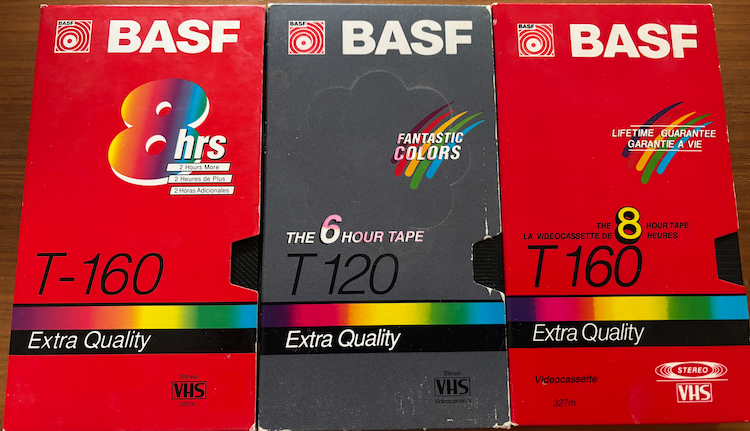
And here I thought BASF only made videocassettes. From magnetic tape to AI, we've come a long way, baby!
May's first notes spring to life

The in-person portion of the the 16th annual University of Waterloo Teaching and Learning Conference takes place today. The theme of this year's conference is "Disruption and Uncertainty as Drivers for Change" and the conversation will focus on "strategies for responding to disruption and uncertainty and leveraging them as occasions to innovate and improve our educational practices."
Today's sessions take place at Federation Hall.
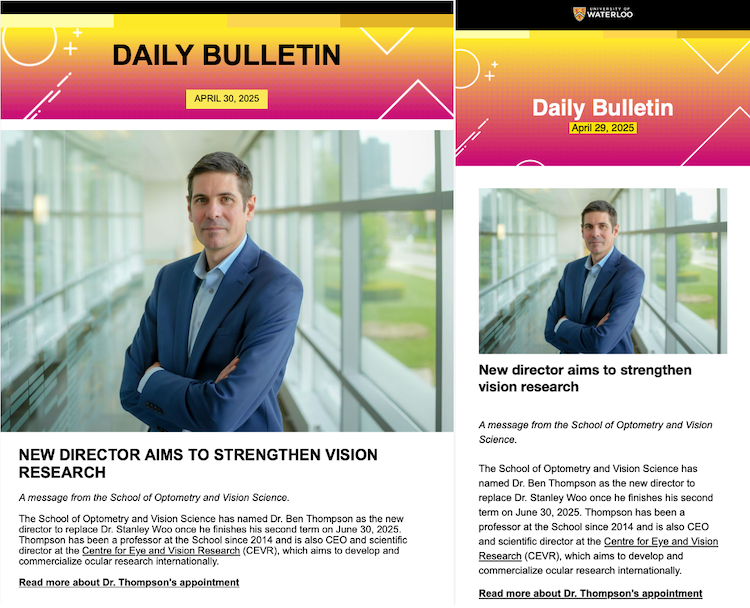
Which is which?
Eagle-eyed e-newsletter readers will notice a slight change in the look of the Daily Bulletin's e-newsletter today. The University of Waterloo's contract with email provider Upaknee has come to an end as of May 1, and the e-newsletter will return to the Mailchimp platform for the time being, albeit in a redesigned template that will provide continuity for subscribers.
We are always happy to take your feedback on the look and feel of the Daily Bulletin e-newsletter, so send any comments to bulletin@uwaterloo.ca. As always, thank you for reading.
Upcoming office closures
The Centre for Teaching Excellence will be closed today for the annual Teaching and Learning Conference.Link of the day
25 years ago: It's gonna be...
When and where
The Campus Wellness Student Medical Clinic offers healthcare visits with Physicians and Nurse Practitioners to current undergraduate and graduate students. Services include: vaccinations, immunity testing, naturopathic services and more. Counselling Services offers appointments with counsellors in person as well as via phone and video. Students can book appointments for these services by calling Campus Wellness at 519-888-4096.
The privately-run Student Health Pharmacy (located in the lower level of the Student Life Centre) is now offering new COVID booster shots and flu shots. Call for appointments to register for the vaccination at 519-746-4500 or dial extension 33784. Walk-ins are welcome.
University of Waterloo Teaching and Learning Conference, Wednesday, April 30 (online) and Thursday, May 1, 8:30 a.m. to 6:30 p.m., Science Teaching Complex.
Waterloo Institute for Nanotechnology (WIN) Day, Thursday, May 1, 9:00 a.m., QNC 0101.
Abortion, Authoritarianism, and Reproductive Justice, Thursday, May 1, 1:00 p.m. to 2:30 p.m., Balsillie School of International Affairs Room 142 and online via Zoom. Register today.
Co-operative work term begins, Monday, May 5.
Lectures and classes begin, Monday, May 5.
Office of Indigenous Relations and SVPRO presents “Red Dress Reflections - Transforming Tomorrow,” Monday, May 5, 10:30 a.m., EXP 1686.
NEW - University Senate meeting, Monday, May 5, 3:30 p.m., NH 3047 and on Zoom.
NEW - Distinguished Lecture Series, Gradient Optimization Methods: The Benefits of a Large Step-size, featuring Peter Bartlett, Professor, Statistics and Computer Science, UC Berkeley, Principal Scientist, Google DeepMind, Tuesday, May 6, 10:30 a.m., DC 1302.
Buckthorn Pull, Wednesday, May 7, 12 noon to 2:00 p.m., meet between Village 1 - South 3 Building and the forest.
Fair Trade Celebration, Monday, May 12, 12 noon to 2:00 p.m., SLC Green.
Anti-Racism Reads: See No Stranger, Tuesday, May 13, 11:30 a.m. to 1:00 p.m., LIB 323.
Spring Tree Planting, Tuesday, May 13, 12 noon to 2:00 p.m., meet between Village 1 - South 3 Building and the forest.
Velocity Innovation Open House, Tuesday, May 13, 4:00 p.m. to 6:00 p.m., South Campus Hall.
Seedling Swap, Wednesday, May 14 and Thursday, May 15, 9:00 a.m. to 2:00 p.m., EV3.
Computational Materials North 2025 (Day 1), Thursday, May 15, 9:00 a.m., QNC 1501.
Master of Taxation Virtual Information Session, Thursday, May 15, 12 noon.
Science in the City - Aging, Thursday, May 15, 6:30 p.m. to 8:30 p.m., Lancaster Smokehouse.
Lectures in Catholic Experience presents Fr. Gregory Boyle, Thursday, May 15, 7:30 p.m. to 9:00 p.m., SJU2 atrium.
NEW - MobilizeU registration deadline, Friday, May 16. Students, faculty and staff eligible for half off the regular price. Contact Nadine Quehl for details.
Safeguarding science webinar – Module 6: Travelling safely: Protecting your research while travelling abroad (English), Friday, May 16, 1 to 2:30 p.m.
Computational Materials North 2025 (Day 2), Friday, May 16, 8:30 a.m., QNC 1501.
Julia Cunningham and Anthea Feaver concert, Friday, May 16, 7:00 p.m., Brubacher House, North Campus.
Register for Centre for Extended Learning (CEL) "Getting Ready to Facilitate Online Courses: TA Training – Spring 2025" course, registration closes Tuesday, May 20.
Shaw-Mannell Award and Lecture, Thursday, May 22, 2:00 p.m. to 4:00 p.m., AHS EXP 1621.
PhD oral defences
Management Science and Engineering. Garros Gong, "Strategic Decision-Making for Wildfire Policy Design: Data-Driven Evidence from Social Media Analytics and Budgetary Shocks." Supervisor, Dr. Stan Dimitrov. Thesis available via SharePoint - email eng.phd@uwaterloo.ca to request a viewing link. Oral defence Wednesday, May 7, 1:00 p.m., remote.
Electrical and Computer Engineering. Milad Entezami, "Strain-Balanced InGaAs/InAlAs Superlattices for 1550 nm-based Terahertz Photoconductive Antennas." Supervisor, Dr. Zbig Wasilewski. Thesis available via SharePoint - email eng.phd@uwaterloo.ca to request a viewing link. Oral defence Wednesday, May 7, 2:00 p.m., EIT 3142.
Management Science and Engineering. Serkan Turhan, "Workload Balancing for Airline Flight Dispatchers." Supervisors, Dr. Fatma Gzara, Dr. Samir Elhedhli. Thesis available via SharePoint - email eng.phd@uwaterloo.ca to request a viewing link. Oral defence Thursday, May 8, 9:00 a.m., CPH 3623.
Systems Design Engineering. Daniel Dapaah, "Oxidative damage of bone collagen as a cause of reduced fracture resistance in human cortical bone." Supervisor, Dr. Thomas Willett. Thesis available via SharePoint - email eng.phd@uwaterloo.ca to request a viewing link. Oral defence Thursday, May 8, 9:00 a.m., E5 6127.
Electrical and Computer Engineering. Seyed Ali Hosseini Farahabadi, "Strain-Balanced InGaAs/InAlAs Superlattices on InP(111)B for Terahertz Photoconductive Antennas." Supervisor, Dr. Zbig Wasilewski. Thesis available via SharePoint - email eng.phd@uwaterloo.ca to request a viewing link. Oral defence Thursday, May 8, 1:00 p.m., EIT 3151-53.
Upcoming service interruptions
Stay up to date on service interruptions, campus construction, and other operational changes on the Plant Operations website. Upcoming service interruptions include:
-
Energy Research Centre, Math 3, Burt Matthews Hall fire alarm testing, Friday, May 2, 6:30 a.m. to 8:15 a.m.
-
Minota Hagey, Mackenzie King Village, Ron Edyt Village fire alarm testing, Friday, May 2, 1:00 p.m. to 2:30 p.m.
- QNC semi-annual PM of rooftop fans, Saturday, May 3, 6:00 a.m. to 4:00 p.m., with a rain date of Sunday May 4. This will affect all exhaust fans, air make-ups, and exhaust fans.
-
Biology 1 localized steam shutdown, Monday, May 5 to Friday, May 16 from 7:00 a.m. to 4:00 p.m., steam to the various portions of the building will be isolated at the beginning of each day, impacting equipment serviced downstream, including AHUs, space heating will still be available at wall radiators. The autoclave will not be affected.
-
Psychology, Anthropology, Sociology (PAS) building domestic cold water shutdown, Sunday, May 4, 9:00 p.m. to Monday, May 5, 8:00 a.m., domestic cold water will be shut off to accommodate a pipe repair.
-
Psychology, Hagey Hall, Tatham Centre, Arts Lecture Hall fire alarm testing, Monday, May 5, 6:30 a.m. to 8:15 a.m.
-
East Campus 1, East Campus 2, East Campus 3 fire alarm testing, Monday, May 5, 10:00 a.m. to 11:00 a.m.
-
Psychology, Anthropology, Sociology (PAS) building domestic cold water shutdown, Tuesday, May 6, 1:00 a.m. to 8:00 a.m., domestic cold water will be shut off for metering installation.
-
Modern Languages (ML) domestic cold water shutdown, Wednesday, May 7, 12:00 a.m. to 7:00 a.m., domestic cold water will be shut off to accommodate metering installation.
-
School of Pharmacy, Integrated Health Building, Innovation Arena (OSC) fire alarm testing, Wednesday, May 7, 6:30 a.m. to 8:15 a.m.
-
Optometry modifications to water piping in Laser Clinic side of building, Wednesday, May 7, 7:00 a.m. to 3:00 p.m., kitchens and bathrooms 2009 student wing area of the building will be without hot and cold water on the 1st and 2nd floors, older north side of building will be unaffected by the work and both floors kitchens and bathrooms will be operating as normal.
-
Physics (SHARC) building domestic cold water shutdown, Thursday, May 8, 1:00 a.m. until 8:00 a.m., domestic cold water will be shut off to accommodate metering installation.
-
Modern Languages, Earth Science Chemistry/Chemistry 1, Biology 1, Arts Lecture, Environment 1, Biology 2, Minota Hagey Residence, Hagey Hall/School of Accounting, Psychology Anthropology and Sociology, Environment 2, Science Teaching, Environment 3 electrical shutdown, Thursday, May 8, 10:00 p.m. to 12 midnight. Normal power will be off, emergency lighting will be on, atrium elevator at Hagey Hall, one elevator at Science Teaching and one at Environment 3 will be operating.
- Columbia Icefield, Warrior Field, Feridun Hamdullahpur Field House, Brubaker House electrical shutdown, Sunday, May 11, 7:00 a.m., normal power will be off at 7:00 a.m. lasting 5 hours, emergency power will be operational.
-
Douglas Wright Engineering (DWE) domestic cold water shutdown, Monday, May 12, 1:00 a.m. to 8:00 a.m., domestic cold water will be shut off to accommodate metering installation.