Editor:
Brandon Sweet
University Communications
bulletin@uwaterloo.ca
A wasp chases its tail through the cosmos

An artistic representation of exoplanet WASP-121 b showing its impressive double helium tail spanning nearly 60 per cent of its orbit around its parent star. (Photo credit: B. Gougeon/UdeM)
By Katie McQuaid. This article was originally published on Waterloo News.
Scientists, including Waterloo’s Professor Lisa Dang from the physics and astronomy department, have discovered a huge cloud of helium gas is escaping from the atmosphere of the exoplanet WASP-121 b, an “ultra-hot Jupiter.” Using the James Webb Space Telescope (JWST), scientists found that the helium stretches into long tails in front of and behind the planet as it orbits around its star. The planet is losing atmosphere in dramatic ways, but current models can’t fully explain the observed structure, leaving scientists searching for more information.
An ultra-hot Jupiter, like WASP-121 b, is a massive exoplanet orbiting close to its star with an extremely hot day temperature. It is also tidally locked, meaning the same side is always facing its star, like how the same side of the moon always faces the Earth. The team’s original goal was to observe WASP-121 b to see the difference between the molecules on the dark and the light sides, but when reviewing the data, the team spotted something else of interest.
“There was a very apparent helium signature that stood out when looking at the data,” Dang says. “Normally, when we look at exoplanets, we search for tiny, tiny signals that are buried in the noise. This one was standing out of the noise, almost like it was waiting for us to find it.”
That helium signature showed them that WASP-121 b was a trail of helium covering 60% of its orbit, creating a stream in front and behind the planet it as it moved. Dang worked with the lead authors of the paper on how to depict the helium stream. They were able to look at the data and split it into three parts: ahead of the planet, around the planet, and behind the planet. Then they ran simulations to see what the shape of the full helium stream might be, giving them the banner photo above.
This is the first time scientists have detected important atmospheric loss like this on a Jupiter-sized planet.
“Atmospheric loss of this nature is common for smaller Neptune-sized planets, but planets the size of WASP 121-b have a stronger gravitational pull and are usually very good at keeping their atmosphere intact,” Dang says. “Until now, we didn’t know a hot Jupiter could lose its atmosphere at such a rate so this is a surprising discovery.”
This new observation has sparked excitement in Dang and her colleagues and inspired them to revisit other ultra-hot Jupiter-sized planets to see if they can find something similar or if there is something special about WASP-121 b. Once they find a planet with promise, they hope to observe it further.
“To see whether any other ultra-hot Jupiters have the same helium outputs, we will have to observe them for a full rotation, which means requesting more time on the James Webb Space Telescope (JWST),” Dang says. “Getting 40+hours on the JWST aimed at one star is hard to get approved because the telescope is in such high demand, but I think there is the potential for meaningful science here that we would not be able to do without a long stare with JWST.”
As Dang and her collaborators move into the next phase, she will continue to work with her Waterloo co-op students on extracting more information from the data set they already have.
The paper, “A complex structure of escaping helium spanning more than half the orbit of the ultra-hot Jupiter WASP-121b,” was published in Nature Communications.
Faculty of Arts hosts AI forum
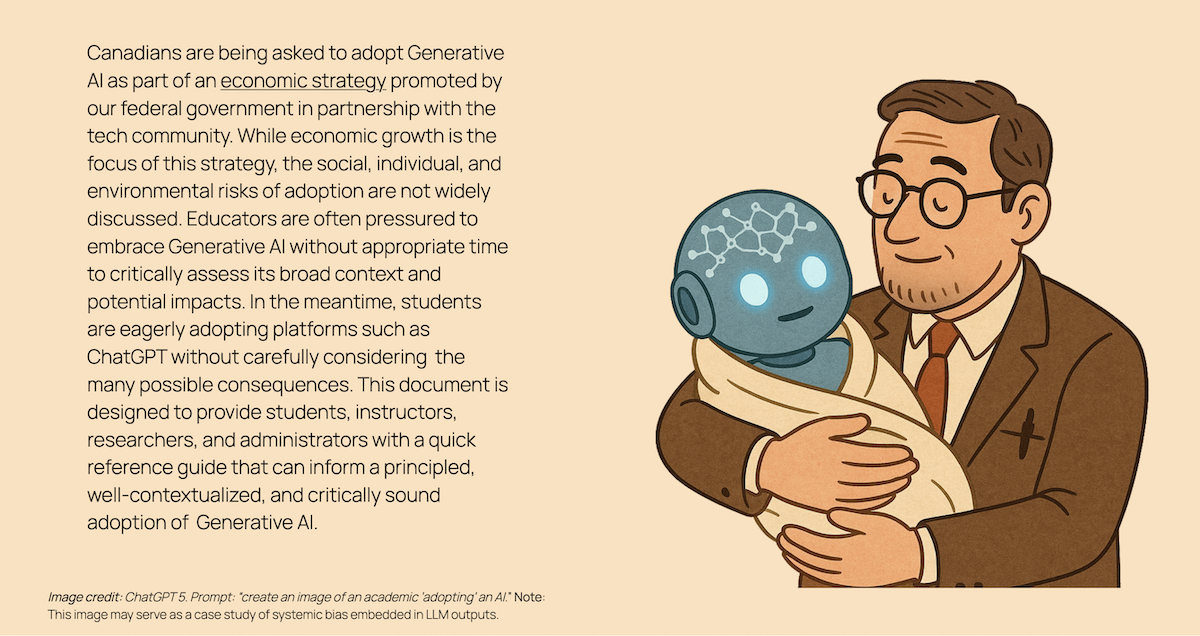
An image from the "Before You Adopt GenAI" resource document on the Critical Media Lab website, appropriately enough, created from a generative AI prompt.
The Faculty of Arts' AI Task Force is hosting a faculty-wide AI Forum on Friday, December 19.
"When it comes to GenAI adoption, Arts has a specific set of concerns, especially regarding writing, art, and design," writes Professor Marcel O'Gorman. "The task force is trying to address concerns from the Arts community while forging a path forward that leverages AI in critical and creative ways."
The forum is an opportunity for members of the Faculty of Arts to exchange views, learn from others, and generate new ideas and projects relating to Generative AI. It also provides an opportunity for the Arts AI Task Force to continue its consultations with the community as it develops Faculty-wide initiatives in response to the emergency of Generative AI in education.
The forum begins at 10:00 a.m. with refreshments and a welcome from the Arts AI Task Force, and will be followed by a series of "Arts AI in Context" five-minute presentations with question periods afterwards. Presenters include Tara Collington of the French department, Richard Eibach, Associate Dean, Undergraduate Studies, Jay Dolmage, Chair of English Language and Literature, Blake Phillips, Director of the School of Accounting and Finance, and James Malzahn, Fine Arts MFA candidate.
Following the 5x5 presentations, there will be an open discussion from 11:00 a.m. to 11:30 a.m. dealing with the question, "What should Arts prioritize in an AI strategy?"
The forum takes place in the Senate and Board chambers in NH 3407. Register online.
"The Forum is open to all faculty, staff, and administrators in Arts," say the organizers. "Future events will focus specifically on student participation."
Celebrating retirees from 2025’s third quarter

Human Resources has reported that the following faculty and staff members have retired between July and September 2025:
July 2025
- William Mark, who started at Waterloo on September 10, 1984, retired as Senior EA-IRMS Isotope Technician in Earth and Environmental Sciences;
- Aida Martinez Casillas, who joined the University on September 2, 2008, retired as Research Appointment Coordinator in Electrical and Computer Engineering;
- Dolores Pereira, who began working at Waterloo on April 9, 2001, retired as Custodian in Plant Operations;
- Mark Knight, who joined the University on August 1, 1997, retired as Associate Professor in Civil and Environmental Engineering;
- Andrew Ecclestone, who began his career at Waterloo on July 1, 2018, retired as Lecturer in the School of Accounting and Finance; and
- Susannah King, who started at the University on November 15, 2010, retired as Administrative Manager in the History department.
August 2025
- Nancy Sej, who began working at Waterloo on September 12, 2017, retired as Research Project Accountant in the Office of Research;
- Leslie Smith, who joined the University on May 31, 2005, retired as Global Learning Coordinator in the Student Success Office (SSO);
- Robyn Landers, who started at Waterloo on April 10, 1989, retired as Information Technology Specialist in the Mathematics Faculty Computing Facility (MFCF);
- Caroline Brookes, who joined the University on August 8, 2000, retired as Executive Assistant to the Dean in the Dean of Arts Office;
- Susan Arruda, who began working at Waterloo on February 15, 1982, retired as Manager, Circulation Services in the Libraries;
- Liz Wehner, who joined the University on September 1, 2006, retired as Library Associate – Cataloguing and Metadata;
- Sherri Anne Arsenault, who started her career at Waterloo in July 2013, retired as Administrator in the Economics department; and
- Linda Bream, who began working at Waterloo on May 1, 2017, retired as Psychologist in the Centre for Mental Health Research and Treatment (CMHRT).
September 2025
- Denise Hileeto, who joined the University on April 1, 2012, retired as Clinical Associate Professor in the School of Optometry and Vision Science;
- Robert Duniec, who started at Waterloo on April 23, 2012, retired as Custodian in Plant Operations;
- Shari Mann, who began working at the University on July 1, 2018, retired as Assistant Professor in the School of Accounting and Finance;
- David Rose, who began working at Waterloo on August 1, 2017, retired as a Lecturer in the Conrad School of Entrepreneurship and Business;
- Douglas Cowan, who joined Renison University College on January 1, 2006, retired as a Professor of Religious Studies at Renison;
- Alfred Menezes, who started at Waterloo on January 1, 1998, retired as Professor in Combinatorics and Optimization;
- Erin Murphy, who began working at Waterloo on July 25, 1988, retired as Librarian in the Libraries;
- Shaun Frape, who joined the University on September 1, 1979, retired as Professor in Earth and Environmental Sciences;
- Bruce Wildfong, who began working at Waterloo on October 24, 2006, retired as Mechanic I in Plant Operations;
- Catherine Wessels, whose career at the University began on May 1, 2013, retired as Senior Development Officer in Advancement and External Relations;
- Xianguo Li, who started at Waterloo on September 1, 1997, retired as Professor in Mechanical and Mechatronics Engineering;
- Janusz Pawliszyn, who joined the University on January 1, 1988, retired as Professor in Chemistry; and
- Mungo Marsden, who began working at Waterloo on July 1, 2004, retired as Associate Professor in Biology.
Congratulations all on your much-deserved retirement!
Upcoming office closures
The William M. Tatham Centre for Co-operative and Experiential Education (TC) will be closed today from 12 noon to 4:30 p.m. for a staff event. The building will re-open for regular service on Tuesday, December 16 at 8:30 a.m.
ChemStores in the Chemistry department will be closed today after 2:00 p.m.
The Science Undergraduate Office will be closed on Wednesday, December 17, from 9:00 a.m. to 10:00 a.m. and from 11:30 a.m. to 1:30 p.m.
Link of the day
When and where
The Campus Wellness Student Medical Clinic offers healthcare visits with Physicians and Nurse Practitioners to current undergraduate and graduate students. Services include: vaccinations, immunity testing, naturopathic services and more. Counselling Services offers appointments with counsellors in person as well as via phone and video. Students can book appointments for these services by calling Campus Wellness at 519-888-4096.
The privately-run Student Health Pharmacy (located in the lower level of the Student Life Centre) is now offering new COVID booster shots and flu shots. Covid booster shots are available by appointment only – please call ext. 33784 or 519-746-4500. The Student Health Pharmacy’s summer hours are Monday to Friday, 9:30 a.m. to 4:30 p.m. Naloxone kits are still available – pick them up in the pharmacy at no charge.
The Waterloo Eye Institute optometry clinics in Waterloo and downtown Kitchener offer comprehensive eye exams and eyewear, including glasses and contact lenses, with the Waterloo location offering various specialized services including urgent eye care. Discounts apply for University of Waterloo students and employees. The Waterloo Clinic is at a nearby interim location, 419C Phillip St, during construction at the School of Optometry and Vision Science. The Kitchener Clinic remains at the Health Sciences Campus, 10B Victoria St. S. Book online or by phone at 519-888-4062.
Warriors Winter Youth Camps, registration is now open for multi-sport and games, baseball, basketball, eSports, football and hockey camps for boys and girls ages 5 to 18. Register today!
Final examination period, Friday, December 5 to Friday, December 19.
CVIS 2025 - 11th Annual Conference on Vision and Intelligent Systems, Monday, December 15 and Tuesday, December 16, Pearl Sullivan Engineering Building (formerly E7).
OHD Lending Library drop-in session, Tuesday, December 16, 11:30 a.m. to 1:30 p.m., EC1 1004. Register on Portal.
Master of Taxation virtual information session, Wednesday, December 17, 12 noon,
Retirement celebration for Cathy Newell Kelly, Wednesday, December 17, 3:00 p.m. to 5:00 p.m., Pearl Sullivan Engineering building (E7) event space, room 2472.
Research Impact Canada December Dr. RIC: Thursday, December 18, 1:00 p.m. to 2:00 p.m., online. Contact Nadine Quehl to receive the Zoom link.
Co-operative work term ends, Friday, December 19.
Faculty of Arts AI Forum, Friday, December 19, 10:00 a.m. to 11:30 a.m., NH 3407.
Nominations open: WUSA General Elections, Monday, December 22.
University holiday break, Wednesday, December 24 to Friday, January 2, 2026.
Upcoming service interruptions
Stay up to date on service interruptions, campus construction, and other operational changes on the Plant Operations website. Upcoming service interruptions include:
- North parking lot at RAC-1 shoring activity, Monday, November 10 to January 1, 2026, shoring, pile driving, lagging and tie-backs will take place between November 10 to the end of December 2025 as part of WaterFEL construction, traffic restrictions and limited access to be in place, excessive noise and vibration may occur in the work area.
-
Centre for Environment & Information Technology, Earth Science & Chemistry, Physics, Chemistry 2 fire alarm testing, Monday, December 15, 6:30 a.m. to 8:15 a.m.
-
Carl Pollock Hall, Douglas Wright Engineering, South Campus Hall, Rod Coutts Hall, Grad House fire alarm testing, Wednesday, December 17, 6:30 a.m. to 8:15 a.m.
-
General Services Complex, Commissary, Central Plant fire alarm testing, Wednesday, December 17, 10:00 a.m. to 11:00 a.m.
-
Optometry elevator shutdown, Thursday, December 18, 7:00 a.m. to 8:00 a.m., south elevator will be out of service.
-
South campus replacement of 4 main backflow preventers, Friday, December 19, 2:00 a.m. to 5:00 p.m., all soft water on campus will be affected, some locations will not have the use of hot water, or soft water.
-
School of Architecture fire alarm testing, Friday, December 19, 6:30 a.m. to 8:15 a.m.
-
Digital Media Stratford fire alarm testing, Friday, December 19, 12 noon to 3:00 p.m.
-
Burt Matthews Hall (original section) domestic hot water shutdown, Friday, December 19, 5:00 p.m. to 11:00 p.m., no water available to building for the duration to accommodate metering installation.
- South campus replacement of 4 main backflow preventers, Saturday, December 20, 2:00 a.m. to 5:00 p.m., all soft water on campus will be affected, some locations will not have the use of hot water, or soft water.
-
Modern Languages domestic cold water shutdown, Saturday, December 20, 7:00 a.m. to 11:00 a.m., no cold water available to the building for a period of one hour during the shutdown window, toilets and sinks will not have water at this time.
-
Psychology, Anthropology, and Sociology (PAS) domestic cold water shutdown, Saturday, December 20, 7:00 a.m. to 11:00 a.m., no cold water available for a period of one hour during the shutdown window, no water to toilets and sinks during this time.
-
Quantum Nano Centre, Biology 1 and 2, Health Services, Science Teaching Complex fire alarm testing, Monday, December 22, 6:30 a.m. to 8:15 a.m.
-
MKV-East temporary electrical shutdown, Tuesday, December 23, 6:30 a.m. to 7:30 a.m., there will be an electrical shutdown that will affect all normal power and lighting due to ongoing electrical work, the east wing of the building (mostly bedrooms and hallways on the 1st floor) will be without normal power for approximately 1 hour, emergency power will be active.